
Tax Reform and Fiscal Policy in 2026: Decoding the W-2/W-4 Shifts and Their Investment Implications
The U.S. tax code has long been a mirror of the nation's economic priorities, reflecting its values, challenges, and aspirations. The One Big Beautiful Bill Act (OBBBA) of 2025, now fully implemented in the 2026 tax year, is no exception. The changes to W-2 and W-4 forms—once dry administrative updates—reveal a broader fiscal strategy: a recalibration of incentives toward labor, savings, and intergenerational equity. For individual investors and tax-sensitive portfolios, these shifts demand a reevaluation of asset allocation, risk management, and long-term planning.
The Anatomy of the 2026 Changes
The OBBBA's amendments to W-2 and W-4 forms are not merely procedural. They codify a policy agenda that prioritizes three pillars:
1. Labor Market Flexibility: The introduction of $25,000 in annual tax-free tips and $12,500 in tax-free overtime (or $25,000 for joint filers) signals a recognition of the gig economy and the precariousness of traditional wage structures. These deductions, phased out for higher earners, aim to cushion low- and middle-income workers while encouraging employers to retain labor.
2. Intergenerational Savings: The "Trump accounts" (Code TA) for children under eight, with a $5,000 annual contribution limit, are a nod to long-term wealth-building. These accounts, akin to IRAs but with a $1,000 tax credit, reflect a push to democratize retirement savings and reduce reliance on public pensions.
3. Simplification and Clarity: The restructured W-4 form, with new lines for seniors, car-loan interest, and charitable gifts, streamlines deductions for a broader demographic. This aligns with the OBBBA's goal of reducing compliance burdens while expanding access to tax benefits.
Fiscal Policy and Macroeconomic Trade-offs
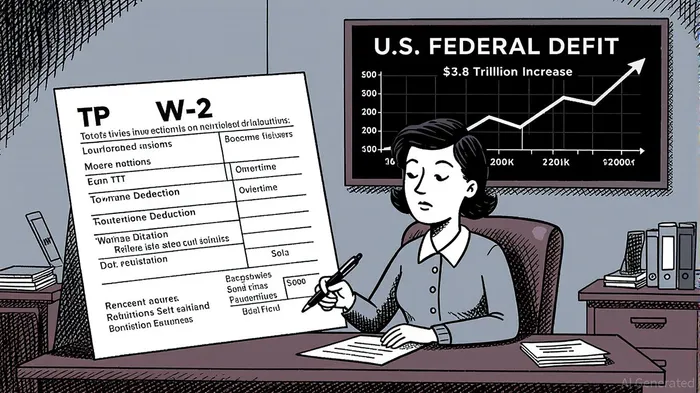
The OBBBA's $3.8 trillion spending increase over a decade, with only $500 billion in revenue offsets, raises critical questions about fiscal sustainability. illustrates the trajectory: deficits are projected to swell, exacerbating the national debt and potentially fueling inflationary pressures. For investors, this means a higher risk of interest rate hikes, which could dampen bond prices and elevate borrowing costs for corporations.
Yet the law's focus on labor and savings also hints at a strategic attempt to mitigate inequality. The expanded SALT deduction cap ($40,000 for high-income households) and the $6,000 Social Security benefit for seniors are designed to stabilize consumption and reduce reliance on public transfers. These measures may buoy sectors like healthcare and housing, where demand from aging populations and high-tax states is likely to grow.
Implications for Tax-Sensitive Portfolios
The OBBBA's changes necessitate a nuanced approach to portfolio construction:
1. Sector Rotation: The no-tax-on-overtime provision could benefit industries reliant on hourly labor, such as hospitality, retail, and logistics. Conversely, sectors with rigid wage structures (e.g., traditional manufacturing) may face margin pressures as employers adjust to new cost dynamics. could highlight divergent trends.
2. Fixed-Income Exposure: With deficits rising, Treasury yields are likely to climb, making bonds less attractive for income-focused investors. However, the OBBBA's emphasis on private savings (via Trump accounts) could drive demand for alternative fixed-income vehicles, such as municipal bonds or corporate debt with tax-advantaged structures.
3. Estate and Wealth Planning: The permanent $15 million estate tax exemption (indexed for inflation) provides clarity for high-net-worth individuals. This could spur increased activity in trusts, charitable remainder trusts, and intergenerational asset transfers, favoring financial institutionsFISI-- and wealth management firms.
Strategic Recommendations for Investors
- Rebalance Toward Labor-Linked Sectors: Investors should consider overweighting industries where the OBBBA's labor incentives are most impactful. For example, companies in the gig economy or those offering flexible work arrangements may see improved profitability as workers retain more of their earnings.
- Leverage Tax-Advantaged Vehicles: The Trump accounts and expanded SALT deductions offer opportunities for tax-efficient savings. Investors should explore contributions to these accounts, particularly for younger dependents, to lock in long-term growth.
- Hedge Against Fiscal Uncertainty: Given the OBBBA's deficit risks, portfolios should include assets that perform well in high-interest-rate environments, such as short-duration bonds, equities in rate-insensitive sectors (e.g., utilities), or commodities like gold.
Conclusion
The 2026 W-2 and W-4 reforms are more than administrative updates—they are a blueprint for the U.S. economy's next chapter. By prioritizing labor flexibility, intergenerational savings, and fiscal simplification, the OBBBA reflects a shift toward a more inclusive but fiscally precarious model. For investors, the challenge lies in balancing the immediate benefits of these changes with the long-term risks of rising deficits. Those who adapt their strategies to this new landscape will not only navigate the turbulence but also capitalize on the opportunities it creates.







Comentarios
Aún no hay comentarios