
Tax Policy Shifts and Market Behavior in 2026: How the One Big Beautiful Bill Could Reshape Consumer Spending and Investment Strategies
The 2026 tax landscape, reshaped by the One Big Beautiful Bill Act (OBBB), is poised to catalyze significant shifts in consumer behavior, retail investor activity, and stock market dynamics. Enacted on July 4, 2025, the OBBB introduces sweeping deductions, refund mechanisms, and innovative retirement savings tools like Trump Accounts, all of which are expected to amplify economic growth and market volatility. For investors, understanding these policy-driven changes is critical to identifying strategic entry points in a rapidly evolving financial environment.
Deductions and Refund Dynamics: A Catalyst for Consumer Spending
The OBBB's expanded deductions for the 2026 tax year are designed to inject liquidity into households. Single filers can claim a standard deduction of $16,100, while married couples filing jointly receive $32,200-a 10% increase over 2025 levels. Additionally, seniors aged 65 and older gain a $6,000 deduction, and workers benefit from a $25,000 cap on tip deductions and a $12,500 cap on overtime income deductions. These provisions, combined with the IRS's delayed adjustment of withholding tables, have resulted in larger-than-expected tax refunds for many taxpayers.
According to a report by the Tax Foundation, these refunds could boost average household savings by $300 to $1,000, directly stimulating consumer spending. Historical parallels, such as the 2001 and 2017 tax cuts, show that increased disposable income often translates to higher retail activity, particularly in discretionary sectors like automotive and technology. For instance, the OBBB's $10,000 deduction for U.S.-assembled vehicle loan interest is likely to spur demand for domestic manufacturing, benefiting automakers and their supply chains.
Trump Accounts: A New Era for Retirement Savings and Retail Investing
The OBBB's most transformative provision is the introduction of Trump Accounts, tax-advantaged IRAs for children under 18. These accounts, seeded with a $1,000 federal contribution for eligible children born between 2025 and 2028, allow parents and employers to contribute up to $5,000 annually. Funds are invested in low-cost index funds or ETFs, fostering long-term wealth accumulation and potentially increasing retail investor participation.
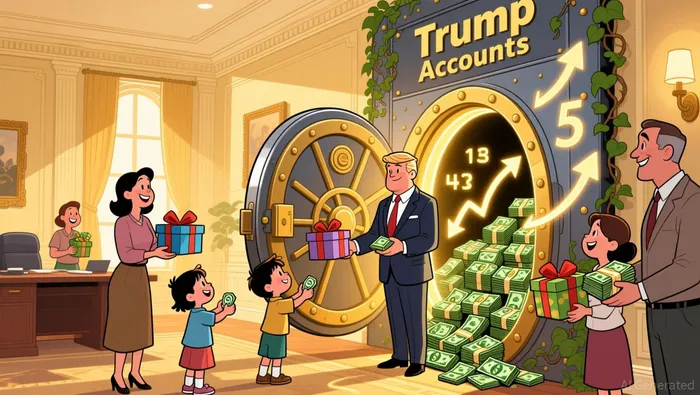 Vanguard analysts note that Trump Accounts could democratize access to financial markets, encouraging families to adopt systematic investment strategies early. This aligns with historical trends: the 2017 Tax Cuts and Jobs Act (TCJA) saw a 12% rise in IRA adoption rates as tax incentives simplified retirement planning. By 2026, the proliferation of Trump Accounts may drive demand for passive investment vehicles, stabilizing ETF markets while reducing volatility in speculative sectors.
Market Volatility and Sectoral Shifts
The OBBB's tax incentives for domestic manufacturing and high-income earners are expected to reshape asset allocation. For example, the Act's permanent extension of TCJA provisions-such as expanded state and local tax deductions- could redirect capital toward sectors like semiconductors and AI, which benefit from corporate tax cuts. Conversely, the Act's "No Tax on Tips" and "No Tax on Overtime" rules may reduce labor costs for service-sector firms, potentially boosting earnings in hospitality and retail.
However, market volatility remains a concern. The TCJA's 2017 passage initially triggered a 15% surge in equity markets but later saw corrections as investors recalibrated to shifting tax policies. Similarly, the OBBB's large refunds and IRA incentives could create short-term overbought conditions in consumer discretionary stocks, prompting rebalancing opportunities in underperforming sectors like utilities and energy.
Strategic Entry Points for Investors
For investors navigating this landscape, the OBBB's provisions highlight three key opportunities:
1. Consumer Discretionary Sectors: With tax refunds likely to boost spending, automakers, retailers, and tech firms stand to benefit. For example, Tesla and Ford, which produce U.S.-assembled vehicles, could see increased demand due to the $10,000 loan interest deduction.
2. Passive Investment Vehicles: The rise of Trump Accounts may drive inflows into low-cost index funds and ETFs, particularly those tracking S&P 500 or Nasdaq indices. Vanguard and Fidelity's ETFs are prime candidates for sustained growth.
3. Financial and Energy Sectors: As investors diversify away from overvalued tech stocks, financial institutions and energy firms-both poised to benefit from potential interest rate cuts- could offer attractive entry points.
Conclusion
The One Big Beautiful Bill Act's tax reforms are a double-edged sword: they stimulate consumer spending and retirement savings while introducing market volatility through policy-driven shifts. For investors, the key lies in balancing exposure to growth sectors like manufacturing and passive investments with hedging strategies in cyclical industries. As the IRS finalizes guidance on Trump Accounts and withholding adjustments, proactive portfolio rebalancing will be essential to capitalize on the OBBB's long-term economic tailwinds.







Comentarios
Aún no hay comentarios