
Tax-Efficient Income Generation in a High-Yield, Tech-Driven ETF: QQQI's Strategic Edge
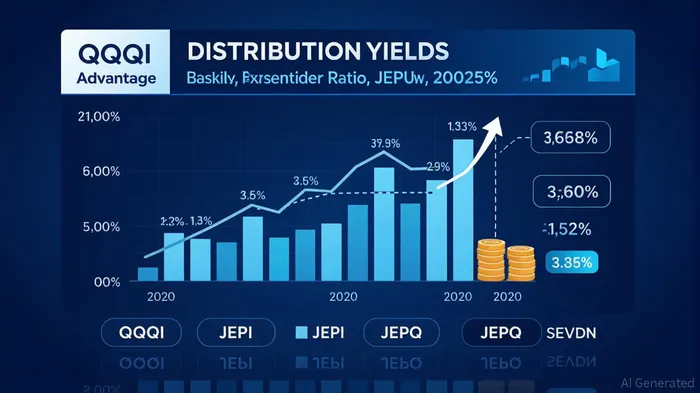
In an era where traditional income sources like bonds and dividend-paying stocks offer meager returns, the NEOS NASDAQ-100® High Income ETF (QQQI) has emerged as a compelling solution for investors seeking tax-efficient, high-yield exposure to the tech sector. By combining dynamic options trading with Nasdaq-100 exposure, QQQI not only delivers a staggering 14.5% distribution yield[1] but also outperforms traditional covered call funds like JPMorgan's JEPIJEPI-- and JEPQ in both risk-adjusted returns and tax efficiency. This analysis explores how QQQI's innovative strategy positions it as a standout option for income-focused investors in 2025.
QQQI's Dual-Pronged Strategy: Call Options and Nasdaq-100 Exposure
QQQI's core strategy revolves around two pillars: exposure to the Nasdaq-100 Index and an actively managed call options overlay. The fund holds at least 80% of its assets in securities or derivatives linked to the Nasdaq-100, providing direct access to top technology and growth stocks[2]. Simultaneously, it sells call options on the index to generate premium income, a tactic that caps potential upside but ensures consistent cash flow[3]. This approach allows QQQI to balance growth and income, making it particularly attractive in a market where volatility and interest rate uncertainty persist.
The fund's dynamic options strategy is a key differentiator. Unlike static covered call strategies, QQQI adjusts strike prices and rebalances its options portfolio monthly[4], optimizing for market conditions. While the exact frequency of rebalancing and strike price adjustments is not disclosed, the fund's data-driven approach ensures adaptability to shifting volatility and index performance[5]. This flexibility enables QQQI to maximize premium capture while mitigating downside risks—a critical advantage in a sector prone to rapid swings.
Tax Efficiency: Return of Capital and Section 1256 Treatment
QQQI's tax advantages are a cornerstone of its appeal. A significant portion of its distributions is classified as return of capital, which reduces investors' cost basis rather than being taxed immediately[6]. For example, the most recent distribution was estimated to be 100% return of capital[7], deferring tax liability and enhancing after-tax returns. This structure contrasts sharply with traditional covered call funds, where distributions are often taxed as ordinary income.
Additionally, QQQI leverages Section 1256 contracts, which are taxed at a favorable 60/40 long-term/short-term capital gains rate[8]. By structuring its options strategy to qualify for this treatment, QQQI minimizes the tax burden on gains from premium income. In contrast, funds like JEPI and JEPQ lack this advantage, resulting in less favorable tax outcomes for investors[9].
Outperforming Traditional Covered Call Funds
QQQI's combination of high yield and tax efficiency gives it a clear edge over peers. As of 2025, QQQI's 14.5% yield dwarfs the 7.4% and 8.8% yields of JEPI and JEPQ, respectively[10]. While these funds rely on conservative strike prices and broader market indices, QQQI's focus on the Nasdaq-100—home to high-growth tech giants—amplifies its income potential.
However, QQQI's 0.68% expense ratio[11] is higher than the 0.40% and 0.45% fees of JEPI and JEPQ[12]. This trade-off is justified by QQQI's superior risk-adjusted returns, particularly in volatile markets. By dynamically adjusting its options strategy and leveraging tax-advantaged structures, QQQI mitigates downside risks while maintaining upside participation—a balance that traditional funds struggle to achieve[13].
Risks and Considerations
Despite its strengths, QQQI is not without risks. The call options strategy caps gains if the Nasdaq-100 surges beyond the strike price[14], and market downturns could erode the fund's value. Additionally, the high yield relies on consistent premium income, which may fluctuate with volatility. Investors must weigh these factors against their risk tolerance and income needs.
Conclusion
For income-focused investors in 2025, QQQI represents a rare convergence of high yield, tax efficiency, and tech-sector growth. Its dynamic options strategy, return of capital distributions, and Section 1256 treatment create a compelling case for those seeking to optimize after-tax returns in a low-yield environment. While traditional covered call funds like JEPI and JEPQ offer stability, QQQI's aggressive approach and superior performance metrics make it a standout choice for investors willing to embrace a bit of volatility for enhanced income and growth potential.







Comentarios
Aún no hay comentarios