
Tate & Lyle (TATYY): Is This Dividend-Paying Staple Stock a Buy Amid Rising Risks?
In the realm of dividend-paying staples, Tate & Lyle (TATYY) has long been a fixture for income-focused investors. However, recent developments suggest that the company's trajectory is being reshaped by a confluence of bearish signals, institutional sentiment shifts, and structural market risks. As the global sweetener and ingredient giant navigates a deflationary environment and client-driven disruptions, the question of whether TATYY remains a compelling buy requires a nuanced assessment of its challenges and resilience.
Financial Performance: Mixed Signals Amid Structural Headwinds
Tate & Lyle's Q3 2025 earnings report underscored a challenging operating environment. Revenue declined by 3% on a constant-currency basis for the first half of the fiscal year, driven by softer demand in North America and broader market softness. Adjusted EBITDA fell by 6%, reflecting the drag from these conditions and the timing of cost synergies from its CP Kelco acquisition. While the company has exceeded its cost synergy targets-delivering $30 million in run-rate savings ahead of schedule-it has maintained its full-year earnings guidance, albeit with a projected low-single-digit revenue decline. This resilience in cost discipline contrasts with the fragility of its top-line growth, raising questions about the sustainability of its margins in a deflationary climate.
Analyst Downgrades: A Cautionary Shift in Sentiment
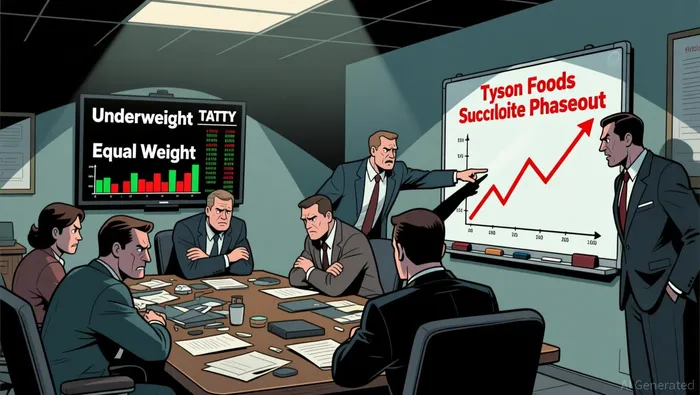 The bearish narrative has gained traction among institutional analysts. Barclays downgraded Tate & Lyle to Equal Weight from Overweight, slashing its price target to 430 GBp from 650 GBp, while Morgan Stanley moved to Underweight and reduced its target to 500 GBp from 590 GBp (https://finance.yahoo.com/news/recent-developments-rewriting-story-tate-041454990.html). These downgrades highlight concerns over valuation, execution risks, and the deflationary market environment. Morgan Stanley explicitly cited the Tyson Foods decision to phase out sucralose in U.S. branded products as a catalyst for uncertainty, warning that similar moves by other consumer goods companies could erode demand for Tate & Lyle's core sweetener product. The shift in analyst sentiment reflects a broader skepticism about the company's ability to defend its market position amid evolving customer preferences and regulatory scrutiny.
Institutional Sentiment: A Subtle but Significant Retreat
Institutional ownership of Tate & Lyle has also seen subtle but telling shifts. Black Creek Investment Management Inc. reduced its voting rights below the 3% threshold in Q3 2025, signaling a minor but noteworthy reduction in stakeholder confidence. While Citi maintained a Buy rating, it lowered its price target, aligning with the broader trend of cautious optimism. Meanwhile, global hedge fund activity in Q3 2025 showed mixed performance, with multi-strategy and equity funds outperforming while commodities and event-driven strategies struggled. These dynamics suggest that institutional investors are recalibrating their exposure to Tate & Lyle, prioritizing risk mitigation over aggressive bets.
Client Decisions and Structural Risks: The Sucralose Conundrum
The most pressing risk to Tate & Lyle's outlook stems from client-driven shifts in the sucralose market. Tyson Foods' decision to phase out sucralose in its U.S. branded products has sparked fears of a domino effect, with analysts warning that other consumer goods companies may follow suit. While Tate & Lyle reported a 16% revenue increase in its Sucralose business for fiscal 2025, this growth appears to be decoupled from the broader market dynamics. The company's recent profit outlook cut-projecting low-single-digit declines in revenue and EBITDA for fiscal 2026-underscores the fragility of its near-term guidance. Compounding these challenges are external factors such as tariffs and category softness, which further cloud the path to recovery (https://www.reuters.com/world/uk/sweetener-maker-tate-lyle-expects-annual-profit-drop-tepid-demand-2025-10-01/).
Balancing the Equation: Dividend Yield vs. Execution Risks
For income-focused investors, Tate & Lyle's dividend yield remains a compelling feature. However, the sustainability of this payout is now in question. The company's cost synergies from CP Kelco integration provide a buffer, but these gains may not offset the structural headwinds from sucralose demand erosion and global market slowdowns. The key question is whether Tate & Lyle can pivot its portfolio to offset these risks-perhaps by accelerating innovation in alternative sweeteners or expanding into higher-growth segments. For now, the bearish signals suggest that the company's ability to execute on such a strategy is under scrutiny.
Conclusion: A Stock at a Crossroads
Tate & Lyle's position as a dividend-paying staple is being tested by a perfect storm of market conditions, institutional skepticism, and client-driven disruptions. While its cost discipline and integration progress offer some resilience, the risks to its sucralose business and broader revenue streams are material. Investors must weigh the allure of its yield against the likelihood of further downgrades and execution challenges. In this environment, a cautious approach-prioritizing risk management over yield capture-appears prudent.







Comentarios
Aún no hay comentarios