
Tata Motors' Strategic Move into European Commercial Vehicles via Iveco Acquisition
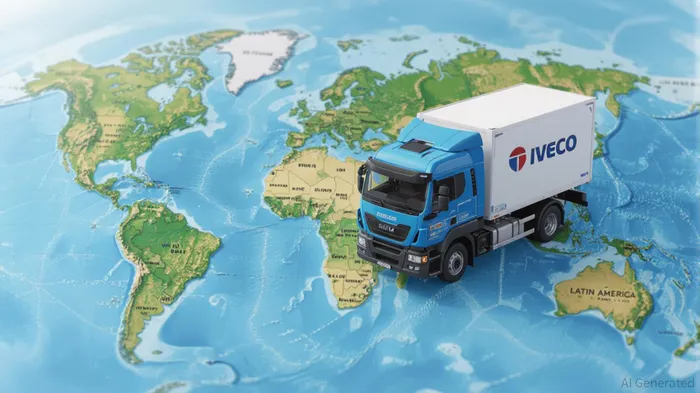
In the ever-evolving automotive sector, cross-border mergers and acquisitions (M&A) have become pivotal for firms seeking to expand their global footprint and drive long-term value creation. Tata Motors' proposed €3.8 billion acquisition of the Italian commercial vehicle manufacturer Iveco[1] is a case in point. This transaction, if finalized by March 31, 2026[1], represents a bold strategic move to consolidate Tata's position in the global commercial vehicle (CV) market while addressing the challenges of decarbonization and shifting consumer preferences. However, the financial viability and long-term success of such a deal hinge on a nuanced interplay of strategic alignment, integration capabilities, and market dynamics.
Financial Viability: Structure and Performance Metrics
Tata's all-cash offer of €14.10 per share for Iveco[1] is underpinned by a €3.8 billion bridge loan from Morgan StanleyMS-- and MUFG Bank, with plans to refinance through equity raises and asset monetization[1]. This financing structure reflects a calculated approach to managing debt levels, though it exposes Tata to refinancing risks if market conditions deteriorate. The Agnelli family's Exor, which owns 27.1% of Iveco, has pledged support, signaling confidence in the deal's potential[3].
Financial performance data reveals contrasting trajectories for the two firms. Tata's CV segment reported a 7.40% EBITDA margin in 2023[1], up from 3.70% in 2022[1], underscoring its dominance in India's heavy and light commercial vehicle markets. In contrast, Iveco's 2023 revenue (excluding defense) fell 5.6% to €14,994 million[1], with Q2 2025 results showing a further 3.5% revenue decline and a contracted adjusted EBIT margin of 5.7%[3]. Despite these challenges, Iveco's 13.3% market share in Europe's light CV segment[2] and its advanced R&D capabilities in electrification and hydrogen technologies[1] make it a strategic asset for Tata.
Long-Term Value Creation: Synergies and Strategic Fit
The acquisition's value proposition lies in its potential to create a global CV powerhouse. By combining Tata's cost-efficient Indian engineering with Iveco's European and Latin American distribution networks, the merged entity could achieve €22 billion in annual revenues[1]. Synergy projections highlight three key areas:
1. Revenue Diversification: Cross-selling Iveco's premium buses and trucks in India while exporting Tata's mid-sized CVs to Europe and Latin America[1].
2. Technological Collaboration: Joint R&D in electrification, hydrogen fuel, and ADAS (Advanced Driver Assistance Systems) to accelerate innovation[1].
3. Operational Efficiency: Streamlining product complexity and reducing material costs without compromising European manufacturing jobs[1].
These synergies align with broader industry trends, such as the global shift toward sustainable mobility. The 2025 Global Commercial Vehicle Outlook notes that investments in electric and hydrogen-powered vehicles are critical for meeting zero-emission targets[2], a domain where Iveco's expertise complements Tata's ambitions.
Benchmarking Against Historical Precedents
Cross-border M&A in the automotive sector offers mixed lessons. The Renault-Nissan alliance, for instance, initially thrived through cultural sensitivity and high integration but later faced challenges as Nissan's market share declined[1]. Conversely, GM's acquisition of Daewoo, though initially turbulent, eventually improved profitability through participatory leadership and localized decision-making[1]. These cases underscore the importance of cultural alignment and adaptive integration strategies.
Academic research further highlights critical success factors. A 2022 study found that acquirer experience and board expertise positively correlate with higher announcement returns in cross-border deals[5], particularly in culturally distant markets. Similarly, social connectedness between countries—such as shared language or historical ties—can mitigate integration risks[5]. For Tata-Iveco, India-Italy relations and Iveco's established European operations may provide a buffer against cultural friction.
Risks and Mitigation
Despite its strategic logic, the deal faces headwinds. Iveco's recent financial underperformance[3] and Tata's reliance on refinancing could strain liquidity. Additionally, regulatory scrutiny in Europe, where antitrust concerns often delay cross-border deals[4], remains a wildcard. To mitigate these risks, Tata must prioritize transparent communication, preserve Iveco's European workforce, and accelerate R&D collaboration to unlock synergies swiftly.
Conclusion
Tata's acquisition of Iveco is a high-stakes bet on global expansion and technological leadership. While the financial structure and strategic rationale are compelling, long-term success will depend on effective integration, cultural alignment, and the ability to capitalize on synergies in electrification and sustainability. Historical precedents and academic insights suggest that cross-border M&A can create value—but only for firms that approach integration with rigor and adaptability. For investors, the deal offers a compelling case study in the evolving dynamics of the automotive sector, where strategic vision must be matched by operational execution.







Comentarios
Aún no hay comentarios