
Tata Motors' Post-Demerger Restructuring: Strategic Clarity and Valuation Opportunities Unveiled
The demerger of Tata Motors, effective October 1, 2025, marks a pivotal moment in the company's history, restructuring its operations into two distinct entities: Tata Motors Passenger Vehicles Ltd (TMLPV) and Tata Motors Commercial Vehicles Ltd (TMLCV). This strategic move, designed to unlock value through operational and financial independence, has already triggered significant market reactions and valuation shifts. For investors, the post-demerger landscape presents both clarity and complexity, offering opportunities to reassess the intrinsic worth of each business segment while navigating the uncertainties of market dynamics.
Strategic Repositioning: Focus and Flexibility
The demerger separates Tata Motors' passenger vehicle (PV), electric vehicle (EV), and Jaguar Land Rover (JLR) operations under TMLPV, while TMLCV will exclusively focus on commercial vehicles, including the anticipated acquisition of the Iveco Group, according to Kotak Securities. This division allows each entity to tailor its capital structure, innovation strategies, and market positioning. For instance, TMLPV's integration of JLR and EV initiatives aligns with global trends toward premium and sustainable mobility, whereas TMLCV's dominance in India's commercial vehicle (CV) market-particularly in LCV Cargo and electric buses-positions it to capitalize on infrastructure growth, according to CNBC TV18.
Analysts argue that the demerger enhances strategic agility. "By isolating the CV business, TMLCV can prioritize investments in high-margin segments like heavy commercial vehicles and electric buses without being diluted by the PV segment's capital-intensive EV ambitions," notes a CNBC TV18 report. Conversely, TMLPV's focus on JLR and EVs allows it to pursue global expansion and R&D without the operational drag of commercial vehicle logistics, as INDmoney explains.
Valuation Implications: Market Reactions and Analyst Forecasts
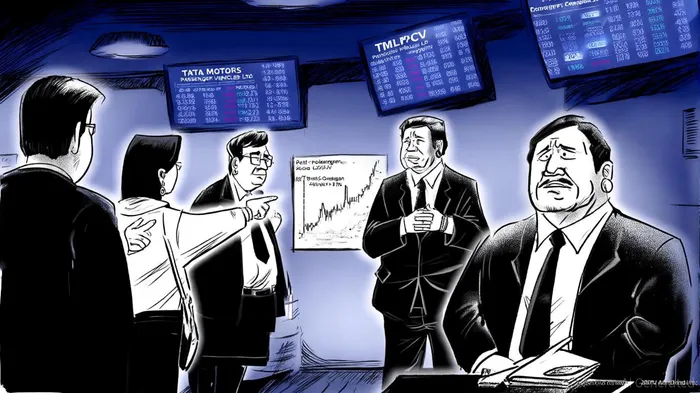
The immediate market response to the demerger was stark. On October 14, 2025-the record date for shareholder entitlements-TMLPV's stock price plummeted by 40% to ₹399.00, reflecting the notional removal of the CV segment's valuation from the consolidated entity, as reported by the Times of India. This drop, while volatile, aligns with pre-demerger analyst expectations. For example:
- Nomura valued TMLPV at ₹367 per share and TMLCV at ₹365 per share, per Samco.
- Goldman Sachs allocated ₹306 to TMLCV and ₹236 to JLR within TMLPV, according to Economic Times.
- Nuvama projected a lower TMLCV valuation of ₹280 per share, as noted by Polyeyes.
These divergent valuations highlight the market's uncertainty about each entity's growth trajectory. TMLCV's strong domestic CV market position and potential synergy from the Iveco acquisition could justify its higher valuations, while TMLPV's JLR segment faces headwinds from weak Q2 FY26 sales and margin pressures due to aggressive discounting, according to Analytics Insight.
Post-Demerger Performance: A Mixed Outlook
From October 1 to October 13, 2025, TMLPV's stock extended its decline for four consecutive sessions, closing at ₹400 on October 13-a 38% drop from its pre-demerger price of ₹660.90, CNBC TV18 reported. However, intra-day rallies, such as a 5% surge to ₹421.45 on the BSE, suggesting investor optimism about long-term value unlocking, were noted by ScanX Trade. The listing of TMLCV in early November 2025 will further test market sentiment, as its valuation will depend on how investors perceive its standalone growth potential versus its historical performance as part of the consolidated entity, according to LiveMint.
Risks and Opportunities
While the demerger offers strategic clarity, challenges persist. JLR's recent cyberattack and production disruptions could weigh on TMLPV's short-term performance, reported by The Week. Meanwhile, TMLCV's reliance on India's cyclical commercial vehicle demand exposes it to macroeconomic volatility. However, the separation also enables investors to hedge their exposure: for instance, those bullish on India's EV transition might overweight TMLPV, while infrastructure-focused investors could favor TMLCV, according to Naukri-Sarkari.
Conclusion: A New Era for Tata Motors
The demerger of Tata Motors represents a bold reimagining of its business model, prioritizing specialization over diversification. While the immediate stock price volatility reflects market recalibration, the long-term benefits-such as tailored capital allocation and clearer valuation metrics-could outweigh the short-term risks. For investors, the key lies in aligning their portfolios with the distinct growth narratives of TMLPV and TMLCV, leveraging the transparency this restructuring provides.







Comentarios
Aún no hay comentarios