
Tariffs, Inflation, and Fed Policy: Navigating the Dual Risks of Structural and Cyclical Pressures
The Inflationary Toll of Tariffs: A Gradual but Persistent Surge
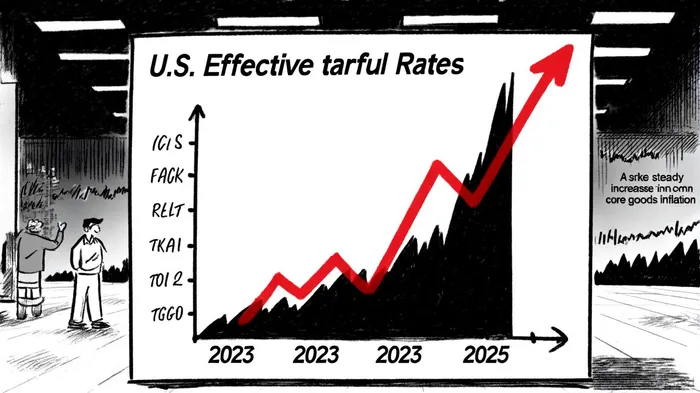
The U.S. tariff regime enacted between 2023 and 2025 has had a measurable, if uneven, impact on inflation. According to a Budget Lab analysis, the average effective tariff rate in the U.S. soared from 2.4% in early 2025 to 11.5% by August, pushing core goods prices up by 1.9% above pre-2025 trends. This represents a pass-through rate of 72–80% for core goods and durables-a stark reminder that tariffs are not just political tools but direct contributors to consumer price inflation, as shown in a short-run study.
However, the effects are not immediate. Daily pricing data from the Harvard Business School Pricing Lab reveal a lagged response: imported goods prices rose 5% by September 2025, while domestic goods climbed 2.5%, as described in a Minneapolis Fed analysis. Retailers initially absorbed some of the cost increases, but this buffer is eroding. The cumulative fiscal impact is also significant, with $88 billion in new tariff revenues collected by August 2025-offsetting federal deficits but at the cost of reduced consumer purchasing power, particularly for lower-income households, according to the Budget Lab analysis.
Fed Policy in a Tariff-Driven World: Balancing Growth and Stability
The Federal Reserve's response to this inflationary backdrop has been cautious but adaptive. In 2025, the Fed resumed rate cuts after a strategic pause, reducing its benchmark rate by 25 basis points in September-a move aimed at supporting growth amid trade policy uncertainty, as noted in a Wellington note. The FOMC remains anchored to its dual mandate of maximum employment and 2% inflation, but the lagged effects of monetary policy complicate its execution, as set out in the Fed statement.
Investors must now navigate a Fed that is simultaneously managing cyclical inflation (driven by tariffs) and structural shifts in global trade. The 10-year Treasury yield, which oscillated between 3.99% and 4.49% in April 2025, reflects this duality, according to a Farther post. A steepening yield curve suggests markets are pricing in delayed rate cuts, while credit markets signal a nuanced outlook: investment-grade spreads widened by 35 basis points, but high-yield bonds outperformed, buoyed by energy sector strength (Farther).
Strategic Asset Allocation: Bonds, Equities, and the New Normal
In a high-tariff environment, asset allocation frameworks must prioritize resilience over growth. JPMorgan's analysis underscores a preference for bonds and credit, where attractive valuations and potential rate cuts create a compelling case for fixed income, according to the JPMorgan analysis. The Bloomberg U.S. Aggregate Bond Index gained 2.9% year-to-date in 2025, while short-term bonds offer 85% of long-dated yields with 40% less volatility-a critical consideration in a higher-for-longer rate world (Farther).
Equities, meanwhile, are trading at recalibrated valuations. The S&P 500's forward P/E ratio fell to 20.2x from 26.7x by mid-2025, reflecting a shift in risk sentiment (Farther). International equities, trading at a 35% discount to U.S. peers, present opportunities for long-term investors, particularly in mid- and small-cap sectors with more attractive valuations (Farther). A quality bias-favoring companies with strong balance sheets and pricing power-is essential to weather potential trade-related shocks (Farther).
For credit investors, the calculus is nuanced. While high-yield markets carry elevated risks, sectors like retail and healthcare show robust interest coverage ratios, offering a buffer against tariff-driven downturns, according to JPMorganJPM--. A strategic tilt toward U.S. dollar-denominated emerging market debt and high-yield bonds aligns with the Fed's likely path of rate cuts and the resilience of private sector balance sheets, JPMorgan argues.
Historical Lessons: Tariffs, Returns, and the Power of Discipline
History offers both caution and guidance. A 150-year study shows that equities averaged 5.3% real returns during high-tariff periods, outperforming bonds and aligning with long-term averages, according to a CFA Institute study. However, low-volatility equity factor strategies-particularly during market stress-added 2.0% annualized returns, underscoring the value of defensive positioning, as noted in a Northern Trust piece.
Today's environment mirrors these historical patterns. Tariff uncertainty has already triggered a 4.5% year-to-date decline in the U.S. dollar, boosting international equities (Farther). Yet the opportunity cost of protectionism is higher now, given the interconnected global economy. Investors must balance tactical rotations (e.g., domestic industrials if trade tensions escalate) with a long-term focus on inflation resilience, leveraging real assets priced for 2% inflation but offering protection against 4%+ scenarios (Farther).
Conclusion: Navigating the Fog of Uncertainty
The dual pressures of tariffs and Fed policy demand a disciplined, adaptive approach to asset allocation. Bonds and credit provide stability in a high-tariff world, while equities require a quality bias and sectoral selectivity. Historical data reinforces the importance of low-volatility strategies and valuation discipline, even as geopolitical risks persist. For investors, the key is to build portfolios that can withstand both the immediate inflationary shocks of tariffs and the long-term structural shifts in global trade.
As the Fed inches toward rate cuts and markets recalibrate, the winners will be those who prioritize resilience over speculation-and who recognize that in a world of structural uncertainty, the most valuable asset is flexibility.





Comentarios
Aún no hay comentarios