
Tariff Turbulence: Ford's Forecast Withdrawal Signals Auto Sector Uncertainty
Wall Street is bracing for volatility as Ford Motor Company’s decision to withdraw its 2025 financial guidance underscores the escalating risks of U.S. tariff policies on automotive manufacturers. The automaker cited a projected $1.5 billion net adverse impact from tariffs imposed by the Biden administration, with broader industry risks—including supply chain disruptions and retaliatory trade measures—compounding the uncertainty.
Ford’s move marks a stark departure from its peers. While General Motors revised its guidance to account for up to a $5 billion tariff-related hit, Ford’s suspension of its outlook altogether highlights its vulnerability to policy instability. The company now joins a growing list of firms caught in the crossfire of protectionist trade measures, raising questions about the long-term viability of global supply chains in an era of geopolitical tension.
The Tariff Tightrope
The tariffs in question include a 25% duty on imported vehicles and non-compliant automotive parts—a policy aimed at boosting domestic manufacturing. Ford’s domestic footprint, with 80% of its U.S. sales coming from domestically assembled vehicles, initially seemed to insulate it from the worst effects. However, the 21% of imported vehicles it sells, combined with reliance on cross-border supply chains—particularly with Mexico—has left the company exposed.
In the first quarter of 2025, tariffs already cost Ford $200 million in adjusted EBIT, with the full-year gross impact estimated at $2.5 billion. The company expects to mitigate $1 billion of this through logistical shifts, such as using bonded carriers to avoid tariffs on vehicles shipped between Mexico and Canada and halting U.S. exports to China. Yet the remaining $1.5 billion net cost remains a significant burden.
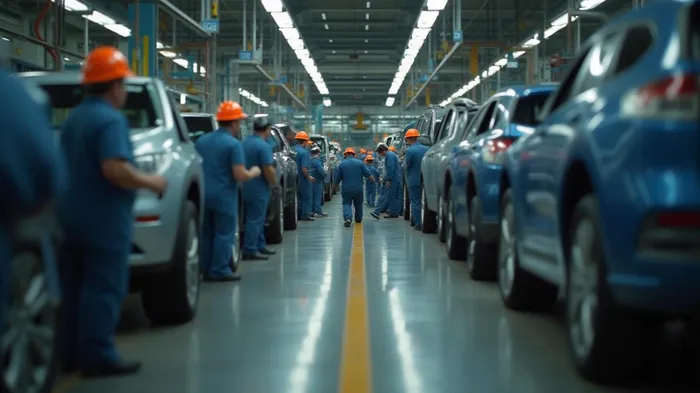
The Financial Fallout
Ford’s CFO, Sherry House, emphasized that uncertainties extend beyond tariffs. Potential supply chain bottlenecks, retaliatory tariffs from other countries, and shifting tax and emissions policies could further disrupt operations. The automaker’s underlying businesses—particularly Ford Pro, which reported $1.3 billion in EBIT—remain strong, but pricing pressures threaten to strain consumer affordability.
The automotive sector’s broader struggles are reflected in market performance. show Ford’s shares lagging as investors digest the tariff risks. Meanwhile, industry forecasts for U.S. vehicle sales have been slashed by 500,000 units to 15.5 million annually, amplifying concerns over demand.
A Crossroads for Auto Manufacturing
Ford’s strategy to mitigate costs includes a $10 billion investment in U.S. manufacturing starting in 2026, aiming to shift production of popular models like the F-150 pickup to domestic plants. However, such capital expenditures require stable policy environments—a luxury that may be elusive.
The company’s decision to reassess guidance in Q2 2025 hinges on clarity around tariff policies. Until then, investors must weigh Ford’s resilience against the sector’s fragility. With global automakers like Toyota and BMW also navigating similar headwinds, the ripple effects could extend far beyond Detroit.
Conclusion: Navigating the Policy Maze
Ford’s withdrawal of guidance is a watershed moment for investors. The $1.5 billion tariff hit and $10 billion capital plan reveal a company balancing short-term pain with long-term bets on domestic production. Yet the broader risks—geopolitical tensions, supply chain fragility, and policy volatility—suggest the automotive sector’s recovery remains tenuous.
Investors should monitor two key indicators: , and . With Wall Street now pricing in greater uncertainty, the path forward depends on whether Ford—and the industry—can adapt faster than policy makers can disrupt.
In the end, the auto sector’s next chapter will be written not just on assembly lines, but in the boardrooms and trade negotiations shaping its future.





Comentarios
Aún no hay comentarios