
Tariff Turbulence: How Asia-Pacific's Supply Chain Shifts Are Creating Billion-Dollar Investment Opportunities
The U.S. tariff wars of 2023–2025 have done more than disrupt global trade—they’ve sparked a seismic realignment of supply chains in the Asia-Pacific region. South Korea’s aggressive diplomatic moves to counter American protectionism have created a goldmine of opportunities for investors in three critical sectors: tech manufacturing in Vietnam/Mexico, critical minerals supply chains, and trade-enabling infrastructure. This is not a temporary blip—it’s a structural shift. Here’s why investors should act now.
1. Tech Manufacturing in Vietnam & Mexico: The New Asian Tigers
The U.S. tariffs on South Korean goods (25% on autos, 46% on Vietnamese imports) have forced firms like Samsung, Hyundai, and LG to double down on production hubs in Vietnam and Mexico. These nations are now the de facto assembly lines for the global tech sector.
- Vietnam’s Semiconductor Surge: South Korean FDI in Vietnamese semiconductor facilities hit $4.2 billion in 2024, with Samsung’s $3 billion expansion in Bac Giang province leading the charge. These factories now produce 30% of Samsung’s global smartphone chips.
- Mexico’s USMCA Playbook: Hyundai’s $21 billion U.S. investment in 2024 included a strategic pivot: sourcing 60% of U.S.-bound auto parts through Mexico to qualify for tariff exemptions under USMCA. Mexican states like Coahuila are now the “Detroit of the 2020s.”

Investment Catalyst:
- Buy into Vietnamese tech manufacturers like FPT ($FPT) or Korean exporters with Mexico exposure (e.g., Hyundai Mobis ($018270.KS)).
-
2. Critical Minerals: The New “Oil” of the 21st Century
The race for lithium, cobalt, and rare earth elements is now a geopolitical arms race. South Korea’s $150 billion trade deal with Vietnam (target by 2030) includes deep collaboration on mineral extraction and recycling.
- Vietnam’s Mineral Powerhouse: Vietnam now supplies 53% of South Korea’s urea solution (a semiconductor essential) and holds 18% of global rare earth reserves. Their joint venture with Korea’s POSCOPKX-- ($005490.KS) to build a $2.5 billion lithium refinery by 2026 is a game-changer.
- Korea-China Tug-of-War: While China dominates 80% of global rare earth processing, South Korea is leveraging Vietnam to bypass Beijing. This is a long-term supply chain hedge.
Investment Catalyst:
- Firms like POSCO Chemical or Vietnam’s Phu Kien ($PKC.HM) are positioned to profit from EV battery demand.
-
3. Trade Infrastructure: The Logistics Gold Rush
Tariffs have made speed and efficiency paramount. Ports, rail networks, and digital trade platforms are now the arteries of the new supply chain order.
- Vietnam’s Logistics Leap: South Korea’s $12 billion supplementary budget (2024) included $3 billion for Vietnam’s high-speed rail and port modernization. This slashes shipping times for tech exports by 40%.
- Mexico’s Digital Gateway: The U.S.-Mexico FTA renegotiation (ongoing) is driving investment in cross-border digital customs systems. Firms like Cemex ($CX) and the Mexican logistics giant Transportes Marítimos Nacionales (TMN) are beneficiaries.
Investment Catalyst:
- Infrastructure ETFs like the Global X MSCI Infrastructure Development ETF (PAIC) or Vietnamese port operator Vinalines ($VIL.HM).
-
The Bottom Line: Bet on Geopolitical Stability, Not Volatility
Yes, U.S. tariffs are chaotic. But the companies and regions thriving in this chaos—Vietnam’s tech hubs, Mexico’s USMCA compliance play, and Korea’s mineral partnerships—are the ones building resilient supply chains.
Investors who focus on short-term tariff fluctuations will miss the bigger picture: this is a multi-year trend. The firms leading in these sectors will dominate the next decade of global trade. The question isn’t whether to act—it’s whether you can afford to wait.
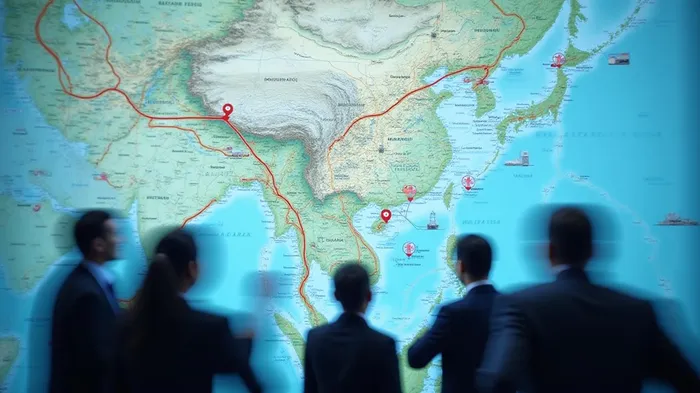
Act now. The next billion-dollar winners are already in motion.





Comentarios
Aún no hay comentarios