
U.S. Tariff Probe on Machine Tools and Its Implications for Japanese Exporters: Strategic Risk Assessment and Diversification Opportunities
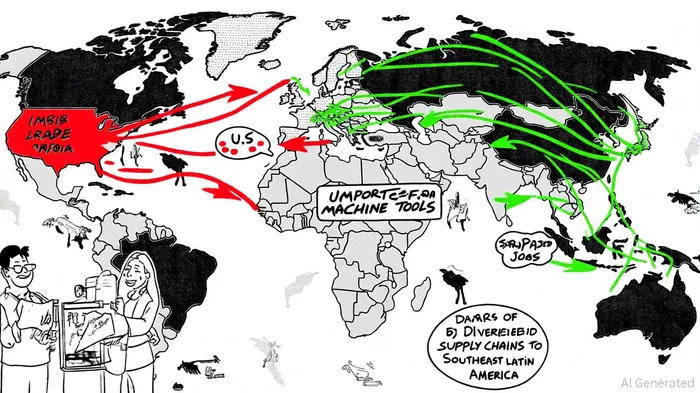
The U.S. Department of Commerce's recent Section 232 investigation into machine tools and industrial machinery has sent ripples through global markets, particularly for Japanese exporters who dominate this sector. With the probe focusing on national security risks posed by foreign imports—including CNC machining centers, industrial stamping machines, and laser-cutting tools—the potential for new tariffs looms large. For investors, this represents a critical juncture to assess strategic risks and identify diversification opportunities in a rapidly shifting trade landscape.
The U.S. Tariff Probe: Scope and Immediate Risks
The U.S. Commerce Department's investigation, initiated on September 2, 2025, explicitly targets machinery critical to advanced manufacturing, such as welding equipment, industrial ovens, and application-specific metalworking tools [1]. While no tariffs are currently in place, the probe's findings could justify quotas or duties under the guise of national security. This mirrors Trump-era precedents, such as the 2018 steel and aluminum tariffs, which disproportionately impacted Japanese firms reliant on U.S. markets [2].
Japanese machine tool companies, including Okuma and Yamazaki Mazak, already face a 10% surcharge on imports under the 2025 U.S.-Japan Trade Agreement, a rate higher than the pre-tariff 2.5% but lower than the initially threatened 27.5% [3]. However, the new Section 232 probe introduces uncertainty, as it could lead to layered tariffs or stricter quotas. For instance, Haas Automation, a U.S. manufacturer, has lobbied for further restrictions on imports from Japan, Taiwan, and South Korea, arguing that foreign competition undermines domestic production and national security [4].
Existing Tariff Impacts and Industry Vulnerabilities
Beyond the Section 232 probe, Japanese exporters are already contending with a web of existing tariffs. A 25% duty on steel and aluminum, coupled with a 20% tariff on Chinese imports, has inflated input costs for precision manufacturing [5]. These measures have squeezed profit margins, particularly for SMEs lacking the scale to absorb price shocks. According to a report by GMO Research & AI, 52.1% of Japanese firms are re-evaluating global supply chains, while 41.7% are raising product prices to offset costs [6].
The ripple effects extend beyond machinery. For example, Suntory's shift in tequila exports to the U.S. and its pivot toward American whiskey production illustrate how broader industries are recalibrating to tariff pressures [7]. Japanese machine tool firms, however, face a unique challenge: their U.S. market share in high-value sectors like aerospace and robotics is under threat from both tariffs and U.S. “reshoring” incentives.
Diversification Strategies: Short-Term Adaptations and Long-Term Resilience
Japanese exporters are adopting a dual approach to mitigate risks. In the short term, companies are renegotiating contracts to shift from FOB to CIF terms, optimizing logistics routes, and utilizing bonded warehouses to defer tariff payments [8]. Transshipment through third countries and strategic stockpiling of inventory before tariff hikes are also gaining traction. For example, Sony has increased U.S. inventory reserves to buffer against supply chain disruptions [9].
Long-term strategies focus on localization and supply chain diversification. Over 54.2% of Japanese firms are diversifying suppliers, while 47.9% are investing in automation or reshoring [10]. Major players like Honda are relocating production to the U.S. to bypass tariffs entirely, as seen in its decision to manufacture a new car model domestically instead of in Mexico [11]. Similarly, machine tool companies are establishing U.S. subsidiaries to handle direct imports, reducing reliance on cross-border tariffs.
The Japanese government, through METI, is also pushing a strategic vision to expand overseas business expansion rates from 30% to 50% by 2040, emphasizing high-value sectors like robotics and energy [12]. This aligns with the U.S.-Japan trade agreement's $550 billion investment fund, which prioritizes American manufacturing in semiconductors and advanced technologies—a sector where Japanese firms hold critical expertise [13].
Investment Opportunities: Navigating the New Normal
For investors, the key lies in identifying firms that balance risk mitigation with innovation. Japanese companies leveraging the U.S. investment fund to establish localized production hubs—such as those in semiconductors or energy—present compelling opportunities. Additionally, firms excelling in automation and high-value-added machinery (e.g., CNC systems for aerospace) are better positioned to withstand tariff pressures.
However, caution is warranted. The U.S. political landscape remains volatile, with the 2026 midterm elections potentially reshaping trade policies. Investors should monitor METI's support programs and JETRO's consultation services, which provide critical resources for tariff mitigation [14].
Conclusion
The U.S. tariff probe on machine tools underscores a broader shift toward protectionism, but it also highlights the adaptability of Japanese exporters. While immediate risks persist, the industry's strategic pivot toward localization, diversification, and innovation offers a roadmap for resilience. For investors, the challenge is to align with firms that not only navigate these headwinds but also capitalize on the opportunities they create.







Comentarios
Aún no hay comentarios