
U.S. Tariff Policy and the Reshaping of Global Supply Chains: Strategic Asset Reallocation in Emerging Markets
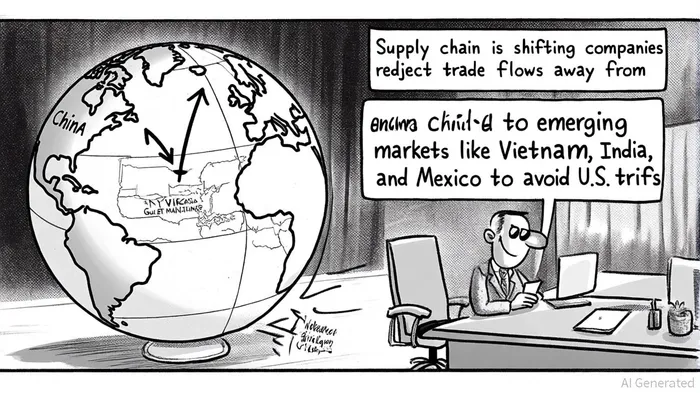
The U.S. tariff regime since 2023 has rewritten the rules of global trade, triggering a seismic reallocation of capital and production across emerging markets. With the effective U.S. tariff rate now at 15.8%—driven by reciprocal duties on imports from Vietnam, South Africa, and others—corporations are accelerating their pivot away from traditional manufacturing hubs like China. This shift is not merely a short-term adjustment but a structural reordering of supply chains, with profound implications for investors.
Sectoral Shocks and the New Tariff Landscape
The Trump administration's 2025 “Liberation Day” tariffs, which impose a baseline 10% duty on all imports and escalate to 30% for the EU and Mexico, have created a fragmented trade environment[1]. Sectors such as automotive and agriculture have borne the brunt of these policies. For instance, U.S. automakers face an estimated $2,000–$12,000 per vehicle cost increase due to tariffs, forcing General MotorsGM-- to slash its profit forecast by 20%[2]. Meanwhile, retaliatory measures from China—125% tariffs on U.S. soybeans and pork—have slashed U.S. agricultural exports to China by 47% in 2025[3]. These disruptions are pushing companies to redesign products, rethink sourcing strategies, and localize production to mitigate exposure[4].
Emerging Markets: Winners and Losers in the Tariff Era
Vietnam, India, and Mexico have emerged as key beneficiaries of this reallocation, though each faces unique challenges.
Vietnam has become a prime destination for offshoring, particularly in textiles and electronics. However, the U.S. reciprocal 20% tariff on Vietnamese goods—reduced from an initial 46%—has forced firms to diversify markets and boost domestic value addition[5]. A June 2025 PwC survey found 86% of Vietnamese companies planning to streamline operations or enter new markets to offset tariff impacts[6].
Mexico, meanwhile, is leveraging its proximity to the U.S. and the USMCA framework to attract capital. Despite a delayed 30% tariff increase announced in July 2025, Mexico's strategic advantages—such as lower labor costs and streamlined logistics—have made it a preferred alternative to China for automotive and tech manufacturing[7]. However, compliance with stricter USMCA content rules and customs delays remains a hurdle[8].
India is capitalizing on its position as a net exporter, though it faces a 27% reciprocal tariff under Trump's April 2025 order[9]. The country is diversifying trade partnerships in the Indo-Pacific, aligning with broader geopolitical shifts. India's focus on domestic production—exemplified by its Production Linked Incentive (PLI) schemes—positions it to capture a larger share of global supply chains[10].
Long-Term Implications for Investors
The U.S. tariff war has accelerated a trend toward regionalization and supply chain resilience. For investors, this means prioritizing markets that offer both strategic depth and policy flexibility. Vietnam's industrial parks, India's tech ecosystem, and Mexico's automotive clusters are now critical nodes in a decentralized global economy.
However, risks persist. The U.S. dollar's depreciation following tariff announcements—observed in 2025 and echoing the 2018 steel/aluminum tariff era—highlights the volatility of protectionist policies[11]. Emerging markets must also navigate the dual pressures of attracting foreign capital while managing domestic inflation and debt.
Conclusion
The U.S. tariff regime is not a temporary blip but a catalyst for a new era of trade. For emerging markets, the challenge—and opportunity—lies in adapting to a world where proximity to the U.S. market, regulatory agility, and supply chain diversification determine economic success. Investors who recognize these dynamics early will be well-positioned to capitalize on the next phase of global trade evolution.





Comentarios
Aún no hay comentarios