
U.S. Tariff Policy 2025: Sector-Specific Vulnerabilities and Investment Opportunities in a Fractured Global Trade Landscape
U.S. Tariff Policy 2025: Sector-Specific Vulnerabilities and Investment Opportunities in a Fractured Global Trade Landscape
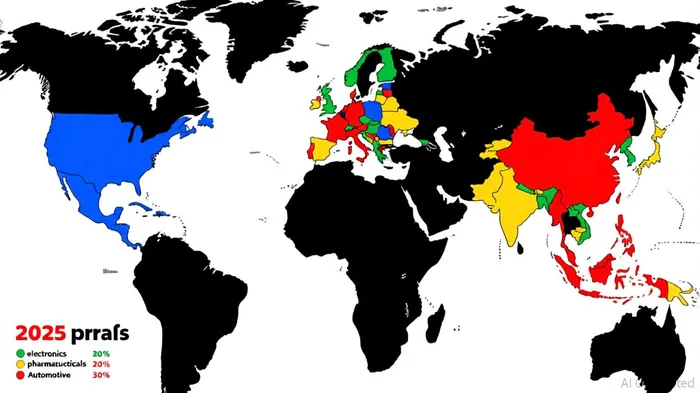
The U.S. tariff policy introduced in April 2025 has reshaped global trade dynamics and equity market valuations, creating a complex landscape of vulnerabilities and opportunities. These "reciprocal" tariffs, structured around trade deficits and exceeding market expectations, have triggered a minimum 10 percentage point increase on most trade partners, with sector-specific impacts ranging from steel and aluminum to pharmaceuticals and electronics, according to a CEPR analysis. The resulting trade war has disrupted global value chains, with Southeast Asia, China, and the EU bearing the brunt of escalating tariffs. For investors, the challenge lies in navigating sector-specific risks while identifying pockets of resilience and growth.
Sector-Specific Vulnerabilities
Electronics and Semiconductors: The electronics sector, deeply integrated into global value chains, has faced a 30% output decline under the "status quo" scenario, with 30% of its production reliant on cross-border trade, according to that CEPR analysis. The Trump administration's threat to hike pharmaceutical tariffs to 200% by late 2026 adds regulatory uncertainty, pressuring firms like IntelINTC-- and TSMCTSM--, according to J.P. Morgan Global Research.
Automotive and Transport Equipment: Tariffs on cars and auto parts-spiking to 50% on steel and aluminum-have disproportionately affected manufacturers. The U.S.-China tit-for-tat escalation pushed bilateral rates to 125%, directly impacting automakers like Ford and Tesla, which rely on Chinese components, as noted in the CEPR analysis.
Agriculture: While less integrated into global supply chains, agriculture faces retaliatory tariffs from China and Mexico, slashing soybean and pork exports. Input costs have risen due to tariffs on Canadian potash, with production costs increasing by $12–$30 per acre for corn and soybeans, according to a Forbes analysis.
Equity Market Reactions:
- Tech and Energy Sectors: The Magnificent Seven lost $2 trillion in market value, while energy firms like ExxonMobil saw a 17% two-day drop in the S&P 500 energy index, highlighted in an FRBSF economic letter.
- Defensive Sectors: Healthcare and utilities outperformed, with smaller declines as investors sought safety amid uncertainty; the FRBSF letter also notes these defensive patterns.
- Global Disparities: Emerging markets, particularly China and Southeast Asia, underperformed due to reliance on U.S. exports, while U.S.-focused firms with limited foreign sales rebounded, according to an OECD Ecoscope post.
Opportunities Amidst the Turmoil
Domestic Manufacturing and Agriculture: Sectors incentivized by protectionist policies, such as steel and agriculture, may benefit from reduced foreign competition. Farmers shifting to domestic crops like wheat and sorghum could capitalize on higher prices, as noted in the Forbes piece.
Defensive Sectors: Utilities and healthcare remain resilient, with low exposure to trade. For example, Johnson & Johnson and UnitedHealth Group have seen stable earnings despite broader market volatility, consistent with the FRBSF findings.
Services and Cybersecurity: Non-tangible industries like software and cybersecurity are less vulnerable to tariffs. Firms like Microsoft and Palantir Technologies are positioned to thrive as global trade shifts toward digital infrastructure, according to a Morgan Stanley guide.
Strategic Investment Considerations
Investors must balance exposure to vulnerable sectors with hedging strategies. Diversification into defensive stocks, intermediate-term bonds, and services-oriented industries can mitigate risks, as outlined in a BCG report. Additionally, companies diversifying supply chains into Vietnam, India, and Mexico-such as Apple and BMW-may reduce reliance on China and stabilize costs, according to a Global Trade Magazine guide.
Conclusion
The 2025 U.S. tariff regime has created a fractured global trade environment, with winners and losers emerging across sectors. While electronics, pharmaceuticals, and automotive industries face headwinds, opportunities exist in domestic manufacturing, defensive sectors, and services. For investors, the key is to align portfolios with macroeconomic realities, leveraging data-driven insights to navigate this new era of protectionism.





Comentarios
Aún no hay comentarios