
U.S. Tariff Impact on Japanese Auto Exports and Its Implications for Global Auto Sector Investments
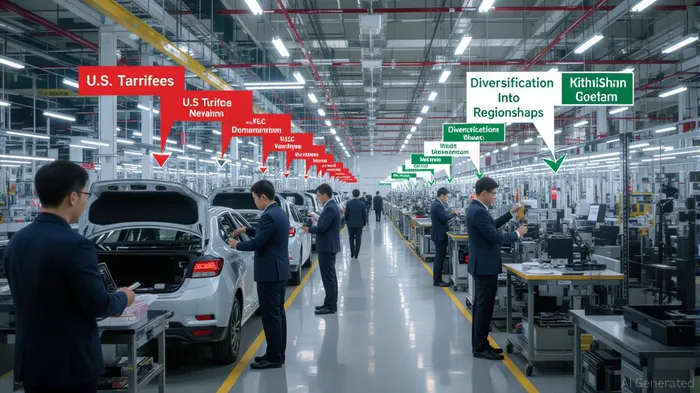
The U.S. auto sector has long been a battleground for trade wars, . For Japanese automakers, whose exports to the U.S. market have historically been a cornerstone of growth, these represent both a headwind and a catalyst for reinvention. While direct data on Japanese automakers' responses remains sparse, broader trends in the global auto sector—particularly China's strategic pivot to Europe and North America—offer a blueprint for how supply chains are adapting to a protectionist world[2].
The Tariff Tightrope: Pressure on Japanese Exports
The U.S. tariffs have directly inflated costs for Japanese automakers, squeezing profit margins on vehicles and components. For context, , deterring price-sensitive American buyers[1]. This isn't just a pricing issue—it's a structural one. Japanese firms like ToyotaTM--, HondaHMC--, and Nissan, which have relied on just-in-time manufacturing and low-cost U.S. imports, now face a stark choice: absorb the costs, pass them to consumers, or reengineer their supply chains entirely.
Supply Chain Resilience: Diversification as a Survival Strategy
The answer, as global players increasingly adopt, lies in . While no specific data exists on Japanese automakers' moves, the broader industry's playbook is clear. For instance, , respectively, to offset U.S. tariffs[2]. Japanese firms are likely following a similar path, shifting production to lower-cost, politically stable regions like Vietnam, Thailand, and Mexico. These hubs not only bypass tariffs but also tap into growing demand in emerging markets.
Partnerships are another linchpin. Collaborations with local firms in Southeast Asia or Mexico—where labor costs are a fraction of those in Japan—allow Japanese automakers to localize production and sidestep U.S. duties. For example, Toyota's recent expansion in Vietnam or Honda's joint ventures in Mexico could signal a broader strategy to hedge against trade volatility[1].
Sector Opportunities: Where to Invest in a Fragmented World
For investors, the key lies in identifying firms that are not just surviving but thriving in this fragmented landscape. Here's where to focus:
- Supply Chain Innovators: Companies that help automakers reconfigure logistics, such as port infrastructure firms in Southeast Asia or software providers enabling real-time supply chain tracking, are prime candidates.
- Regional Powerhouses: Automakers with diversified production footprints—like Toyota, which already has a strong presence in Vietnam and Mexico—offer resilience. Look for firms with “regionalization” in their strategic plans.
- Battery and EV Partnerships: As the U.S. pushes for domestic EV production, Japanese firms that partner with U.S. or European battery makers (e.g., Panasonic with Tesla) could benefit from subsidies while avoiding tariffs[2].
The Bottom Line: Adapt or Be Left Behind
The U.S. tariff regime isn't a temporary blip—it's a structural shift toward economic nationalism. Japanese automakers, like their global peers, must now prioritize supply chain resilience over cost efficiency. For investors, this means betting on companies that can navigate this new reality: those with agile production networks, strategic regional partnerships, and a willingness to embrace innovation.
The auto sector's future belongs to the adaptable. And in a world where protectionism is the new normal, adaptability isn't just a virtue—it's a necessity.





Comentarios
Aún no hay comentarios