
Tariff Fears and Profit-Taking: Navigating DAX Volatility in a Shifting Trade Landscape
The U.S.-EU trade standoff, now entering its critical phase with the August 1 deadline looming, has transformed the Frankfurt DAX into a barometer of global economic anxiety. Investors face a precarious balancing act: rotate into defensive sectors to weather tariff-driven volatility or hold onto cyclical assets in anticipation of a negotiated reprieve. Meanwhile, gold and BitcoinBTC-- are emerging as asymmetric hedges against the geopolitical storm. Here's how to position your portfolio.
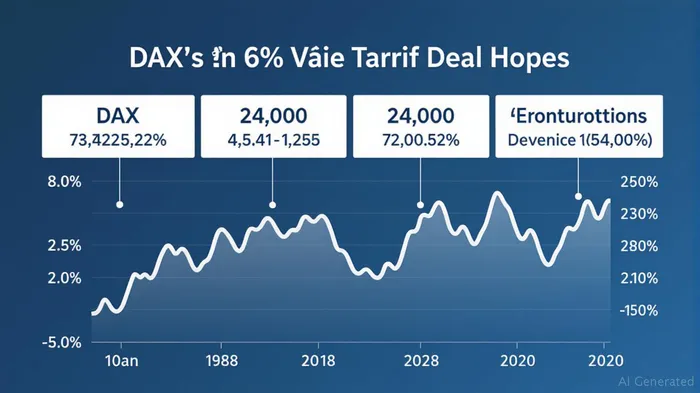
Sector Analysis: Trade Tensions Redraw the Playing Field
Financials: A Tale of Two Airlines
The financial sector is bifurcating between defensive resilience and tariff-induced pain. German lender Commerzbank (CRZB) (+90% YTD) has thrived on ECB rate cuts and corporate refinancing demand, while airlines like Norwegian Air Shuttle (up 18.1% on cost discipline) and Embraer (down 11.6% due to tariff-hit orders) highlight sector-specific risks.
Investment Takeaway: Hold financials with stable earnings (e.g., CRZB) but avoid trade-exposed names until clarity on Boeing-style tariff impacts materializes.
Energy: Copper's Rise vs. Lithium's Fall
U.S. copper tariffs (50%) have created a “buy domestic” dynamic for U.S. miners like Freeport-McMoRanFCX--, but disrupted global supply chains for energy infrastructure. Meanwhile, lithium—a once-hot EV material—is down 19% due to oversupply, making it a contrarian play.
Investment Takeaway: Focus on copper-linked equities for now, but monitor lithium's valuation if EV demand rebounds post-2026.
Technology: Supply Chains Under Siege
Tech faces dual pressures: rising input costs (e.g., Boeing's $250M tariff bill in 2025) and geopolitical fragmentation (e.g., EU's FCAS defense project stalling over equity disputes). Yet AI-driven sectors like Nvidia's satellite contracts (+$2.8B for U.S. Space Force) are thriving amid militarized tech spending.
Investment Takeaway: Avoid hardware manufacturers exposed to tariffs but overweight AI/defense plays with strategic relevance.
Safe Havens: Gold and Bitcoin Lead the Flight to Quality
Gold: Central Banks and De-Dollarization
Gold's surge to $3,370/oz reflects more than just inflation—it's a bid for stability in a sanctions-ridden world. North American gold ETFs saw $38B inflows in H1 2025, while emerging markets like Russia and India are diversifying reserves away from the U.S. dollar.
Investment Takeaway: Maintain a 10–15% gold allocation; platinum (up 50%) and silver (up 25%) offer tactical satellites for green tech demand.
Bitcoin: Volatility Amid Volatility
Bitcoin's $113K record mirrors its role as a “non-state” hedge against fiat instability. Institutional adoption (e.g., Coinbase's ETF inflows) is rising, though risks linger: China's stablecoin crackdown and EU regulatory scrutiny could cap gains.
Investment Takeaway: Treat Bitcoin as a 5% allocation for speculative risk, but prioritize gold for core portfolio stability.
Sector Rotation Strategy: Defend Now, Re-Engage Later
- Defensive Fortification (40% of portfolio):
- Healthcare: Fresenius Medical (FRE), Bayer (BAYN)
- Utilities: E.ON (EOAN), RWE (RWE)
ETFs: DAX Utilities ETF (DE000A14XQ58)
Cyclical Re-Entry Triggers:
- Green Light: DAX breaches 24,500 after an August 1 deal capping tariffs at 10%. Rotate into industrials like Rheinmetall (RHM) (+200% YTD) and tech winners like Nvidia (NVDA).
Red Light: Below 23,700 signals tariff escalation; add to gold and cash.
Risk Management:
- Use stop-losses at 5% below support levels (e.g., 23,200 for DAX).
- Pair Bitcoin exposure with gold to balance volatility.
Final Call: Prepare for the August Crossroads
The DAX's fate hinges on whether U.S.-EU trade talks produce a “10% tariff ceiling” or descend into a 50% clash. Defensive plays are the prudent path until August 1, but traders with a higher risk tolerance can nibble on cyclical re-entries as the deadline nears. Gold and Bitcoin remain the ultimate insurance against either outcome—a volatile trade landscape demands both caution and calculated opportunism.
Disclaimer: Past performance ≠ future results. Consult a financial advisor before executing any strategy.





Comentarios
Aún no hay comentarios