
Tariff-Driven Inflationary Pressures and Their Implications for Consumer-Discretionary Sectors
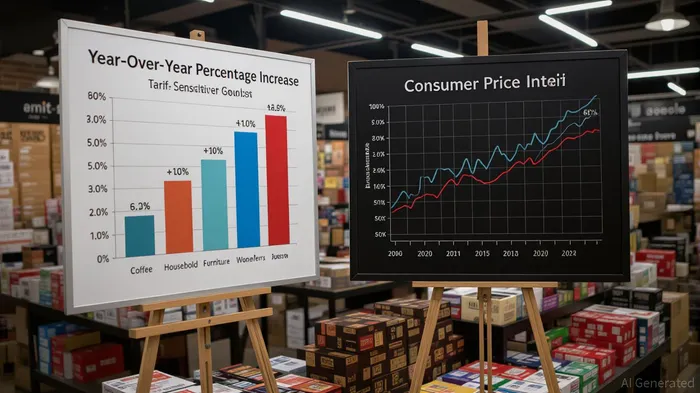
Tariff-driven inflation has emerged as a defining challenge for the U.S. consumer-discretionary sector in 2025. With the Consumer Price Index (CPI) rising 2.9% year-over-year in August, businesses are grappling with escalating costs and shifting consumer behavior. Tariff-sensitive goods such as coffee, household furniture, and apparel have seen some of the most pronounced price surges, with coffee prices climbing 21% due to a 50% import tariff on Brazilian goods[1]. These pressures are not isolated but systemic, as companies reach a tipping point in absorbing costs, leading to widespread price hikes[2].
Strategic Sector Positioning: Supply Chain Reconfiguration and Localization
To mitigate these risks, companies are reconfiguring global supply chains and adopting localization strategies. A 10% universal tariff introduced in April 2025 initially allowed firms to stockpile goods, but as these buffers depleted, businesses began reshoring production and diversifying supplier networks[1]. For example, Tesla's Shanghai Gigafactory leverages a 95% local supply chain to avoid cross-border tariffs while maintaining global technology standards[3]. Similarly, Unilever's localized product adaptations in Southeast Asia—such as smaller shampoo pack sizes—boosted rural market penetration by 17 percentage points over three years[3].
Localization extends beyond product design to digital engagement. Brands like Fiverr and AirbnbABNB-- have seen traffic surges after localizing websites into native languages, with 75% of internet users preferring to shop in their local language[3]. Artificial intelligence and blockchain are further enabling real-time supply chain visibility, allowing firms to pivot swiftly to alternative suppliers in response to tariff shocks[2].
Case Studies: Tariff Engineering and Creative Mitigation
Innovative strategies are emerging to circumvent tariffs. Columbia SportswearCOLM-- redesigned women's shirts to reclassify them as non-blouses, reducing duties from 26.9% to 16%[4]. Converse similarly modified sneaker soles to qualify as slippers, lowering tariffs from 20% to 6%[4]. These examples highlight the importance of product reclassification as a tactical tool.
Financially, companies are leveraging duty drawback programs to recover up to 99% of tariffs paid on exported goods[5]. Foreign trade zones (FTZs) also provide liquidity benefits by deferring duties until goods enter U.S. commerce[5]. For instance, Best BuyBBY-- and General MotorsGM-- have adjusted transfer pricing and supply chain structures to align with customs regulations, mitigating credit risk amid 30 sector-specific credit downgrades in Q2 2025[5].
Investment Implications and Risk Mitigation
For investors, the consumer-discretionary sector remains high-risk but offers opportunities for those prioritizing resilience. A multidisciplinary approach—integrating tax, legal, and supply chain expertise—is critical to navigating tariff volatility[5]. Firms that combine standardization with localization, such as McDonald'sMCD-- and Coca-ColaKO--, demonstrate how global brands can balance cost efficiency with cultural adaptability[3].
However, challenges persist. Academic research underscores a knowledge gap in the long-term effectiveness of reconfigurable supply chains under tariff uncertainty[2]. While digital tools enhance agility, they require significant upfront investment, which smaller firms may struggle to justify[2].
Conclusion
Tariff-driven inflation is reshaping the consumer-discretionary landscape, demanding strategic agility and innovation. Companies that prioritize supply chain diversification, localization, and tariff engineering are better positioned to thrive. For investors, the key lies in identifying firms with robust risk-mitigation frameworks and adaptive leadership. As the Federal Reserve's Beige Book notes, price hikes are spreading across sectors[1], making proactive strategy essential for sustaining competitiveness in an era of trade policy turbulence.





Comentarios
Aún no hay comentarios