
Target’s Earnings Crossroads: Can Retailers Navigate Housing-Driven Inflation?
The retail sector faces a pivotal moment as Target’s Q1 2025 earnings reveal the fragility of consumer discretionary spending in a tightening housing market. With shelter costs still anchoring inflation near 2.3%, the Federal Reserve’s delayed rate-cut plans are compounding pressures on retailers reliant on non-essential purchases. For investors, Target’s results—and the path ahead—serve as a litmus test for the durability of consumer resilience. A beat on earnings or guidance could signal a “buy” for retailers weathering macro headwinds, while weak results may foreshadow broader sector risks until housing affordability improves.
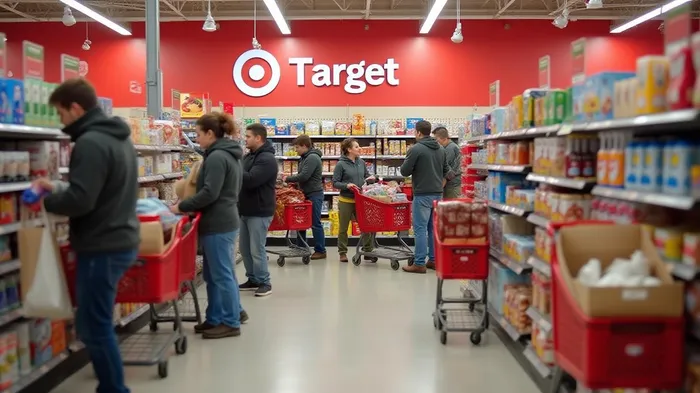
Target’s Q1: A Mirror of Consumer Trade-Offs
Target’s Q1 revenue fell 3.1% to $24.5 billion, underscoring a stark shift in consumer priorities. Discretionary categories like home goods and apparel saw traffic declines of 1.9% year-over-year, as households prioritized essentials like groceries and household items. CEO Brian Cornell noted that “shelter costs are reshaping budgets,” with 5,000 essential items now priced lower to attract cost-conscious shoppers.
The contrast with Walmart’s 3.8% comparable sales growth highlights Target’s vulnerability. While Target’s digital sales grew 8.7% and same-day delivery rose 25%, these gains were offset by a 1.6% drop in average transaction sizes—a red flag for margin health.
Fed Policy: A Delicate Tightrope
The Federal Reserve’s May decision to hold rates at 4.25%-4.5% reflects its struggle to balance inflation risks with economic growth. Shelter costs, contributing over half of April’s inflation rise, remain elevated at 4.1% annually—a key reason the Fed is hesitant to cut rates. Analysts project a 52% chance of a September rate cut, but this hinges on whether tariff-driven price hikes (e.g., Walmart’s recent electronics price increases) trigger a broader inflation rebound.
For Target, the Fed’s caution is a double-edged sword. Slower rate cuts mean borrowing costs remain high, squeezing consumer budgets. Yet, delayed inflation pass-through from tariffs has temporarily shielded retailers—until now. Analysts warn that Q2 could see a spike in goods inflation as companies like Target finally absorb tariff costs and raise prices.
Why This Matters for Investors
A Beat Signals Resilience: If Target exceeds Q2 estimates—say, by stabilizing discretionary sales or improving margins via price cuts—it could validate its strategy to pivot toward essentials. A post-earnings rally could lift its valuation, currently trading at a 35% discount to WalmartWMT-- (WMT) on a forward P/E basis.
A Miss Flags Broader Risks: Weak results would amplify fears of a broader retail slowdown. With shelter costs still elevated and wage growth tepid, households may cut back further on non-essentials, hurting retailers like Target that rely on discretionary spending.
The Bottom Line: Act on the Crossroads
Investors should treat Target’s next earnings as a critical inflection point. A beat would signal that the retailer is navigating housing-driven inflation better than feared, justifying a “buy” on dips below $95. A miss, however, would underscore vulnerabilities in the retail sector—prompting caution until shelter costs subside.
For now, the Fed’s wait-and-see approach keeps the door open for rate cuts, but Target’s ability to adapt will determine if it’s a retail leader or a casualty of inflation’s shifting sands.
Action Items:
- Monitor Target’s Q2 2025 earnings (expected in August) for traffic trends and margin stability.
- Track shelter-cost inflation (June CPI release) to gauge Fed policy risks.
- Compare Target’s performance with Walmart (WMT) and Home Depot (HD) to assess sector-wide resilience.
In a retail landscape where every dollar counts, Target’s next move could define the path for consumer spending—and investor returns—in 2025.





Comentarios
Aún no hay comentarios