
Target Corporation: Assessing Dividend Sustainability and Shareholder Value in a Dynamic Retail Landscape
In the evolving retail sector, where consumer preferences and technological disruptions redefine competitive dynamics, Target CorporationTGT-- (TGT) stands as a case study in balancing dividend commitments with strategic reinvention. For income-focused investors, the company's dividend sustainability is a critical metric, but it must be evaluated alongside broader financial health and operational resilience. This analysis examines Target's dividend trajectory, earnings performance, and strategic investments to assess its capacity to deliver long-term shareholder value.
Dividend Sustainability: A Delicate Balance
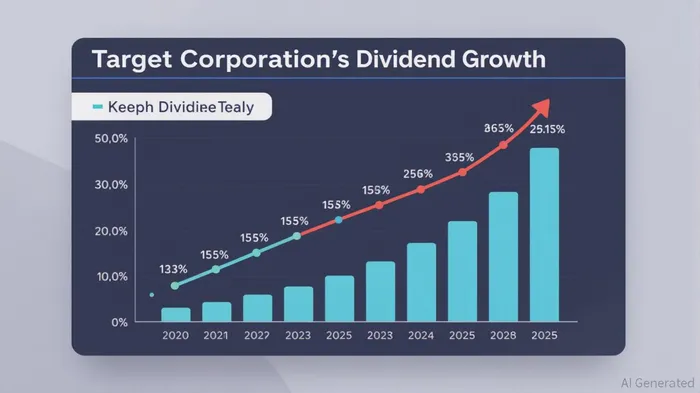
Target's dividend history reflects a disciplined approach to shareholder returns. Since its 1967 IPO, the company has raised its dividend for 58 consecutive years, with the most recent increase of 1.79% in August 2025, bringing the quarterly payout to $1.14 per share [3]. This consistency has driven the dividend yield to 5.15% as of 2025, a significant premium compared to its 3- and 5-year averages [5]. However, the sustainability of this yield hinges on the company's ability to align payouts with cash flow generation.
While the trailing earnings-based payout ratio of 52.2% appears manageable [3], the free cash flow (FCF) payout ratio tells a different story. In Q2 2025, operating cash flow plummeted by 75% year-over-year to $275 million, while capital expenditures surged to $790 million, resulting in negative operating FCF of $515 million [2]. This led to an FCF payout ratio of 211%, indicating that dividends are no longer supported by internally generated cash flow and require reliance on cash reserves or debt [3]. Such a divergence raises concerns about the long-term viability of the dividend, particularly as Target's cash-to-debt ratio has contracted to 0.19, with $7.689 billion in cash and marketable securities as of August 2025 [2].
Earnings and Operational Resilience
Target's 2024 financial results underscore both its strengths and vulnerabilities. Net sales declined 0.8% to $106.6 billion, reflecting macroeconomic headwinds and cold-weather disruptions, yet digital sales grew 8.7% in Q4 2024, driven by robust same-day delivery services [1]. The company's omnichannel strategy, which integrates in-store traffic growth (1.4% year-over-year) with digital innovation, has positioned it to capture a larger share of the retail market.
Profitability metrics, however, remain mixed. Net profit margins dipped below 3.5% in 2023 before stabilizing at 3.67%–4.09% in 2024–2025 [2], while return on equity (ROE) fluctuated between 23% and 30% during the same period. These figures suggest that while Target's operational efficiency has improved, margin pressures from supply chain costs and inventory shrink persist [2]. Analysts project a moderate revenue CAGR of 2.48% through 2030, with EPS growth of 7.38% annually, reflecting optimism about the company's ability to adapt to competitive pressures [5].
Strategic Investments: A Double-Edged Sword
Target's long-term growth hinges on its $15 billion sales expansion plan by 2030, anchored in digital transformation, supply chain modernization, and store network optimization [4]. Investments in AI-powered inventory management, robotic automation, and AI-driven personalization tools aim to enhance customer retention and reduce operational costs [3]. For instance, the company's TargetTGT-- Plus marketplace and Roundel advertising business are expected to generate $5 billion in digital sales by 2030, creating less capital-intensive revenue streams [4].
However, these initiatives come at a cost. Capital expenditures in 2024 totaled $2.9 billion, a decline from prior years, but the company plans to reinvest heavily in 2025–2030 to expand its sortation center network and enhance last-mile delivery [4]. While such investments could drive operational efficiencies and sales growth, they also strain short-term liquidity. The challenge for Target lies in balancing these outlays with dividend obligations, particularly as free cash flow volatility persists.
Shareholder Value Creation: A Calculated Gamble
Target's capital allocation framework—dividends, buybacks, and reinvestment—reflects a strategic prioritization of shareholder returns. In 2024, the company deployed $1.0 billion in share repurchases, leveraging its improved FCF of $4.5 billion [2]. Yet, the recent reliance on cash reserves to fund dividends and buybacks signals a potential overextension of its financial flexibility.
Analysts remain divided on the outlook. Bullish projections suggest shares could reach $164.20 by 2030, driven by successful execution of digital and supply chain initiatives [5], while bearish models anticipate a decline to $21.68 amid cash flow constraints [5]. The key differentiator will be Target's ability to convert its strategic investments into sustainable cash flow growth.
Conclusion: A Test of Resilience
Target Corporation's dividend sustainability and shareholder value creation rest on a precarious equilibrium. While its historical commitment to dividends and strategic reinvention in digital commerce and supply chain efficiency are commendable, the company's reliance on cash reserves and external financing to fund payouts poses risks. For investors, the critical question is whether Target's $15 billion growth plan by 2030 can generate the cash flow necessary to sustain its dividend and buyback programs. The answer will depend on the company's agility in navigating macroeconomic uncertainties and its ability to translate operational investments into scalable profitability.







Comentarios
Aún no hay comentarios