
Tamarack Valley Energy's Dividend Signal and Growth Potential: A Deep Dive into Sustainability and Capital Allocation
In the evolving oil and gas sector of 2025, Tamarack Valley Energy (TVE) stands out for its disciplined approach to dividend sustainability and capital allocation. With a monthly dividend of C$0.01275 per share, according to the 2025 corporate budget, TVE has maintained consistency in shareholder returns while navigating a sector marked by energy transition pressures and fluctuating commodity prices. This article examines TVE's dividend strategy, capital deployment, and peer comparisons to assess its long-term appeal for investors.
Dividend Sustainability: A Balanced Approach
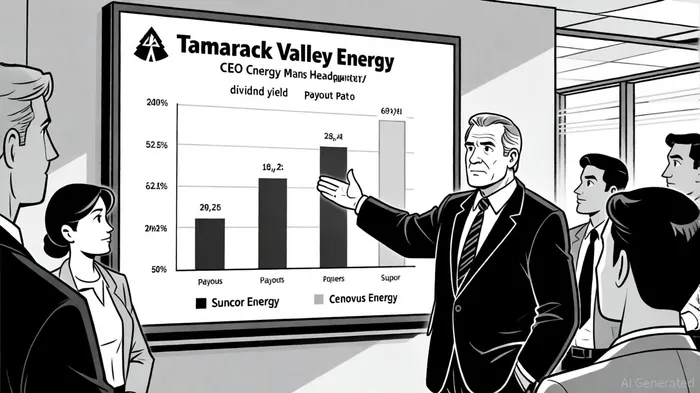
TVE's dividend policy is anchored in a 50.17% payout ratio, as shown in the TVE dividend history, ensuring that the company retains sufficient earnings to fund operations and growth. This ratio aligns with industry norms, as peers like Suncor EnergySU-- (49.55% payout ratio, per the Suncor dividend history) and Cenovus EnergyCVE-- (35.49% payout ratio, per the Cenovus dividend page) also prioritize balancing dividends with reinvestment. TVE's Dividend Sustainability Score (DSS) of 72.07%, reported in the TVE dividend history, further underscores its ability to maintain current payouts, supported by strong free funds flow generation and a 60% allocation of free cash to shareholders through dividends and buybacks per the 2025 corporate budget.
The company's recent performance reinforces this sustainability. In Q2 2025, TVE achieved record production of 70,260 boe/d (a 19% year-over-year increase) while reducing production expenses to $7.76/boe, according to the company's Q2 results. These operational efficiencies, coupled with a 7% reduction in capital expenditures due to improved drilling and waterflood efficiency reported in the same Q2 results, demonstrate TVE's ability to generate cash flow without overextending its balance sheet.
Capital Allocation: Growth and Shareholder Returns
TVE's 2025 capital allocation strategy is a masterclass in balancing growth and returns. The company has allocated $430–450 million for 2025, with $315 million directed toward sustaining operations in core areas like Clearwater and Charlie Lake (per the 2025 corporate budget). A further $125 million is earmarked for growth initiatives, including waterflood expansion, which is projected to increase injection rates by 60% by year-end according to the 2025 corporate budget. This strategy not only mitigates production decline but also enhances long-term operational efficiency.
Notably, TVE plans to allocate 60% of its 2025 free funds flow to shareholders, with total returns potentially reaching 16% under a $70/bbl WTI price scenario, as outlined in the 2025 corporate budget. This approach mirrors broader industry trends, where companies like SuncorSU-- Energy and Cenovus Energy are also prioritizing disciplined capital deployment, according to the Deloitte outlook. However, TVE's focus on monthly dividends and aggressive share repurchases (e.g., 3.9 million shares in April 2025 reported in the Q2 results) differentiates it as a high-conviction play for income-focused investors.
Peer Comparisons: TVE's Competitive Edge
While TVE's 2.55% dividend yield (per the TVE dividend history) is lower than the top 25% of energy sector payers (8.73%, per the TVE dividend history), it outperforms the bottom 25% of Canadian dividend payers (1.92%, per the TVE dividend history). This positions TVE as a mid-tier yielder with strong sustainability metrics. In contrast, peers like Petrobras (17.36% yield) face sustainability risks due to payout ratios exceeding 200%, according to a Nasdaq article, while Permian Resources Corporation (5% yield) maintains a more conservative 60% payout ratio in the same Nasdaq piece.
TVE's capital allocation strategy also compares favorably. Suncor Energy, with a 4.16% yield and 49.55% payout ratio (per the Suncor dividend history), emphasizes integrated operations for stability, while Cenovus Energy's 35.49% payout ratio (per the Cenovus dividend page) reflects a growth-oriented approach. TVE's hybrid model-combining operational efficiency with strategic reinvestment-positions it to capitalize on both near-term cash flow and long-term production growth.
Navigating the Energy Transition
The oil and gas sector's shift toward low-carbon technologies and natural gas is another critical factor. TVE's focus on waterflood expansion and existing infrastructure optimization, described in the 2025 corporate budget, aligns with cost-effective decarbonization, while its $325 million debt restructuring noted in the 2025 corporate budget provides flexibility for future green investments. This contrasts with peers like Imperial Oil, which is investing heavily in renewable diesel facilities, according to a Nasdaq list, but TVE's strategy appears more aligned with incremental, capital-efficient improvements.
Conclusion: A Compelling Case for TVE
Tamarack Valley Energy's dividend sustainability and capital allocation strategy reflect a disciplined, forward-looking approach. With a 50.17% payout ratio, 72.07% DSS, and a capital plan that balances growth and returns, TVE is well-positioned to navigate the 2025 energy landscape. While its yield may not be the highest in the sector, its combination of operational efficiency, production growth, and shareholder-friendly policies makes it a compelling choice for investors seeking stability and long-term value.





Comentarios
Aún no hay comentarios