
Taiwan’s Resilient Export Growth Amid U.S. Tariff Risks: A Strategic Opportunity in AI-Driven Semiconductor Exports
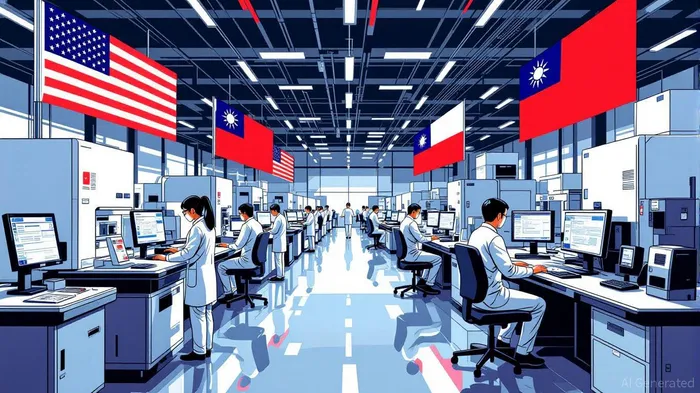
The U.S. semiconductor tariff landscape in 2025 has been nothing short of seismic. President Trump’s 100% tariff on imported chips from non-U.S. manufacturers has sent shockwaves through global supply chains, yet Taiwan’s semiconductor industry is not only weathering the storm—it’s thriving. This resilience stems from a perfect storm of AI-driven demand, strategic supply chain repositioning, and the dominance of companies like TSMCTSM--. For investors, this is a golden opportunity to capitalize on a sector where geopolitical headwinds are being outmaneuvered by technological momentum.
The Tariff Challenge: A Double-Edged Sword
The U.S. tariff policy, announced in August 2025, targets companies that do not manufacture chips domestically, aiming to force a shift toward U.S. production [1]. While this has created uncertainty for many, it has also accelerated strategic investments. TSMC, for instance, has leveraged its Arizona facility—producing 4nm wafers since late 2024—to bypass the 100% tariff entirely [1]. This move not only secures its position in the U.S. market but also underscores its ability to adapt to protectionist policies. Smaller players like UMCUMC-- and Vanguard are following suit, with U.S. factory setups or partnerships to mitigate risks [1].
The tariffs have also spurred a broader realignment of supply chains. Companies like Foxconn, Pegatron, and Quanta are shifting AI-related production from China to Mexico under the USMCA framework, aiming to assemble AI servers in North America [3]. While the Trump administration’s 30% tariff threat on Mexican imports and 35% tariff on Canadian goods has introduced friction, Mexico’s 90-day reprieve to negotiate a framework for advanced computing sectors highlights the industry’s adaptability [3].
AI Demand: The Unstoppable Engine
Despite these challenges, AI and high-performance computing (HPC) demand have been a lifeline for Taiwan’s semiconductor exports. In H1 2025, Taiwan’s semiconductor exports hit historical highs, driven by surging orders for AI accelerators and HPC chips [1]. TSMC’s Q2 2025 earnings report revealed a 38.6% year-over-year revenue increase, with 74% of its wafer revenue coming from advanced nodes (7nm and below), primarily used in AI applications [1]. Bernstein analysts predict at least 33% revenue growth for TSMC in 2025, with AI demand as the central catalyst [2].
The global semiconductor industry outlook further reinforces this trend. Generative AI chips, particularly those used in data centers, are projected to contribute over $150 billion in revenue in 2025 [4]. TSMC’s leadership in 3nm and 5nm processes, coupled with its pivotal role in supplying chips to NVIDIANVDA-- and other AI leaders, positions it as the linchpin of this boom [1].
Strategic Supply Chain Dominance
Taiwan’s ability to navigate U.S. tariffs is rooted in its strategic supply chain dominance. While the Trump administration’s Section 232 investigation continues to shape policies, the industry’s focus remains on global layout adjustments rather than mass offshoring [2]. TSMC’s Arizona plant is a case in point: it not only circumvents tariffs but also aligns with U.S. hyperscalers’ demand for regional manufacturing [3].
Moreover, U.S. companies like AppleAAPL-- and Nvidia have announced significant U.S. investments, which could further solidify Taiwan’s role in the supply chain. For example, Apple’s M-series chips and Nvidia’s H100 GPUs rely heavily on TSMC’s advanced manufacturing capabilities [1]. These partnerships create a flywheel effect, where U.S. demand drives investment in U.S. facilities, which in turn secures Taiwan’s market share.
Mitigating Geopolitical Risks
The U.S. tariff policy has also created a two-tier pricing structure in the chip sector. While manufacturing equipment remains stable due to exemptions with South Korea, Malaysia, and the EU, tariffs on finished chips and raw materials like copper have increased volatility for OEMs [4]. However, Taiwan’s focus on advanced nodes—where equipment costs are less sensitive to tariffs—mitigates this risk.
Additionally, geopolitical tensions, such as China’s export restrictions on gallium and germanium, have further complicated supply chains [5]. Yet, Taiwan’s diversified supplier base and technological leadership allow it to navigate these challenges. For instance, TSMC’s ability to source materials from alternative regions and its emphasis on U.S. production facilities reduce exposure to China-specific risks [1].
A Call to Action for Investors
For investors, the key takeaway is clear: Taiwan’s semiconductor industry is not just surviving—it’s thriving in the face of U.S. tariffs. The combination of AI-driven demand, strategic supply chain repositioning, and TSMC’s dominance creates a compelling investment thesis.
Source:
[1]
Taiwan's Semiconductor Industry Outlook Amid the U.S. 100 ...[2] TSMC: Bernstein hikes PT, maintains Outperform on ... [https://ca.investing.com/news/stock-market-news/tsmc-bernstein-hikes-pt-maintains-outperform-on-stronger-ai-outlook-4188374][3]
Taiwan Is Rewiring North America's AI Hardware Chain[4]
Tariffs and trade deals: How they impact chip pricing[5]
How New Tariffs Will Impact Global Manufacturers in 2025





Comentarios
Aún no hay comentarios