
Taiwan's T-Dome Air Defense System and Its Strategic Implications for Defense and Tech Sectors
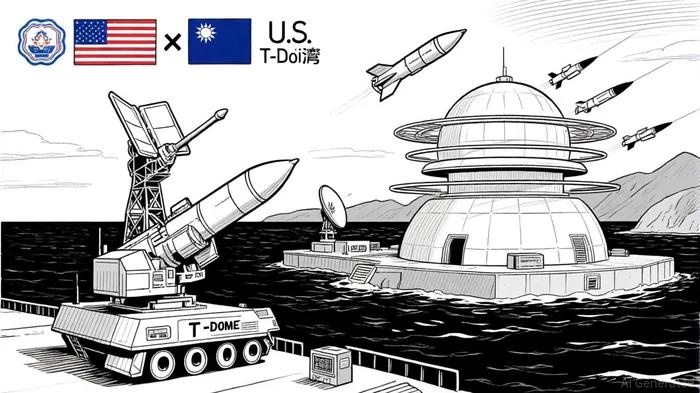
In an era of escalating geopolitical tensions and technological competition, Taiwan's T-Dome air defense system represents a convergence of strategic necessity and industrial innovation. Announced by President Lai Ching-te in October 2025, the T-Dome initiative aims to establish a multi-layered defense network to counter potential threats, particularly from China, according to DevDiscourse. This system, developed by the National Chung-Shan Institute of Science and Technology (NCSIST), integrates advanced radar, missile interception, and command-and-control technologies, as described by Open Nuclear. However, its significance extends beyond military preparedness: the T-Dome is deeply intertwined with Taiwan's semiconductor industry, which underpins its technological edge and global supply chain dominance. For investors, this intersection of defense and tech sectors presents compelling opportunities in both traditional contractors and cutting-edge semiconductor suppliers.
The T-Dome: A Technological and Strategic Milestone
The T-Dome system is designed to replace aging systems like the HAWK and complement the Patriot (PAC) system, creating a low-altitude air defense network, as noted in Open Nuclear's analysis. Key components include phased-array radars, engagement control stations, and vertical-launch missile systems capable of targeting aircraft, cruise missiles, and tactical ballistic missiles, according to the same Open Nuclear analysis. DevDiscourse reports that the system's development is part of a broader strategy to complete 12 T-Dome bases by 2026. While technical specifications remain classified, the Tien Kung-3 (TK III) system-on which the T-Dome likely builds-demonstrates capabilities such as directional fragmentation warheads, digital signal processing, and mobility enhancements, per Open Nuclear.
The strategic imperative for the T-Dome is clear. China's military exercises near the Taiwan Strait, including simulated blockades and missile tests, have heightened regional instability, DevDiscourse notes. The U.S. Department of Defense's parallel Golden Dome initiative-a $175 billion layered defense architecture-underscores the global recognition of such threats, as reported by Aviation Week. For Taiwan, the T-Dome is not merely a defensive tool but a symbol of resilience in a volatile geopolitical landscape.
Defense Contractors: A Hub of Innovation and Collaboration
NCSIST, the primary developer of the T-Dome, has long been a cornerstone of Taiwan's defense industry. Its expertise in systems like the Tien Kung series and Wan Chien air-to-surface missiles highlights its role in advancing asymmetric capabilities, according to AdensAmerica. However, the T-Dome's complexity necessitates collaboration with international partners. In 2025, NCSIST signed agreements with U.S. defense firms at the Taipei Aerospace & Defense Technology Exhibition, focusing on uncrewed systems and interoperability, as described in Open Nuclear's coverage. This aligns with broader U.S.-Taiwan efforts to strengthen defense ties, including a 2023 delegation of 25 U.S. contractors exploring joint projects, reported by DevDiscourse.
Investors should also monitor emerging players. Companies like Aerospace Industrial Development Corporation (AIDC) and Lockheed Martin are likely to contribute to the T-Dome's radar and missile technologies, per Open Nuclear. Additionally, startups such as Rocket Lab and Sophia Space are exploring niche roles in hypersonic defense and space-based sensors, according to Aviation Week. The Pentagon's Multiple Award Scalable Homeland Innovative Enterprise Layered Defense (SHIELD) contract-a $151 billion IDIQ vehicle-provides a blueprint for how U.S. and Taiwanese firms might collaborate on large-scale, flexible defense systems, as Aviation Week explains.
Semiconductor Suppliers: The Invisible Backbone of the T-Dome
The T-Dome's technological sophistication is inseparable from Taiwan's semiconductor ecosystem. TSMCTSM--, the world's largest contract chipmaker, dominates the production of advanced nodes critical for defense systems, including AI-driven radar and command-and-control processors, according to The Diplomat. TSMC's recent investments in gallium nitride (GaN) semiconductors-used in high-power military applications-further underscore its strategic relevance, as noted by AdensAmerica. The Diplomat's 2025 report positions TSMC's leadership in wafer foundry and packaging technologies as a linchpin for both commercial and defense-grade chips.
Other key suppliers include United Microelectronics Corporation (UMC) and Vanguard International Semiconductor, which collectively account for 69% of the global foundry market, according to The Diplomat. These firms supply analog and mixed-signal chips essential for radar systems and communication networks. Meanwhile, smaller players like Chenfull International and Daxin Materials provide critical materials and equipment for semiconductor manufacturing, a point highlighted by Aviation Week. The integration of these companies into the T-Dome supply chain highlights the interdependence of Taiwan's defense and tech sectors.
The geopolitical stakes are equally high. A disruption in Taiwan's semiconductor production-whether through a Chinese blockade or labor shortages-could cripple global supply chains, including those for defense systems, as warned by Global Taiwan. This has spurred U.S. efforts to diversify manufacturing, such as TSMC's $100 billion investment in U.S. facilities under the CHIPS Act, noted by Global Taiwan. For investors, this dual reliance on Taiwan's domestic expertise and its global partnerships creates a unique opportunity set.
Investment Opportunities: Balancing Risk and Resilience
The T-Dome initiative offers multiple avenues for investment. In the defense sector, established contractors like NCSIST and AIDC are likely to benefit from increased R&D funding and procurement contracts. U.S. firms with existing ties to Taiwan, such as Lockheed Martin and Northrop Grumman, could also see growth through joint ventures. For semiconductor suppliers, TSMC's expansion into GaN and AI-driven manufacturing processes presents long-term value, while smaller firms specializing in materials or equipment (e.g., Topco Scientific's partners) offer high-growth potential, Aviation Week reports.
However, risks remain. Geopolitical tensions could escalate, impacting both defense spending and semiconductor exports. Additionally, labor shortages in Taiwan's semiconductor industry-driven by declining STEM enrollment and aging populations-pose a challenge to sustained growth, as Global Taiwan emphasizes. Investors must also weigh the implications of U.S. export controls and intellectual property concerns, which could complicate cross-border collaborations, according to AdensAmerica.
Conclusion: A Strategic Nexus for Investors
Taiwan's T-Dome air defense system is more than a military project-it is a testament to the island's technological prowess and its role in global security. For investors, the system's development highlights the symbiotic relationship between defense innovation and semiconductor leadership. While geopolitical risks cannot be ignored, the strategic imperative for resilient supply chains and advanced defense capabilities ensures that both sectors will remain critical to global stability. By targeting firms at the intersection of these domains, investors can capitalize on a unique confluence of national security and technological progress.





Comentarios
Aún no hay comentarios