
Tactical Income Generation in a Low-Yield Environment: Analyzing the F/m Opportunistic Income ETF
A Flexible Approach to Income Generation
XFIX is an actively managed ETF designed to maximize total return by targeting undervalued sectors and securities across the U.S. fixed-income landscape. Unlike traditional bond funds constrained by sector or duration limits, XFIXXFIX-- employs a "go anywhere" strategy, allowing it to dynamically allocate assets across investment-grade corporate bonds, municipal bonds, high-yield bonds, preferred stocks, and mortgage-backed securities. This flexibility enables the fund to capitalize on relative value opportunities, a critical advantage in a low-yield environment where traditional benchmarks like the S&P 500 or the Bloomberg Aggregate Bond Index offer limited upside.
For instance, in 2025, XFIX demonstrated a 5.47% dividend yield, significantly outpacing the yields of 10-year Treasury bonds (which hover near 3.5%) and investment-grade corporate bond indices. This high yield is achieved through a combination of sector rotation and credit selection, with the fund's managers actively adjusting exposure to sectors such as utilities, financials, and energy based on macroeconomic signals.
Performance in a Challenging Market
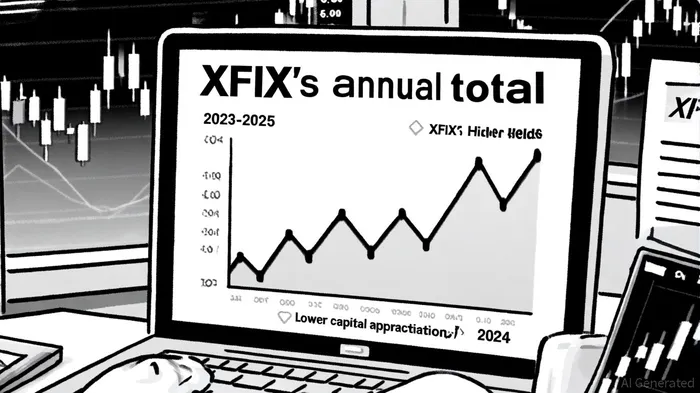
While XFIX's yield is attractive, its performance metrics reveal a mixed picture. Over the past 12 months, the fund has delivered a total return of 3.40%, outperforming the 1.2% return of the Bloomberg Aggregate Bond Index but lagging behind high-yield bond indices, which have surged on aggressive monetary policy easing. However, over the 36-month period, XFIX's total return has flattened at 0%, reflecting the challenges of maintaining consistent returns in a market characterized by volatile interest rates and shifting credit spreads.
This performance underscores the fund's tactical nature. By dynamically reallocating assets, XFIX avoids overexposure to sectors experiencing headwinds. For example, during the 2025 energy sector downturn, the fund reduced its exposure to energy-related bonds and increased holdings in municipal bonds, which benefited from tax-exempt yields and stable cash flows. Such agility is a hallmark of tactical income strategies, though it also introduces higher volatility compared to passive alternatives.
Risk Considerations and Benchmark Comparisons
XFIX's unconstrained approach carries inherent risks. The fund's portfolio is not diversified across all sectors, and its managers may concentrate holdings in specific credits or industries where they perceive value, according to SignalBloom. For example, as of October 2025, XFIX's top five holdings accounted for 18% of the portfolio, with significant exposure to high-yield corporate bonds and preferred stocks (per StockAnalysis). While this concentration can amplify returns in favorable conditions, it also increases downside risk during market corrections.
Risk-adjusted metrics further highlight these trade-offs. XFIX's Sharpe Ratio of 0.21 over the past year indicates moderate risk-adjusted returns relative to its volatility, while by comparison the iShares 20+ Year Treasury Bond ETF (TLT) has a Sharpe Ratio of 0.35, reflecting its lower volatility but also its lower yield. This suggests that XFIX is better suited for investors prioritizing income over capital preservation, particularly those with a medium-term horizon and tolerance for price fluctuations.
Strategic Implications for Income Investors
For investors navigating a low-yield environment, XFIX offers a unique value proposition. Its active management and sector-agnostic approach allow it to exploit inefficiencies in the fixed-income market, generating income where traditional strategies fall short. However, its performance is contingent on the skill of its managers and the accuracy of their macroeconomic forecasts.
A key consideration is the fund's expense ratio of 0.39% (per StockAnalysis), which is competitive with actively managed bond funds but higher than passive alternatives. Given XFIX's performance, this cost appears justified for investors seeking to enhance yield, though it may be less appealing for those prioritizing capital preservation.
Conclusion
The F/m Opportunistic Income ETF (XFIX) exemplifies the potential of tactical income strategies in a low-yield environment. By leveraging a flexible, active approach, the fund has delivered a compelling dividend yield while adapting to shifting market conditions. However, its performance variability and concentration risks necessitate careful due diligence. For investors willing to accept moderate volatility in exchange for income generation, XFIX represents a viable option-but one that should be integrated into a diversified portfolio rather than treated as a standalone solution.





Comentarios
Aún no hay comentarios