
T1 Energy Inc.: Navigating the Clean Energy Transition Amid Strategic and Financial Crosscurrents
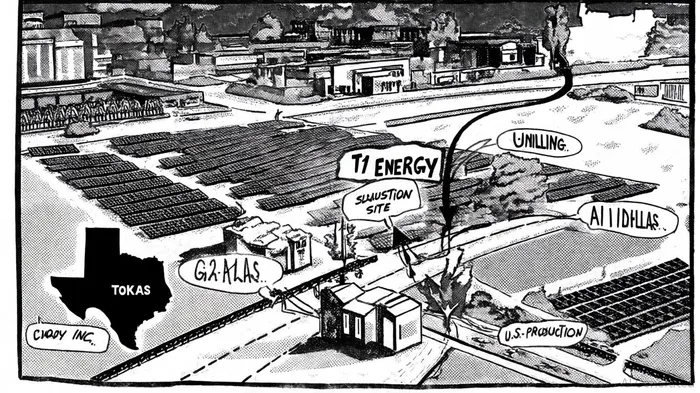
In the high-stakes arena of the clean energy transition, T1 EnergyTE-- Inc. (NYSE: TE) has positioned itself as both a beneficiary and a battleground of U.S. policy ambitions. The company's 2025 strategic moves-ranging from a transformative partnership with Corning, Inc. to its $850 million G2_Austin solar cell manufacturing project-underscore its commitment to reshaping the domestic solar supply chain. Yet, beneath the surface of these bold initiatives lies a complex interplay of financial fragility, regulatory compliance challenges, and operational risks that could redefine its long-term value proposition for shareholders.
Strategic Positioning: A Domestic Supply Chain Play
T1 Energy's recent agreement with Corning, Inc. to purchase solar wafers is more than a procurement deal-it is a calculated step to align with the Foreign Entity of Concern (FEOC) regulations under the One Big Beautiful Bill (OBBB) and secure eligibility for Section 45X tax credits, as outlined in T1 Energy's U.S. solar strategy. By sourcing wafers domestically, T1TE-- mitigates the risk of supply chain disruptions tied to foreign inputs, particularly from China, which remains a critical but politically sensitive supplier for many clean energy firms-a point emphasized in PV Magazine's FEOC guide. This alignment is not merely defensive; it is a proactive strategy to capitalize on the U.S. government's push for localized manufacturing.
The G2_Austin project, a 5 GW solar cell facility slated to begin production in late 2026, further cements T1's vertical integration strategy. With construction expected to start in Q3/Q4 2025 and a two-phase rollout, the project reflects a bet on sustained demand for U.S.-made solar components, particularly for hyperscale AI infrastructure; the company reiterated these targets in T1's Q2 2025 report. This timing is critical: as data centers and AI-driven industries consume an increasing share of global energy, T1's ability to supply high-purity solar cells could position it as a key enabler of the digital economy's green transition.
Financial Realities: EBITDA Guidance vs. Operational Strain
Despite these strategic strides, T1's financial performance in Q2 2025 reveals a company walking a tightrope. The firm reported a net loss of $32.8 million, with cash reserves totaling $46.7 million as of June 30, according to its Q2 2025 results. While it has maintained its EBITDA guidance of $25–$50 million for 2025, risks are skewed to the downside due to trade policy uncertainties and supply chain bottlenecks; the QuiverQuant commentary on these results also flagged downside risks. The company's reliance on Section 45X tax credits-whose eligibility hinges on stringent FEOC compliance-adds another layer of volatility. For instance, the 45X credit for solar equipment requires 50% of costs to be sourced from non-prohibited foreign entities in 2026, rising to 85% by 2029, as detailed in the FEOC maze analysis. T1's ability to meet these thresholds will determine not only its tax benefits but also its competitiveness against rivals with more diversified supply chains.
Historical data on T1's earnings releases since 2022 provides a nuanced perspective on its financial trajectory. While the company's Q2 2025 results highlight near-term challenges, backtesting reveals that over a 30-day horizon following earnings announcements, TE's cumulative returns have averaged +34%, with statistically significant outperformance emerging after day 28, according to a Panabee earnings analysis. Notably, while short-term (≤7 days) reactions to earnings events have been mixed, the win rate for positive returns rises to 100% from day 23 onward, suggesting that market confidence in T1's long-term strategy may materialize in the medium term. However, with only four earnings events in the sample, these findings remain illustrative.
Accounting Scandals and Shareholder Trust
The most pressing threat to T1's long-term value, however, stems from its recent accounting misstatements. A material error in Q1 2025 financials-stemming from the misclassification of amortization expenses-has forced the company to restate its earnings and disclose a material weakness in internal controls, as noted in the Panabee earnings analysis. This revelation has triggered a Notification of Late Filing for its Q2 10-Q and raised questions about management's ability to execute its strategic vision. For shareholders, the implications are twofold: first, the restatement process will divert critical resources from core operations over the next 12–24 months; second, the erosion of investor confidence could increase the company's cost of capital, complicating its financing needs for projects like G2_Austin.
The Path Forward: Balancing Ambition and Prudence
T1 Energy's strategic positioning in the clean energy transition is undeniably ambitious. Its partnerships, tax credit strategies, and vertical integration efforts align with the U.S. government's broader goals of energy security and decarbonization. Yet, the company's financial fragility and governance issues present a stark counterpoint. For long-term shareholders, the key question is whether T1 can execute its capital-intensive projects while restoring trust in its financial reporting.
A critical test will be the successful completion of G2_Austin and the company's ability to monetize Section 45X credits without further regulatory hiccups. If T1 can navigate these challenges, it may emerge as a pivotal player in the domestic solar industry. However, any missteps-whether in construction delays, compliance lapses, or continued accounting issues-could undermine its value proposition and force a reevaluation of its role in the clean energy ecosystem.





Comentarios
Aún no hay comentarios