
Systemic Risks in DeFi Lending and Stablecoin Collateral Chains: A Looming Crisis of Liquidity and Solvency Contagion
Liquidity Contagion: The Domino Effect of Interconnected Collateral
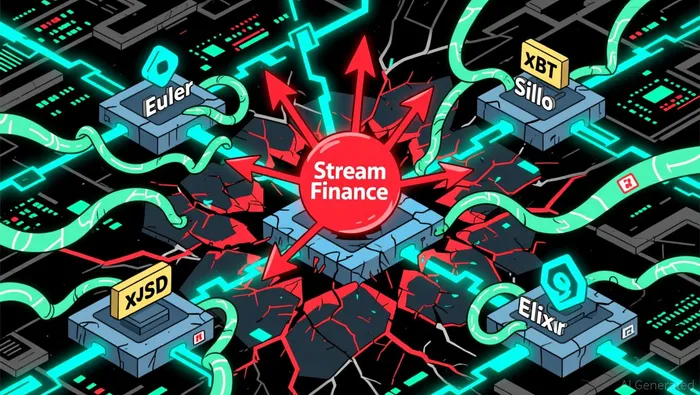
Stream Finance's failure was not an isolated incident but a catalyst for a cascading liquidity crisis. Its synthetic stablecoins-xUSD, xBTC, and xETH-were repeatedly collateralized across protocols like EulerEUL--, Silo, MorphoMORPHO--, and Sonic, creating a web of dependencies. According to a Markets.com report, over $284 million in stablecoin exposure and outstanding loans were linked to Stream Finance, with TelosC and Elixir holding the largest stakes at $123 million and $68 million, respectively.
This interconnectedness highlights a critical vulnerability: when one node in the network fails, liquidity constraints ripple outward. For instance, Elixir's deUSD stablecoin, which had 65% of its reserves lent to Stream Finance, faced immediate redemption risks as repayments were paused pending legal review, the report noted. The lack of transparency in collateral chains-where assets are reused across multiple lending loops-exacerbates the problem, leaving creditors with little recourse when devaluation or insolvency strikes.
Solvency Contagion: Rehypothecation and the Fragility of Stablecoins
The technical architecture of DeFi stablecoins further compounds systemic risks. Stream Finance's Staked Stream USD (XUSD) depegged to $0.3004 from $1 after its $93 million loss, triggering a solvency crisis. As noted by Yahoo Finance, XUSDXUSD-- was rehypothecated across multiple protocols, meaning its declining value directly impacted the solvency of borrowers and lenders alike. Analysts estimate that $222 million in DeFi losses occurred in November 2025 alone, with Stream Finance accounting for a significant portion, according to a Crypto.ro report.
Rehypothecation-the practice of reusing collateral to generate additional yields-creates a house of cards. When collateral devalues, it triggers margin calls, liquidations, and cascading defaults. Treeve's scUSD, for example, was entangled in multi-layered lending loops through platforms like Mithras and Euler, amplifying its exposure to solvency shocks, as the Markets.com analysis showed. The opaque governance structures of many DeFi protocols, which blend centralized and decentralized operations, further obscure accountability during crises; Yahoo Finance also highlighted this lack of clarity.
Mitigation Efforts: Bridging Compliance and Capital Efficiency
Amid the chaos, some projects are attempting to address systemic risks through regulatory alignment and infrastructure upgrades. Bitnomial's RLUSD launch and Deutsche Bank's EURAU stablecoin, which operates across six blockchain networks, represent efforts to enhance transparency and capital efficiency. These initiatives aim to integrate traditional finance (TradFi) safeguards-such as auditable reserves and multi-chain interoperability-into DeFi ecosystems.
However, such solutions remain nascent. The Stream Finance collapse demonstrates that even with high-yield incentives, the absence of robust risk governance and liquidity buffers can lead to catastrophic failures. Investors must weigh the allure of elevated returns against the latent risks of interconnected collateral chains.
Conclusion: A Call for Prudent Innovation
The DeFi sector stands at a crossroads. While its potential to disrupt traditional finance is undeniable, the Stream Finance crisis serves as a stark reminder of the dangers posed by liquidity and solvency contagion. For investors, the lesson is clear: diversification, due diligence, and a critical evaluation of collateral transparency are paramount. For developers and regulators, the challenge lies in designing resilient infrastructure that balances innovation with systemic stability.
As the sector evolves, the question remains: Can DeFi reconcile its decentralized ethos with the need for centralized safeguards? The answer may determine whether it becomes a pillar of global finance-or another cautionary tale of speculative excess.







Comentarios
Aún no hay comentarios