
Systemic Risk in Decentralized Trading Platforms: Liquidity Crises and Smart Contract Vulnerabilities
The decentralized finance (DeFi) sector, once hailed as a bastion of financial innovation, has increasingly exposed systemic vulnerabilities that threaten its long-term viability. Recent events on Hyperliquid-a prominent decentralized exchange-highlight the dual perils of liquidity crises and smart contract flaws, offering a cautionary tale for investors and developers alike.
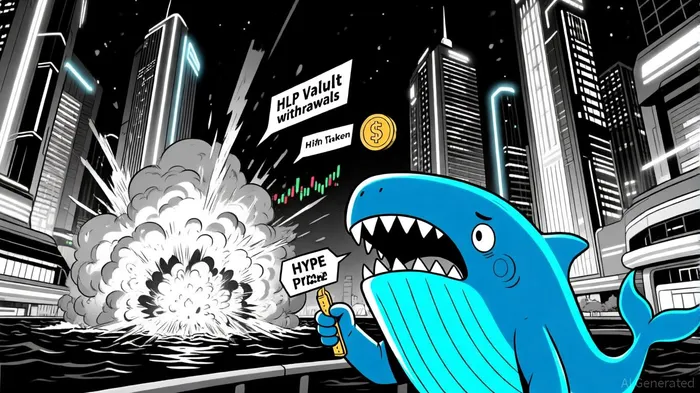
The Hyperliquid Liquidation Event: A Case Study in Systemic Risk
On March 13, 2025, Hyperliquid faced a $4 million loss in its HLP Vault due to a sophisticated liquidation arbitrage attack, as reported by Cointeeth. A whale deposited 15.23 million USDCUSDC-- to open a long ETH position of approximately 160,000 ETH, leveraging between 13.5x and 19.2x. By strategically withdrawing unrealized profits, the whale reduced its margin to a level that triggered liquidation as ETH prices dipped. This maneuver allowed the attacker to profit $1.86 million while the HLP Vault absorbed the loss, exposing the platform's susceptibility to market manipulation, as Cointeeth noted.
The incident triggered a $166 million net outflow from Hyperliquid and an 8% drop in the HYPE token's value, from $14 to $12.84, according to Cointeeth. Hyperliquid's response-reducing leverage limits for BTC and ETH and planning margin system upgrades-underscored the fragility of its risk management framework. This event is emblematic of a broader trend: high-leverage decentralized exchanges (DEXs) are increasingly targeted for exploitation due to thin liquidity and inadequate position concentration controls, according to Ave.ai.
Liquidity Crises: The Achilles' Heel of DeFi
Liquidity crises in DeFi are not isolated to Hyperliquid. A 2025 study identified EthereumETH-- (ETH), ChainlinkLINK-- (LINK), and UniswapUNI-- (UNI) as key assets that propagate losses during market downturns, while stablecoin DAI demonstrated resilience in absorbing stress, per the Ave.ai analysis. The interconnectedness of DeFi protocols exacerbates these risks. For instance, the AaveAAVE-- and EthenaENA-- case study revealed how a positive feedback loop between stablecoin liquidity pools could trigger a "bank run"-style cascade, amplifying losses across platforms, as described in the Aave & Ethena report.
Hyperliquid's March 2025 $JELLY token manipulation further illustrates this vulnerability. Attackers exploited the platform's isolated oracleADA-- system and illiquid markets to artificially inflate the token's price, leading to multimillion-dollar losses for the HLP Vault, according to the Ave.ai write-up. The platform's reliance on internal oracles, rather than decentralized price feeds, left it exposed to manipulation in low-liquidity environments, as Cointeeth warned.
Smart Contract Vulnerabilities: The Hidden Threat
While liquidity risks dominate headlines, smart contract flaws remain a silent but pervasive danger. A Bitium analysis of OWASP's 2025 Smart Contract Top 10 found that reentrancy attacks, oracle manipulation, and logic errors accounted for over $1.42 billion in losses in 2024 alone (Bitium analysis). Hyperliquid's own vulnerabilities, such as potential reentrancy exploits and unbounded loops in its codebase, could have catastrophic consequences, including fund drainage or distorted reward accounting, as discussed in the Threesigma analysis.
A notable example is the $223 million CetusCETUS-- DEX hack in 2024, which stemmed from a missing overflow check in the smart contract, an incident highlighted by Bitium. Similarly, the $9.57 million zkLend incident was caused by a decimal precision error, also documented by Bitium. These cases highlight how even minor coding mistakes can lead to systemic failures, particularly in high-leverage environments where small errors compound rapidly.
Systemic Implications and the Path Forward
The Hyperliquid incidents have reignited debates about the trade-offs between decentralization and security. Critics argue that centralized interventions-such as delisting tokens or force-settling positions-undermine DeFi's core principles, according to the Ave.ai write-up. However, proponents of such measures contend that they are necessary to mitigate large-scale economic attacks in the absence of robust governance frameworks, as the Aave & Ethena report argued.
To address these risks, DeFi platforms must adopt multi-oracle systems, enforce liquidity depth requirements, and implement position size limits, a suite of measures recommended by Cointeeth. Developers should also prioritize rigorous code audits and leverage secure libraries like OpenZeppelin to mitigate smart contract vulnerabilities, per Bitium. Regulatory oversight, while contentious, may be inevitable as cross-protocol transparency and liquidity provisioning standards become critical to preventing cascading failures, the Ave.ai analysis suggests.
Conclusion
The Hyperliquid liquidation event of March 2025 serves as a stark reminder of the systemic risks inherent in decentralized trading platforms. Liquidity crises and smart contract vulnerabilities, when combined with high leverage and market manipulation, can erode trust and destabilize entire ecosystems. For investors, the lesson is clear: DeFi's promise of innovation must be balanced with a pragmatic approach to risk management. As the sector evolves, platforms that prioritize security, transparency, and adaptability will likely emerge as the new benchmarks for resilience.







Comentarios
Aún no hay comentarios