
Systemic Risk in the Crypto Sector Post-Terra Collapse: Regulatory Convergence and Investor Protection in Cross-Border Digital Asset Cases
The collapse of TerraLUNA-- and LunaLUNA-- in 2022 exposed critical vulnerabilities in the crypto sector, triggering a global reevaluation of systemic risk and investor protection. In response, regulatory frameworks such as the U.S. GENIUS Act, the EU's Markets in Crypto-Assets (MiCA) regime, and the CLARITY Act have emerged as pivotal tools to address cross-border challenges. These reforms reflect a growing consensus on the need for harmonized standards, yet divergences in implementation persist, shaping the evolving landscape of digital asset governance.
The Genesis of Post-Terra Reforms
The Terra collapse underscored the dangers of algorithmic stablecoins and opaque reserve structures. In the U.S., the GENIUS Act, enacted in July 2025, introduced a federal framework mandating that stablecoin issuers maintain 100% high-quality liquid reserves, with monthly disclosures and annual audits to ensure transparency. This legislation explicitly prioritizes stablecoin holders in insolvency scenarios, a direct response to the Terra crisis. Similarly, the CLARITY Act clarified the classification of digital assets, distinguishing between "digital commodities" (regulated by the CFTC) and "investment contracts" (under SEC oversight), reducing regulatory ambiguity and fostering innovation within a structured framework.
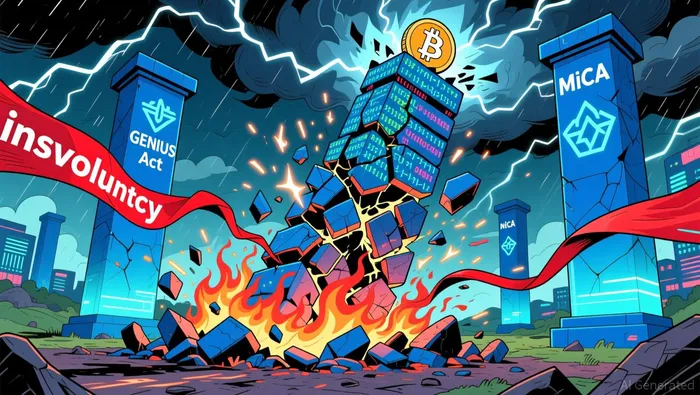 In parallel, the EU's MiCA regime, operationalized in 2025, established a unified regulatory framework for crypto-assets, emphasizing reserve requirements, anti-money laundering (AML) controls, and cross-border operational efficiency. By requiring asset-referenced tokens (ARTs) to maintain fully auditable reserves and undergo third-party audits, MiCA aims to prevent systemic instability while enabling compliant firms to operate across 27 member states with a single license.
Regulatory Convergence and Divergence
While the U.S. and EU share common goals-such as reserve transparency and investor protection-their approaches diverge in execution. The GENIUS Act adopts a modular, innovation-friendly model, allowing state-level regulation for smaller issuers and prohibiting stablecoin reserves from including longer-maturity bonds. In contrast, MiCA's codified taxonomy (electronic money tokens, ARTs, and other crypto-assets) prioritizes harmonization, though it permits national authorities to license e-money token issuers.
Cross-border enforcement actions highlight these differences. For instance, Tether withdrew its USDT from the EU due to MiCA's operational challenges, while Circle aligned its USDCUSDC-- with both MiCA and GENIUS, securing licenses in both jurisdictions. Such cases illustrate the tension between regulatory ambition and market practicality. Meanwhile, international bodies like the Financial Stability Board (FSB) and Financial Action Task Force (FATF) have emphasized the need for consistent standards to prevent arbitrage, with 85 of 117 jurisdictions adopting the Travel Rule for virtual assets by 2025.
Enforcement and Systemic Risk Mitigation
Post-2025 enforcement actions demonstrate the tangible impact of these frameworks. The U.S. Department of Justice shifted priorities under the "Ending Regulation by Prosecution" memo, focusing on conduct harming customers rather than classification disputes. This approach culminated in the guilty plea of Do Kwon, co-founder of Terraform Labs, for wire and securities fraud related to the Terra collapse. Similarly, the EU's MiCA regime has enabled stricter oversight of centralized exchanges, with non-compliant tokens facing de-listing deadlines.
However, challenges remain. The DeFi sector has seen a decline in European activity as traders migrate to jurisdictions with more flexible frameworks, exposing gaps in global regulatory alignment. Additionally, the North Korean hack of Bybit in 2025 highlighted vulnerabilities in unregulated OTC brokers and decentralized exchanges, underscoring the need for real-time information sharing and cross-jurisdictional collaboration.
The Path Forward: Balancing Innovation and Stability
The post-Terra regulatory landscape reflects a delicate balance between fostering innovation and mitigating systemic risk. The GENIUS Act and MiCA have laid the groundwork for a more resilient crypto ecosystem, but their success hinges on international coordination. Initiatives like the Transatlantic Taskforce for Markets of the Future between the U.S. and UK aim to harmonize standards, yet divergences in classification and enforcement persist.
For investors, the implications are clear: jurisdictions with robust regulatory frameworks-such as the U.S., EU, and Singapore-are likely to attract institutional capital, while those with fragmented or lax oversight face reputational and financial risks. As stablecoin market capitalization surpasses $280 billion, with USD-based stablecoins dominating global trading volumes, the need for aligned reserve management and redemption standards becomes ever more critical.
Conclusion
The Terra collapse served as a catalyst for regulatory convergence in the crypto sector, but the journey toward systemic risk mitigation and investor protection is far from complete. While the U.S. and EU have made strides with the GENIUS Act, CLARITY Act, and MiCA, cross-border enforcement gaps and DeFi's regulatory gray areas remain pressing concerns. For investors, the key takeaway is that jurisdictions prioritizing transparency, reserve integrity, and international collaboration will define the next era of digital asset markets.





Comentarios
Aún no hay comentarios