
Systemic Acquisition Mismanagement and Structural Risks in U.S. Shipbuilding: Implications for Defense Investors
Flawed Design Strategies and Sustainment Neglect
The U.S. Navy's shipbuilding programs have consistently failed to integrate sustainment considerations into the acquisition lifecycle, leading to exorbitant long-term costs and operational shortfalls. According to a GAO report, 150 class-wide problems-ranging from unreliable ship systems to inadequate maintenance planning-have emerged due to the Navy's failure to identify, evaluate, or mitigate sustainment risks during design and procurement. The cost to correct just 30% of these issues is estimated at $4.2 billion, a figure that pales in comparison to the $130 billion underestimation of sustainment costs across six major programs. This pattern of underestimation reflects a broader failure to account for the full lifecycle costs of warships, a flaw that has eroded fiscal discipline and strained defense budgets.
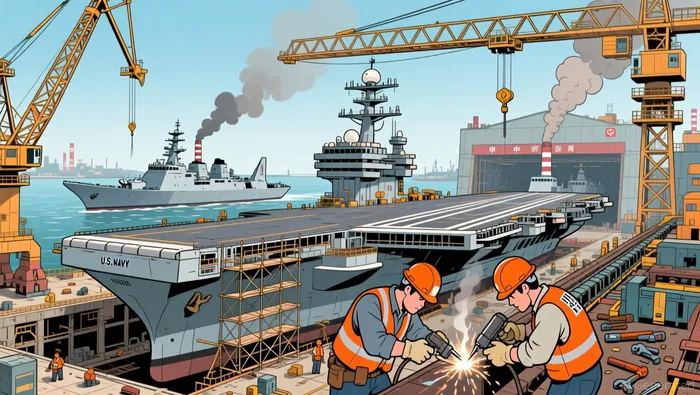
The consequences of these missteps are evident in the operational readiness of the fleet. The Navy's inability to maintain even 300 operational ships-a number dwarfed by China's 370-ship fleet-highlights a strategic vulnerability. Delays in critical programs, such as the Block-IV Virginia Class submarine and Constellation Class frigate, have pushed back timelines by three years, while the USS Enterprise and first Columbia Class submarine are 12–26 months behind schedule. These delays are compounded by quality control issues, including substandard welding practices at Newport News Shipyard, which are under investigation by the Department of Justice according to a Business Standard report.
Operational Inefficiencies and Market Decline
The U.S. shipbuilding industry's decline is further exacerbated by operational inefficiencies. With only 0.13% of the global shipbuilding market share compared to China's 46.59%, the U.S. has ceded strategic ground to a competitor that leverages dual-use civilian and military shipyards to surge production according to a Business Standard analysis. This structural disadvantage is compounded by domestic challenges: supply chain disruptions, rising material costs, labor shortages, and inconsistent defense budgets have created a perfect storm of bottlenecks.
The Navy's maintenance backlog is particularly alarming. As of 2023, 40% of available submarines were awaiting shipyard-level maintenance due to capacity constraints, and public shipyards-critical for depot-level repairs-are in such poor condition that they require substantial investment to remain functional according to a Business Standard report. Private shipyards face their own struggles, with a shortage of skilled labor and post-pandemic labor market volatility further delaying repairs. These inefficiencies have left the Navy 20 years behind in scheduled maintenance, a deficit that directly undermines readiness and increases the risk of operational failures.
Congressional Pushback and Legislative Uncertainty
Congressional responses to these challenges have been mixed, with the National Defense Authorization Act (NDAA) 2024 introducing both reforms and new uncertainties. The Senate-passed version of the bill includes a controversial "right-to-repair" provision, which mandates defense contractors provide the Pentagon with data to operate and sustain military equipment. While this measure aims to reduce long-term maintenance costs and enhance operational independence, defense industry groups argue it could stifle innovation by forcing companies to surrender proprietary software and diagnostic tools. This tension between cost control and innovation highlights the broader legislative struggle to balance fiscal responsibility with industrial competitiveness.
Budgetary discrepancies further complicate the landscape. The Senate's proposed $925 billion fiscal 2026 defense budget exceeds the White House's request by $32 billion, while the House aligns with a $893 billion proposal according to a Politico analysis. These divergences reflect political divisions over acquisition reform and funding priorities, creating uncertainty for defense contractors. Additionally, the NDAA's emphasis on domestic drone production-driven by prohibitions on foreign-sourced technology-is reshaping market dynamics, with investors increasingly favoring firms that align with NDAA-compliant standards according to a Global Newswire report.
Investor Risks and Future Priorities
For investors, the confluence of systemic mismanagement, operational inefficiencies, and legislative uncertainty presents a high-risk environment. Defense contractors face pressure to absorb cost overruns, navigate regulatory shifts, and adapt to a shrinking market share. The Navy's struggles to modernize its fleet-exemplified by its inability to replicate the rapid shipbuilding surges of World War II-underscore the long-term challenges of scaling production in a constrained industrial base.
However, opportunities may emerge for firms that prioritize innovation in sustainment technologies, workforce training, and infrastructure modernization. The NDAA's calls for public and private shipyard investments, while still in early stages, could catalyze a shift toward more resilient supply chains and advanced manufacturing techniques. Investors must also monitor the evolving debate over the "right-to-repair" provision, as its implementation could either reduce contractor margins or spur new business models centered on data-driven maintenance.
Conclusion
The U.S. shipbuilding sector stands at a crossroads, with systemic acquisition mismanagement and operational inefficiencies threatening to erode its strategic and financial viability. While legislative efforts aim to address these challenges, the path forward remains fraught with uncertainty. For defense investors, the key will be to balance short-term risks with long-term opportunities, prioritizing firms that demonstrate agility in navigating a rapidly shifting landscape. As the Navy races to close the gap with China's growing fleet, the stakes for both national security and industrial competitiveness have never been higher.







Comentarios
Aún no hay comentarios