
Syria Eyes Pipeline Lifeline Amid Post-Assad Power Struggle
PorAinvest
martes, 12 de agosto de 2025, 6:26 pm ET2 min de lectura
SANA--
The initiative was discussed during a meeting between Syrian Energy Minister Mohammad Bashir and Iraqi Deputy Prime Minister for Energy and Oil Minister Hayan Abdul Ghani in Baghdad on Tuesday [1]. Bashir highlighted Syria's need for oil imports and proposed linking oil pipelines between the two countries. Abdul Ghani expressed Iraq's interest in reactivating the line and suggested evaluating whether to rehabilitate it or build a new one, citing regional events affecting Iraq’s oil exports.
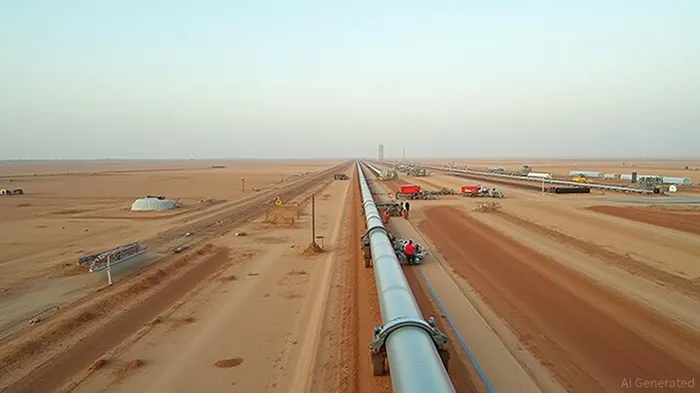
Syrian Deputy Energy Minister Ghiyath Diab noted that pumping stations along the route are largely destroyed and require full rehabilitation. Both sides agreed to form joint technical teams and a main coordination committee, with Diab overseeing the follow-up [1].
The Iraq-Syria-Lebanon oil corridor revival hinges on U.S. sanctions lifted in 2025 and Syria's new U.S.-aligned interim government [2]. Lebanon seeks energy stability via the pipeline, while Iraq aims to diversify exports and counter Turkey's influence. Aging infrastructure requires $1.5B+ in repairs, with Lebanon's 1940s-era Tripoli refinery needing costly modernization [2].
The corridor's revival is inextricably tied to the U.S. decision to revoke the Caesar Act sanctions in 2025, which had previously barred energy transactions through Syria [2]. This policy shift, coupled with Syria's new interim government under Ahmed al-Sharaa, has created a window of opportunity. However, the project's success hinges on more than geopolitics. The pipeline's infrastructure is a patchwork of aging, damaged, and non-operational segments. Syria's civil war left the pipeline's southern stretch in ruins, while Lebanon's Tripoli refinery has been dormant since 1992 [2].
Financial hurdles are staggering. Lebanon's current oil consumption stands at 100,000 barrels per day, far exceeding the Tripoli refinery's 21,000-barrel capacity. To meet demand, the refinery would need a complete overhaul, potentially expanding to 70,000 barrels per day—a costly endeavor with uncertain returns. Meanwhile, the pipeline's Syrian segment, ravaged by conflict, would require billions in rehabilitation [2].
Iraq's political landscape adds another layer of complexity. While unverified documents suggest plans for a 70,000-barrel-per-day refinery in Tripoli, the government has denied involvement. Opposition figures have criticized the project as a distraction from domestic energy needs, and Iraqi oil experts warn of the “costly mistake” of reviving an aging pipeline [2].
Despite these challenges, the corridor's strategic value cannot be ignored. For Iraq, it offers an alternative to the Kirkuk–Ceyhan pipeline, which has been inactive since 2023 due to legal disputes with Turkey. For Lebanon, it could reduce dependence on volatile Gulf imports and stabilize energy costs. And for Syria, it represents a step toward economic normalization and regional integration [2].
The project aligns with broader trends in energy diversification. As global markets shift toward renewable energy, the Middle East's hydrocarbon infrastructure must adapt to remain relevant. The corridor's revival could serve as a test case for hybrid energy systems, integrating oil exports with emerging solar and wind projects in the region [2].
For investors, the corridor presents a high-risk, high-reward scenario. Key considerations include geopolitical stability, infrastructure costs, and energy market dynamics [2]. The coming months will reveal whether this corridor is a bridge to the future or a relic of the past.
References:
[1] https://sana.sy/en/?p=368343
[2] https://www.ainvest.com/news/resurgence-iraq-syria-lebanon-oil-corridor-strategic-energy-play-shifting-middle-east-2508/
Syria's caretaker government is seeking to revive the Kirkuk-Baniyas oil pipeline with Iraq, a strategic corridor that could move up to 300,000 barrels per day. The proposal aims to restore Syria's position as a regional energy hub, reduce reliance on costly maritime imports, and offer Baghdad an alternative export outlet to Europe. The revival could weaken Ankara's leverage over Iraqi exports, reshape Mediterranean energy flows, and heighten tensions with the Kurdistan Regional Government (KRG) over disputed fields.
Syria's caretaker government is seeking to revive the Kirkuk-Baniyas oil pipeline with Iraq, a strategic corridor that could move up to 300,000 barrels per day. The proposal aims to restore Syria's position as a regional energy hub, reduce reliance on costly maritime imports, and offer Baghdad an alternative export outlet to Europe. The revival could weaken Ankara's leverage over Iraqi exports, reshape Mediterranean energy flows, and heighten tensions with the Kurdistan Regional Government (KRG) over disputed fields.The initiative was discussed during a meeting between Syrian Energy Minister Mohammad Bashir and Iraqi Deputy Prime Minister for Energy and Oil Minister Hayan Abdul Ghani in Baghdad on Tuesday [1]. Bashir highlighted Syria's need for oil imports and proposed linking oil pipelines between the two countries. Abdul Ghani expressed Iraq's interest in reactivating the line and suggested evaluating whether to rehabilitate it or build a new one, citing regional events affecting Iraq’s oil exports.
Syrian Deputy Energy Minister Ghiyath Diab noted that pumping stations along the route are largely destroyed and require full rehabilitation. Both sides agreed to form joint technical teams and a main coordination committee, with Diab overseeing the follow-up [1].
The Iraq-Syria-Lebanon oil corridor revival hinges on U.S. sanctions lifted in 2025 and Syria's new U.S.-aligned interim government [2]. Lebanon seeks energy stability via the pipeline, while Iraq aims to diversify exports and counter Turkey's influence. Aging infrastructure requires $1.5B+ in repairs, with Lebanon's 1940s-era Tripoli refinery needing costly modernization [2].
The corridor's revival is inextricably tied to the U.S. decision to revoke the Caesar Act sanctions in 2025, which had previously barred energy transactions through Syria [2]. This policy shift, coupled with Syria's new interim government under Ahmed al-Sharaa, has created a window of opportunity. However, the project's success hinges on more than geopolitics. The pipeline's infrastructure is a patchwork of aging, damaged, and non-operational segments. Syria's civil war left the pipeline's southern stretch in ruins, while Lebanon's Tripoli refinery has been dormant since 1992 [2].
Financial hurdles are staggering. Lebanon's current oil consumption stands at 100,000 barrels per day, far exceeding the Tripoli refinery's 21,000-barrel capacity. To meet demand, the refinery would need a complete overhaul, potentially expanding to 70,000 barrels per day—a costly endeavor with uncertain returns. Meanwhile, the pipeline's Syrian segment, ravaged by conflict, would require billions in rehabilitation [2].
Iraq's political landscape adds another layer of complexity. While unverified documents suggest plans for a 70,000-barrel-per-day refinery in Tripoli, the government has denied involvement. Opposition figures have criticized the project as a distraction from domestic energy needs, and Iraqi oil experts warn of the “costly mistake” of reviving an aging pipeline [2].
Despite these challenges, the corridor's strategic value cannot be ignored. For Iraq, it offers an alternative to the Kirkuk–Ceyhan pipeline, which has been inactive since 2023 due to legal disputes with Turkey. For Lebanon, it could reduce dependence on volatile Gulf imports and stabilize energy costs. And for Syria, it represents a step toward economic normalization and regional integration [2].
The project aligns with broader trends in energy diversification. As global markets shift toward renewable energy, the Middle East's hydrocarbon infrastructure must adapt to remain relevant. The corridor's revival could serve as a test case for hybrid energy systems, integrating oil exports with emerging solar and wind projects in the region [2].
For investors, the corridor presents a high-risk, high-reward scenario. Key considerations include geopolitical stability, infrastructure costs, and energy market dynamics [2]. The coming months will reveal whether this corridor is a bridge to the future or a relic of the past.
References:
[1] https://sana.sy/en/?p=368343
[2] https://www.ainvest.com/news/resurgence-iraq-syria-lebanon-oil-corridor-strategic-energy-play-shifting-middle-east-2508/
Divulgación editorial y transparencia de la IA: Ainvest News utiliza tecnología avanzada de Modelos de Lenguaje Largo (LLM) para sintetizar y analizar datos de mercado en tiempo real. Para garantizar los más altos estándares de integridad, cada artículo se somete a un riguroso proceso de verificación con participación humana.
Mientras la IA asiste en el procesamiento de datos y la redacción inicial, un miembro editorial profesional de Ainvest revisa, verifica y aprueba de forma independiente todo el contenido para garantizar su precisión y cumplimiento con los estándares editoriales de Ainvest Fintech Inc. Esta supervisión humana está diseñada para mitigar las alucinaciones de la IA y garantizar el contexto financiero.
Advertencia sobre inversiones: Este contenido se proporciona únicamente con fines informativos y no constituye asesoramiento profesional de inversión, legal o financiero. Los mercados conllevan riesgos inherentes. Se recomienda a los usuarios que realicen una investigación independiente o consulten a un asesor financiero certificado antes de tomar cualquier decisión. Ainvest Fintech Inc. se exime de toda responsabilidad por las acciones tomadas con base en esta información. ¿Encontró un error? Reportar un problema


SOBRE NOSOTROS
Nuestra historiaAutores de noticiasBase de conocimientosPolítica de privacidadTérmino de usoDescargo de responsabilidad de corretaje de tercerosTérminos de uso de AIMEDivulgaciones de riesgos de AInvest AICarrerasCONTÁCTENOS
Email: support@ainvest.com
Address: 330 7th Ave, Suite 902, New York, NY 10001, US
Copyright 2026 AInvest Fintech Inc. All rights reserved.


Comentarios
Aún no hay comentarios