
Synthetix's Return to Ethereum Mainnet and the Future of Perpetual DEXs
The DeFi derivatives landscape is on the cusp of a strategic inflection point, driven by Synthetix's return to EthereumETH-- Mainnet. After three years of operating on Layer 2 solutions, the protocol is set to launch its canonical perpetual derivatives decentralized exchange (DEX) on December 17, 2025, leveraging Ethereum's post-Merge and EIP-4844 upgrades to overcome prior limitations in scalability and liquidity. This move not only repositions SynthetixSNX-- as a core DeFi infrastructure asset but also signals a broader shift in the industry toward Ethereum's reinvigorated capabilities.
Strategic Rationale: Ethereum's Reemergence as a High-Performance Chain
Synthetix's decision to return to Ethereum Mainnet is rooted in the network's technical advancements. The Merge, which transitioned Ethereum to a proof-of-stake model, and EIP-4844, which introduces proto-accounts and reduced gas costs, have collectively transformed the blockchain into a viable platform for high-throughput financial applications according to industry analysis. These upgrades address the latency and cost issues that previously constrained on-chain derivatives trading, enabling Synthetix to deploy a hybrid system combining off-chain order matching with on-chain settlements. This architecture allows for sub-second trade execution while maintaining the security and composability of Ethereum's ecosystem as reported in official documentation.
The strategic implications are profound. By anchoring its DEX to Ethereum, Synthetix taps into the network's unparalleled liquidity pools and developer ecosystem, creating a flywheel effect that could attract both retail and institutional participants. Founder Kain Warwick has explicitly framed this as a "vote of confidence" in Ethereum's infrastructure, suggesting that other perpetual exchanges may follow suit according to industry analysis.
Market Impact and SNX's Reemergence as a Core Infrastructure Token
Synthetix Network Token (SNX) is central to this narrative. As the primary collateral for minting synthetic assets and participating in governance, SNX's utility is being amplified by the DEX launch. The platform's initial offering of BitcoinBTC-- (BTC), Ethereum (ETH), and SolanaSOL-- (SOL) derivatives with up to 50X leverage will require significant staking of SNXSNX-- to secure the system, directly increasing demand for the token as reported by market analysts.
Market reactions have already validated this thesis. Over the past 30 days, SNX surged 190%, driven by anticipation of the DEX launch and a $1 million trading competition designed to drive liquidity. On-chain activity spiked, with 975 new wallets created in a single day and 229 large whale transfers exceeding $100,000 according to on-chain data. While the token has since corrected 19% from its peak, analysts view this as a healthy consolidation phase, with long-term fundamentals intact as reported by market research.
The Synthetix Liquidity Provider (SLP) model further underscores SNX's evolving role. 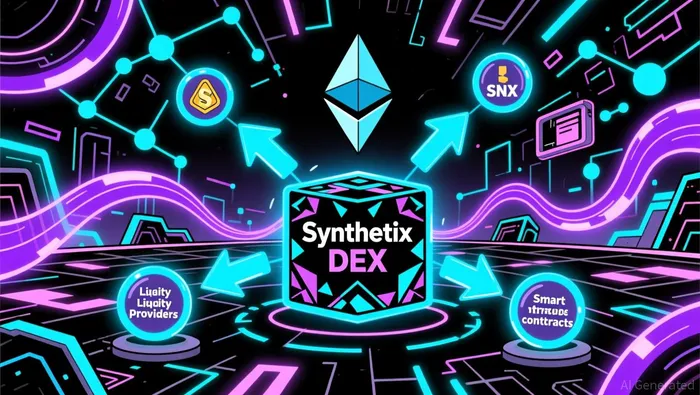 Initially restricted to a whitelist, SLPs will enable users to earn yield by providing liquidity to the DEX, with rewards denominated in sUSD—a stablecoin integral to the ecosystem. This creates a self-reinforcing cycle: increased sUSD usage strengthens its peg, while higher SNX staking deepens the protocol's security as detailed in official documentation.
Competitive Differentiation and the Perpetual DEX Wars
Synthetix's hybrid model positions it as a formidable player in the "perpetual DEX wars," a competitive landscape dominated by platforms like Hyperliquid and AsterASTER--. Unlike traditional centralized exchanges, Synthetix's DEX eliminates custodial risks and settlement fees, while its off-chain order books ensure speed comparable to centralized counterparts according to platform analysis. This technical edge is critical in an industry where user experience and cost efficiency are paramount.
Moreover, Synthetix's return to Ethereum Mainnet aligns with broader trends in DeFi infrastructure. The protocol's focus on composability—allowing its derivatives to be integrated with other Ethereum-native protocols—creates a network effect that centralized platforms cannot replicate. As reported by Longbridge, this interoperability could catalyze the next phase of DeFi innovation, where derivatives become foundational building blocks for yield strategies, hedging tools, and synthetic asset issuance.
Future Outlook: Sustaining Growth and Expanding Utility
The December 2025 trading competition, offering over $1 million in prizes, will serve as a stress test for the platform's scalability and user retention. Success here could accelerate adoption, particularly as Synthetix plans to expand its market offerings and refine staking mechanisms as detailed in price analysis. For SNX, the key metrics to monitor will be the ratio of staked tokens to total supply and the velocity of sUSD within the ecosystem.
Long-term, Synthetix's reintegration with Ethereum Mainnet could redefine the role of infrastructure tokens in DeFi. By combining high leverage, low fees, and Ethereum's composability, the protocol is positioning SNX not just as a governance token but as a critical asset in the decentralized financial system.
Conclusion
Synthetix's return to Ethereum Mainnet represents more than a technical upgrade—it is a strategic pivot that aligns with Ethereum's renaissance and the maturation of DeFi derivatives. For investors, the confluence of SNX's enhanced utility, the DEX's competitive differentiation, and Ethereum's infrastructure improvements presents a compelling case for long-term value creation. As the December 17 launch approaches, the market will likely continue to price in the protocol's potential to reshape the perpetual trading landscape.






Comentarios
Aún no hay comentarios