
Syntheia's Strategic Move into SATCOM: Assessing the Investment Implications of Vertical Integration in the Satellite Communications Sector
The satellite communications (SATCOM) sector is undergoing a seismic shift in 2025, driven by technological innovation and strategic consolidation. Syntheia Corp., an early-stage artificial intelligence (AI) technology company, has positioned itself at the forefront of this transformation through a series of aggressive vertical integration moves. By acquiring key assets, forming strategic partnerships, and raising capital to fund its ambitions, Syntheia aims to leverage the growing demand for AI-powered SATCOM solutions. However, the path to profitability in this high-stakes sector is fraught with risks, from capital intensity to cybersecurity vulnerabilities. This analysis evaluates Syntheia's strategy through the lens of industry trends, financial commitments, and market dynamics to determine its investment viability.
Strategic Rationale: Vertical Integration in SATCOM
Vertical integration has emerged as a critical strategy for satellite operators seeking to reduce costs, accelerate deployment, and capture end-to-end value. According to a report by , the 2025 SATCOM landscape is defined by companies that control multiple stages of the supply chain, from manufacturing to service delivery. Syntheia's recent acquisitions and partnerships exemplify this trend. In July 2025, the company finalized the acquisition of Call Center Guys Inc. (CCG), a move designed to bolster its AI-powered communications platform. By October 2025, Syntheia and Turnium launched a commercial rollout of an AI-driven platform across their partner network, signaling a deeper commitment to integrating customer engagement solutions.
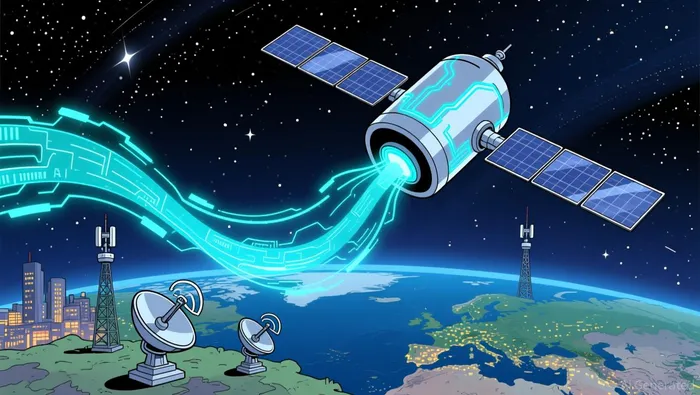 The most significant step, however, came in January 2026, when Syntheia signed a non-binding letter of intent to acquire SATCOM capabilities through Wunderlich. This acquisition, valued at $5.5 million with an additional $4.5 million performance-based earn-out, underscores Syntheia's ambition to vertically integrate its operations and expand into satellite communications. The move aligns with broader industry shifts, as companies like China's state-backed players demonstrate the advantages of vertically integrated ecosystems, including faster iteration and reduced production costs according to industry analysis.
Financial Commitments and Capital Raising
Syntheia's aggressive expansion has required substantial capital. To fund its strategic initiatives, the company has raised $1.46 million through private placements in 2025, including a $709,677.48 tranche issued at $0.12 per unit. These funds have been used to settle $590,768.28 of indebtedness and support working capital needs. Additionally, Syntheia has issued warrants exercisable at $0.16 per share until October 2030, creating a potential upside for investors if the stock price appreciates.
While these fundraising efforts demonstrate Syntheia's ability to attract capital, they also highlight the company's reliance on equity dilution. For instance, the $590,768.28 debt settlement was achieved by issuing 4,923,069 common shares, a move that could dilute existing shareholders. This pattern of equity financing raises questions about long-term shareholder value, particularly in a sector where capital expenditures are notoriously high.
Market Potential and Competitive Positioning
The SATCOM market is projected to grow to $65 billion by 2030, driven by demand for low Earth orbit (LEO) constellations, satellite IoT, and "as-a-service" models. Syntheia's focus on AI-powered solutions positions it to capitalize on this growth, particularly in niche segments like customer engagement and automated service delivery. The company's AssistantNLP platform, which achieved 10,000 subscribers ahead of schedule, suggests a viable product-market fit in AI-driven communications.
However, Syntheia faces stiff competition from established players and well-funded startups. The industry's shift toward modular, commercial-off-the-shelf hardware and standardized satellite buses means that Syntheia must differentiate itself through innovation rather than scale. Its partnership with Turnium and acquisition of CCG provide a foundation for this differentiation, but the success of its SATCOM ambitions will depend on the integration of these assets and the performance of its AI platform.
Investment Risks: Capital Intensity and Cybersecurity Challenges
Vertical integration in SATCOM is inherently capital-intensive. Syntheia's $5.5 million acquisition of Wunderlich, coupled with the need for additional working capital, exposes the company to liquidity risks. According to industry analysis, satellite operators must navigate high upfront costs and long-term government contracts to ensure sustainability. Syntheia's reliance on private placements and equity financing increases its vulnerability to market volatility, particularly if investor sentiment shifts or regulatory hurdles delay its SATCOM acquisition.
Cybersecurity is another critical risk. A study published in highlights vulnerabilities in SATCOM user segments, including modems and ground infrastructure. These risks are amplified by the EU's NIS2 Directive, which imposes stringent cybersecurity standards on critical infrastructure. Syntheia's AI-powered platform, while innovative, could become a target for cyberattacks if robust safeguards are not implemented.
Conclusion: Balancing Opportunity and Risk
Syntheia's strategic moves into SATCOM reflect a bold bet on vertical integration and AI-driven innovation. The company's ability to raise capital and execute acquisitions demonstrates its agility, but its long-term success hinges on navigating significant challenges. Investors must weigh the sector's growth potential against Syntheia's financial risks, including dilution, integration complexities, and cybersecurity threats. While the SATCOM market offers a compelling long-term outlook, Syntheia's speculative profile makes it a high-risk, high-reward investment. For those willing to tolerate volatility, the company's alignment with industry trends and early traction in AI could justify the risk.







Comentarios
Aún no hay comentarios