
Synchrony Financial (SYF): Assessing Valuation Fundamentals Amid Strong Stock Performance
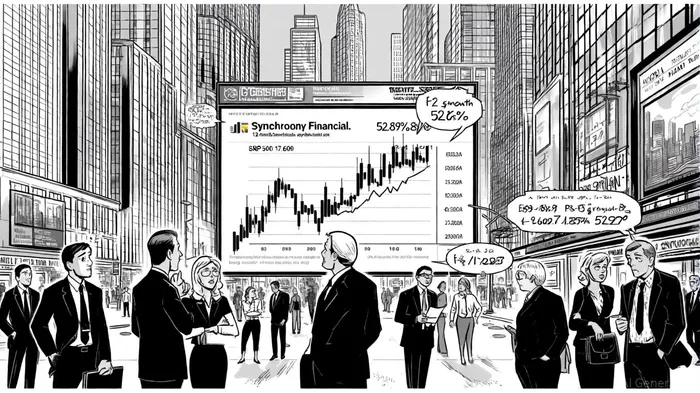
Synchrony Financial (SYF) has delivered a remarkable 12-month stock price return of 52.82% as of September 2025, significantly outperforming the S&P 500's 17.69% total return over the same period[3]. This surge has sparked debate among investors: is SYF's valuation now misaligned with its fundamentals, or does the rally reflect a justified re-rating of its value? A deep dive into the company's financial performance, valuation multiples, and industry positioning provides clarity.
Financial Performance: Earnings Growth Outpaces Revenue
SYF's 2024 financial results underscore robust earnings momentum. The company reported a diluted EPS of $8.23 for the year, a 64.74% increase from $5.00 in 2023[3]. This growth was driven by a 29% year-over-year rise in net earnings during Q3 2025, fueled by a 9.8% increase in net revenue to $3.814 billion[4]. However, total revenue for 2024 edged down slightly to $16.05 billion from $16.13 billion in 2023[1], indicating margin pressures or market saturation in its core consumer finance and retail banking segments.
The efficiency ratio of 30.00%[2] highlights SYF's operational discipline, but the net interest margin (NIM) contracted by 32 basis points to 15.04% in Q3 2025[4], reflecting higher interest expenses. This margin compression, coupled with a 4% decline in purchase volume to $45 billion[4], raises questions about the sustainability of earnings growth in a high-interest-rate environment.
Valuation Multiples: A Discount to Peers
SYF's current trailing P/E ratio of 9.31[5] is 18.6% above its 12-month average of 7.85[5], suggesting investor optimism about future earnings. Yet, this multiple remains significantly below the Financial Services sector average of 14.36[5], indicating SYFSYF-- is trading at a 37% discount to its peers. Similarly, its price-to-book (P/B) ratio of 1.81[6] lags behind the US Consumer Finance industry average of 3.80[7], further underscoring its undervaluation relative to sector norms.
This valuation gapGAP-- appears misaligned with SYF's fundamentals. For instance, its forward P/E of 9.89[5] is even lower than the sector median of 13.12[5], implying the market may be underappreciating its capital returns and balance sheet strength. SYF's debt-to-equity ratio of 0.94[8]—derived from $16.009 billion in long-term debt and $16.952 billion in stockholders' equity[8]—is conservative for a financial institution, particularly given its history of returning capital to shareholders (e.g., $399 million in Q3 2025 through buybacks and dividends[4]).
Fundamentals vs. Market Sentiment
While SYF's valuation multiples suggest it is attractively priced, its financial performance has mixed signals. The company's ability to grow EPS by 64.74% in 2024[3] and maintain a low efficiency ratio[2] demonstrates operational excellence. However, the slight revenue decline and NIM contraction[4] highlight vulnerabilities in a rate-sensitive business model.
Analysts remain cautiously optimistic, with a consensus price target of $73.79[9] (a -3.62% downside from the $76.56 closing price as of September 2025[9]). This “Moderate Buy” rating[9], supported by 12 buy and 8 hold recommendations, reflects confidence in SYF's long-term prospects but acknowledges near-term headwinds.
Conclusion: A Value Opportunity with Caveats
SYF's valuation appears to offer compelling long-term value for investors willing to navigate short-term uncertainties. Its P/E and P/B ratios are meaningfully below industry averages[5][7], while its earnings growth and capital returns[4] justify a re-rating. However, risks such as margin compression, revenue stagnation, and interest rate volatility warrant careful monitoring. For investors seeking a fundamentally sound, undervalued financial play, SYF presents an intriguing case—provided macroeconomic conditions stabilize and the company sustains its operational momentum.





Comentarios
Aún no hay comentarios