
Sylvania Platinum Limited: Navigating Valuation Risks Amid a Volatile Market
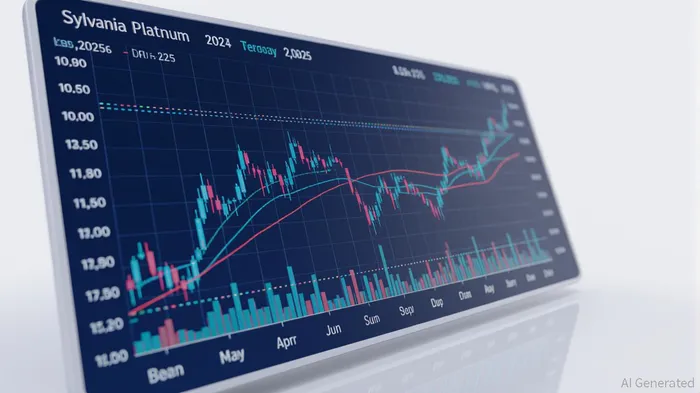
Sylvania Platinum Limited (LON:SLP) has experienced a 8.1% surge in its share price over the past three months, driven by a combination of strong operational performance and favorable platinum market dynamics. However, beneath the surface, several red flags suggest that this rally may not be sustainable—and that a correction could be imminent. For shareholders, the key question is whether to hold, hedge, or exit.
Operational Gains vs. Structural Weaknesses
Sylvania's FY2025 results were undeniably robust. The company reported record production of 81,002 4E PGM ounces, with net revenue rising to $104.2 million and net profit surging 146% year-over-year to $20.2 million [1]. These figures were bolstered by a 13% increase in the average 4E gross basket price to $1,507/oz, reflecting a tightening platinum market. A structural deficit of 966,000 ounces in 2025—driven by declining South African output and surging investment demand—has pushed platinum prices to an 11-year high of $1,454.50/oz [2].
Yet, these gains mask deeper vulnerabilities. Sylvania's capital expenditure of $32.3 million in FY2025—largely directed toward the Thaba Joint Venture (JV)—has strained liquidity, reducing cash reserves from $97.8 million in FY2024 to $60.9 million [1]. While the Thaba JV is expected to ramp up to steady-state production by Q3 2026, delays or underperformance could exacerbate cash flow pressures. Moreover, the company's non-cash impairment charge of $77.2 million in Q3 2025—linked to prior acquisitions—highlighted asset valuation risks [3].
Valuation Risks: A House of Cards?
The 8.1% share price rise since June 2025 appears disconnected from fundamentals. As of September 9, 2025, SLPSLP-- trades at 77.60p, up from 58.8p at the end of FY2025 [4]. Analysts have upgraded price targets, with one firm raising its target to 124.44p—a 59% upside. However, this optimism clashes with technical and valuation indicators.
Sylvania's trailing P/E ratio of 546.43 is astronomically high, even for a commodity play [5]. Worse, its dividend payout ratio of 11,428.57%—implying the company is paying out far more in dividends than it earns—is unsustainable [5]. While the 2.75p annual dividend and $1.0 million share buyback program signal shareholder-friendly policies, they also raise questions about capital allocation discipline.
Technical indicators further cloud the outlook. The stock has dipped below its 200-day moving average of 80.94p, a bearish signal often associated with distribution phases [5]. Meanwhile, platinum prices, though elevated, face headwinds. A 90-day pause on U.S. tariffs provided a short-term boost, but long-term demand hinges on the uncertain shift back to internal combustion engines—a reversal of EV adoption trends [2].
Shareholder Preparedness: Hedging the Bet
For investors, the path forward depends on risk tolerance. Those bullish on platinum's structural deficit might justify holding SLP, given its strong production growth and debt-free balance sheet. However, the following risks warrant caution:
1. Platinum Price Volatility: A sudden drop in prices—triggered by oversupply or a slowdown in investment demand—could erode margins.
2. Thaba JV Delays: If the project misses production targets, cash flow could deteriorate, forcing the company to cut dividends or raise capital at unfavorable terms.
3. Valuation Mismatch: The current P/E ratio suggests the market is pricing in perpetual growth, which is unlikely given Sylvania's operational challenges.
A bearish scenario would see SLP's share price correcting to align with its fundamentals. If platinum prices retreat to $1,000/oz and the company's EBITDA margins compress, the stock could fall to 50–60p. Shareholders should consider hedging via options or reducing exposure until the Thaba JV delivers tangible results.
Conclusion
Sylvania Platinum's recent rally is a classic case of momentum trading—leveraging a favorable platinum market and strong production numbers to drive sentiment. However, the company's valuation metrics, unsustainable dividend, and operational risks paint a cautionary picture. While the Thaba JV offers long-term potential, near-term investors must grapple with the reality that this stock is overbought and vulnerable to a correction. In a bearish scenario, preparedness—through hedging or selective exits—will be key to preserving capital.







Comentarios
Aún no hay comentarios