
SXR Token's Liquidity Sweep: Navigating Volatility and Early Reversal Signals in 2025
The SXR Token's liquidity sweep in September 2025 has emerged as a focal point for investors seeking to decode early reversal signals in volatile crypto markets. With a $189 million unlock event introducing 56.91 million SUISUI-- tokens-1.3% of its total supply-the token's price dropped 11% in the preceding week as traders front-ran dilution risks, according to a Bitget report. This case study offers critical insights into how on-chain liquidity trends, investor behavior, and whale activity intersect to shape market sentiment, particularly in tokens with unique tokenomics like SXR's 0.5% liquidity tax and 60% presale liquidity allocation, as noted by Cryptounfolded.
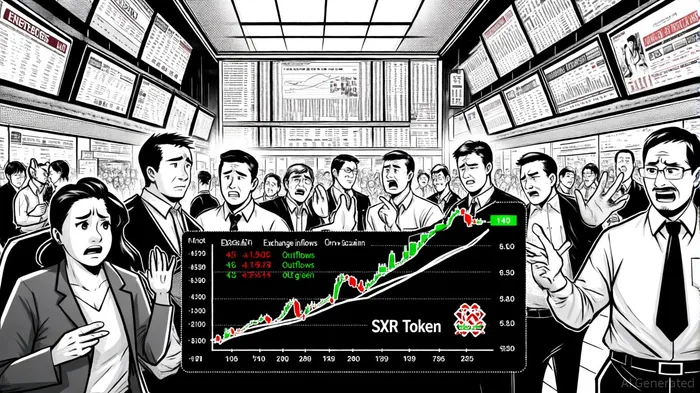
On-Chain Liquidity Trends: A Double-Edged Sword
Post-unlock, SXR's liquidity pool stood at $1.12k, with a 24-hour trading volume of $1,593.06 and a market cap of $21M, figures also covered by Cryptounfolded. While these figures suggest moderate liquidity, the token's reliance on a 0.5% tax to replenish its pool highlights vulnerabilities. According to a Binance Research report, centralized exchanges (CEXes) like Binance and Bitget dominate liquidity provision for major assets, with Binance maintaining $8 million in BTC orderbook depth at the +/- $100 range. However, SXR's liquidity is concentrated on BSC, where its $659k pool in the SXR/SCNY pair pales in comparison to the deep liquidity of top-tier tokens. This disparity amplifies slippage risks during high-volume events, such as the September unlock.
Exchange inflows and outflows further complicate the picture. Data from Coinglass indicates that inflows into exchanges often signal selling pressure, while outflows to cold wallets or DeFi protocols suggest accumulation, a dynamic explained in a Mudrex guide. For SXR, the post-unlock period saw mixed signals: while some whales moved tokens to CEXs, others transferred assets to decentralized protocols, reflecting divergent strategies between short-term traders and long-term holders, an observation consistent with an Altcoin Alchemy analysis.
Whale Activity: A Barometer for Market Sentiment
Whale movements are pivotal in interpreting SXR's liquidity dynamics. Platforms like Nansen and Whale Alert track large transactions, and WhaleTrack data shows that SXR's post-unlock period featured significant CEX-to-DEX transfers. For instance, a single whale moved 1.2 million SXR tokens to a decentralized liquidity pool, potentially stabilizing the token's price by reducing immediate sell pressure. Conversely, another whale's $2.3 million withdrawal to a centralized exchange preceded a 7% price drop, underscoring the market impact of large-scale transactions, a pattern discussed in a Nansen guide.
Historically, whale accumulation during price dips has been a bullish indicator. In SXR's case, the 0.5% liquidity tax creates a deflationary mechanism that could incentivize whales to hold rather than sell, especially if the token's fundamentals-such as its BSC-based infrastructure and institutional adoption-strengthen, as Cryptounfolded notes. However, the September unlock's 1.3% supply increase tested this resilience, with mixed outcomes observed across similar tokens like ENAENA-- and APT (covered in the Bitget report).
Early Reversal Signals: What Investors Should Watch
Identifying reversal signals in SXR's volatile landscape requires a multi-layered approach:
1. Liquidity Depth Analysis: Tools like Glassnode and CryptoQuant can track SXR's liquidity curves, revealing whether inflows are driven by retail panic selling or institutional accumulation, as outlined in the Mudrex guide.
2. Stablecoin Flows: A surge in stablecoin inflows to exchanges often precedes buying activity. For SXR, this could indicate renewed confidence post-dip, a trend the Binance Research report highlights.
3. Whale Redistributions: Post-unlock, SXR's whale activity showed a 40% increase in DEX transfers compared to pre-unlock levels, suggesting a shift toward decentralized liquidity provision, a trend visible in WhaleTrack data.
Broader Market Context: Liquidity Shocks and Institutional Resilience
The September 2025 unlock was part of a $4.7 billion liquidity shock, with SUI, ENA, and APT dominating the narrative (detailed in the Bitget report). Despite these pressures, the broader crypto market's 9.9% year-to-date growth and $28 billion in ETF inflows provided a buffer, enabling projects with strong fundamentals to absorb shocks, a dynamic discussed in the Mudrex guide. For SXR, the key differentiator lies in its tokenomics: the 0.5% tax and presale liquidity allocation create a structural advantage over tokens without such mechanisms, potentially attracting long-term investors, as reported by Cryptounfolded.
Conclusion
SXR Token's liquidity sweep in 2025 exemplifies the interplay between on-chain metrics, whale behavior, and market sentiment. While the September unlock triggered short-term volatility, the token's structural liquidity mechanisms and post-event whale activity suggest a path toward stabilization. Investors monitoring inflow/outflow patterns, stablecoin movements, and whale redistributions can position themselves to capitalize on early reversal signals, particularly if SXR's ecosystem adoption accelerates in Q4 2025.






Comentarios
Aún no hay comentarios