
Switzerland’s Tariff Crisis and Its Implications for Global Export-Driven Markets
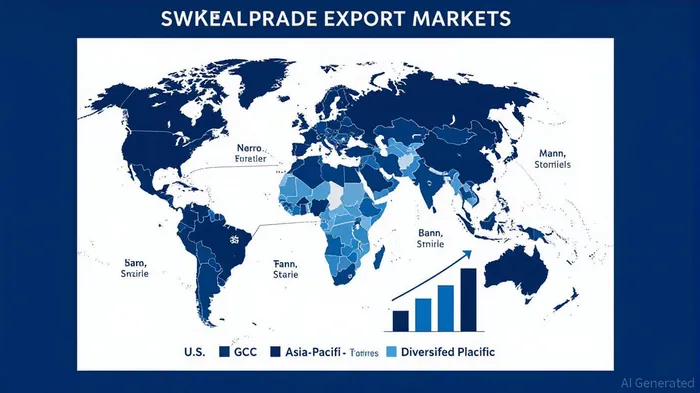
The imposition of a 39% U.S. tariff on Swiss goods in August 2025 has sent shockwaves through global trade, exposing vulnerabilities in export-driven economies and reshaping investment landscapes. This steep tariff—among the highest in modern trade history—targets nearly two-thirds of Swiss exports to the U.S., a market accounting for 13% of Switzerland’s total exports in 2024 [1]. The luxury watch industry, a cornerstone of Swiss manufacturing, has been particularly hard hit, with brands already adjusting pricing and inventory strategies to offset the financial blow [2]. For investors, this crisis underscores the need for strategic risk assessment and diversification in an era of escalating trade tensions.
Strategic Risk Assessment: Volatility in Export-Driven Economies
Switzerland’s economic model, built on high-value exports and a strong currency, is now under strain. The Swiss National Bank has warned that gold demand—a category accounting for 27% of Swiss exports in 2024—may distort trade data, masking the true impact of tariffs on sectors like pharmaceuticals and machinery [3]. Meanwhile, the Trump administration’s rationale for the tariffs—citing “currency manipulation” and trade imbalances—has created a precedent for retaliatory measures, further destabilizing global supply chains [4].
The ripple effects extend beyond Switzerland. As the average U.S. tariff rate climbed to 22.5% in 2025—the highest since 1909—export-dependent economies worldwide face heightened uncertainty [5]. For instance, the GCC’s non-oil sectors, while resilient to U.S. tariffs due to limited export exposure (3% of GCC goods to the U.S.), are still navigating a complex web of global trade shifts [6]. This volatility demands a recalibration of investment strategies, prioritizing sectors and regions less susceptible to geopolitical shocks.
Diversification Opportunities: Beyond the U.S. and Gold
Switzerland’s response to the tariff crisis offers a blueprint for adaptive diversification. The country has accelerated trade partnerships with the Gulf Cooperation Council (GCC) via Bilateral Investment Treaties, leveraging its pharmaceutical and precision manufacturing expertise [7]. This alignment with GCC growth—projected at 4.4% in 2025—highlights opportunities in energy-neutral sectors like logistics and technology [8].
For investors, the Swiss real estate market presents a compelling case. Listed real estate investment trusts (REITs), particularly in logistics and residential properties across the Asia-Pacific, have outperformed traditional office assets, offering a hedge against U.S. market risks [9]. Similarly, Swiss mid-cap equities—backed by robust balance sheets and earnings growth—remain attractive, especially in pharmaceuticals and advanced manufacturing [10].
The GCC’s strategic pivot toward AI and innovation further broadens the horizon. With Saudi Arabia and the UAE classified as “AI rising contenders,” technology-driven investments in these markets could yield long-term gains [11]. Additionally, the Swiss financial sector’s resilience—evidenced by EFG International’s record net new assets in 2025—signals confidence in wealth management and cross-border services [12].
Conclusion: Navigating the New Trade Reality
The Swiss tariff crisis is a microcosm of broader global trade dynamics. As policymakers grapple with protectionist pressures, investors must prioritize flexibility and foresight. Diversifying into sectors like GCC-linked logistics, Swiss mid-cap equities, and AI-driven markets offers a buffer against export-driven volatility. However, success hinges on continuous monitoring of trade policy shifts and a willingness to pivot capital toward emerging opportunities.
In this climate, the mantra for investors is clear: diversify not just geographically, but strategically—aligning portfolios with the resilience of innovation and the stability of diversified trade networks.
Source:
[1] US tariffs on Switzerland take effect [https://www.linkedin.com/pulse/us-tariffs-switzerland-take-effect-lombard-odier-hxeye]
[2] 39% U.S. Tariff on Swiss Watches Sends Shockwaves [https://www.getbezel.com/post/us-tariffs-swiss-luxury-watches]
[3] SNB paper warns against interpreting Swiss export data because of gold demand [https://energynews.oedigital.com/mining/2025/04/08/snb-paper-warns-against-interpreting-swiss-export-data-because-of-gold-demand]
[4] Switzerland will face one of the steepest Trump tariffs, at 39% [https://www.mainepublic.org/2025-08-04/switzerland-will-face-one-of-the-steepest-trump-tariffs-at-39]
[5] Where We Stand: The Fiscal, Economic ... - Yale Budget Lab [https://budgetlab.yale.edu/research/where-we-stand-fiscal-economic-and-distributional-effects-all-us-tariffs-enacted-2025-through-april]
[6] Economic Update: Middle East [https://www.icaew.com/technical/economy/business-confidence-monitor/middle-east]
[7] GCC AND SWISS ECONOMIC OUTLOOK 2024 [https://shortlink.grc.net/gcc-and-swiss-economic-outlook/]
[8] Analysis of the international stock market situation (2025) [https://isdo.ch/analysis-of-the-international-stock-market-situation-summer-2025/]
[9] 2025 Swiss and international real estate outlook [https://macrorealestate.com/2024/10/20/2025-real-estate-outlook-for-switzerland-and-internationally-the-sun-is-shining-again/?lang=en]
[10] Switzerland: 2025 Economic Outlook [https://www.juliusbaer.com/en/insights/market-insights/market-outlook/switzerland-2025-economic-outlook/]
[11] Economic Update: Middle East [https://www.icaew.com/technical/economy/business-confidence-monitor/middle-east]
[12] Record profit of CHF 221.2 million and NNA of ... [https://www.efginternational.com/us/media/2025/record_profit_of_chf_221_million.html]







Comentarios
Aún no hay comentarios