
SWIFT's Instant Cross-Border Payments Initiative: A Game Changer for XRP and the Digital Asset Sector
The New Frontier in Cross-Border Payments
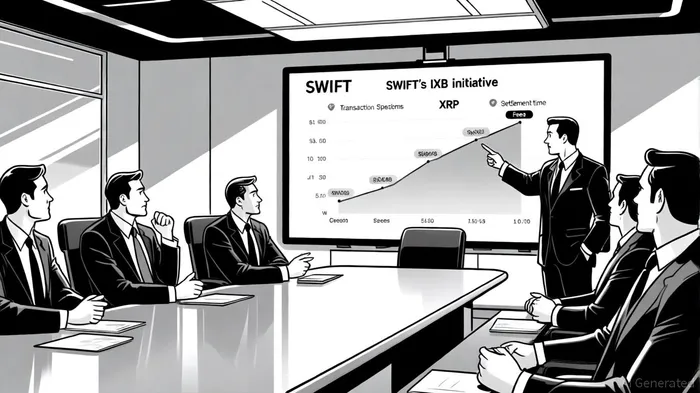
SWIFT's Immediate Cross-Border Payments (IXB) initiative represents a seismic shift in global finance. By leveraging real-time payment systems like the U.S. RTP and Europe's RT1, SWIFT aims to deliver synchronized cross-border settlements in under 60 seconds, with no hidden fees and full-value delivery guaranteed, according to SWIFT's press release. This initiative, supported by 25 financial institutions from the U.S. and Europe, is set to launch live transactions in the USD-EUR corridor in late 2025, aligning with the G20's 2027 roadmap for faster, cheaper, and more transparent payments, as noted in the IXB pilot.
Project Nexus, a complementary SWIFT initiative, further amplifies this disruption by connecting domestic instant payment systems globally. This eliminates the need for custom bilateral integrations, enabling cross-border payments to flow seamlessly through a single platform; the initiative is commonly referred to as Project Nexus. For context, SWIFT's traditional cross-border transactions typically take 1–5 business days and incur fees ranging from $20 to $50, with hidden intermediary charges often exceeding 3–5%, according to a CoinLaw report. The IXB initiative's promise of instant, fee-transparent settlements directly challenges the status quo—and, by extension, XRP's dominance in the low-cost, high-speed niche.
XRP's Edge: Speed, Cost, and On-Demand Liquidity
A 2025 CoinLaw report states that XRPXRP-- transactions settle in 3–5 seconds, with fees averaging just $0.0002 per transfer. This is a stark contrast to SWIFT's $20–$50 fees and 36–96-hour settlement windows. XRP's On-Demand Liquidity (ODL) service further reduces capital costs for banks by enabling real-time currency conversion without pre-funded nostro/vostro accounts, saving institutions up to 65% in liquidity costs, per the same CoinLaw findings.
However, XRP's advantages are not without limitations. While its 24/7/365 availability and 1,500 TPS scalability outpace SWIFT's legacy infrastructure, regulatory headwinds—particularly the SEC's ongoing litigation against Ripple and the EU's MiCA framework—have created uncertainty for institutional adoption, as an InternationalBankLicense article notes. Meanwhile, SWIFT's IXB initiative benefits from its entrenched position as the global standard, with over 11,000 financial institutions already integrated into its network, according to a DeFi Planet piece.
Fee-Free Dynamics: A New Arms Race
The most critical battleground between SWIFT and XRP lies in fee structures. SWIFT's IXB initiative explicitly bans hidden fees, ensuring upfront transparency on costs, as its press release explains. This directly targets XRP's core value proposition: low-cost, high-volume transactions. For example, a €10 million transfer via XRP settled in under 6 seconds in 2025, while the same transaction via SWIFT took 30 hours and incurred significantly higher fees, per CoinLaw. Yet, SWIFT's ability to offer “fee-free” transactions at scale remains untested. Early adopters of IXB, such as Santander and American Express, have not yet disclosed cost benchmarks for live transactions, a point noted in The Clearing House's coverage of the pilot.
XRP's energy efficiency also gives it a unique edge. The XRP Ledger consumes less than 0.001% of Bitcoin's energy, making it a more sustainable option for environmentally conscious institutions, according to CoinLaw's analysis. This could become a differentiator as global regulators increasingly prioritize green finance.
Implications for the Digital Asset Sector
SWIFT's IXB initiative signals a broader trend: legacy financial infrastructure is no longer standing still. While XRP's speed and cost advantages remain unmatched in many cases, the digital asset sector must adapt to a landscape where traditional players are innovating rapidly. For XRP, the key will be maintaining its first-mover advantage in niche markets—such as remittances and small-to-medium enterprises—where speed and cost efficiency are paramount, a goal echoed by discussions around Project Nexus.
However, the IXB initiative's success could erode XRP's market share in high-volume corridors like USD-EUR. If SWIFT's fee-free model proves scalable, it may force Ripple to further reduce XRP's already minimal fees or innovate in adjacent areas, such as tokenized assets or decentralized identity solutions, as noted by industry analysts.
For investors, the takeaway is clear: the cross-border payments race is entering a new phase. While XRP remains a formidable contender, SWIFT's institutional credibility and regulatory alignment give it a unique edge in capturing market share. The digital asset sector must watch closely as these two titans reshape the future of global finance.







Comentarios
Aún no hay comentarios