
Sweden's Strategic Defense Sector: Post-War Opportunities and Geopolitical Implications for Investors
Sweden's military support for Ukraine has evolved from a reactive response to Russian aggression into a strategic pillar of its national defense and industrial policy. With over SEK 80 billion ($8 billion) in cumulative aid since 2022 and a recent SEK 70 billion ($7.47 billion) two-year commitment to supply advanced systems like the Archer artillery and Gripen fighter jets, Reuters reported. Sweden is positioning itself as a critical player in the post-war reconstruction of Ukraine's defense infrastructure. This shift is not only reshaping the geopolitical landscape but also creating fertile ground for long-term growth in the Swedish defense sector.
Defense Spending and Export Momentum
Sweden's defense budget has surged to 2.3% of GDP in 2025, with plans to reach 3.5% by 2030, according to a GlobeNewswire report, surpassing NATO's 2.0% guideline. This spending is fueling a record SEK 29 billion ($2.9 billion) in military equipment exports in 2024, a 63% increase from 2023, UNN reported. Over 70% of these exports are directed to defense partners, including the UAE, the U.S., and Brazil, but Ukraine remains a standout recipient. The country's SEK 43 million ($4.3 million) in 2024 arms exports to Ukraine, according to Statista-though modest compared to other markets-signals a strategic pivot toward fostering a post-war industrial partnership.
The Swedish government has further incentivized this transition by offering SEK 500 million ($90 million) in export credit guarantees to defense firms like Saab AB and BAE Systems AB, reducing financial risks for companies supplying Ukraine, Defense Mirror reported. This support is part of a broader Defence Industry Strategy aimed at boosting innovation, production capacity, and international competitiveness.
Key Players and Stock Market Performance
Saab AB, a cornerstone of Sweden's defense ecosystem, has emerged as a prime beneficiary of this momentum. The company's shares have surged 450% over three years, driven by increased demand for its Carl Gustaf grenade launchers, air defense systems, and Gripen E fighter jets, Sweden Herald reported. Analysts at Goldman Sachs highlight Saab's "strategic alignment with NATO modernization goals" as a key driver of its valuation, a point noted by Skilling.
Other firms, such as BAE Systems AB (producer of Archer artillery systems) and Semcon AB (specialist in defense electronics), are also seeing heightened activity. BAE's recent contract to supply 12 Archer howitzers to Ukraine, Army Recognition reported, underscores its role in meeting immediate battlefield demands, while Semcon's expertise in electronic warfare aligns with Sweden's push to integrate Ukrainian tech into its export offerings.
Post-War Opportunities: A New Era of Collaboration
The most transformative development is Sweden's joint production agreement with Ukraine, formalized in August 2025, the Government of Sweden announced. This initiative leverages Sweden's advanced manufacturing capabilities with Ukraine's strengths in unmanned systems, drone production, and software development. For example, Swedish firms are now collaborating with Ukrainian partners to co-produce long-range missiles and integrate AI-driven targeting systems into existing platforms.
Post-war, this partnership could evolve into a regional defense hub, with Sweden acting as a supplier of high-tech systems and Ukraine serving as a production base for export. Defence Finance Monitor projects that this model could generate $1.2 billion in annual revenue for Swedish defense firms by 2030, assuming Ukraine's military rebuild mirrors NATO standards.
Geopolitical Implications and Sector Projections
Sweden's strategic alignment with NATO and its pivot toward European defense autonomy are amplifying the sector's growth potential. The European Commission's proposed $158 billion defense fund, as discussed by Goldman Sachs, and Germany's $100 billion modernization package, S&P Global reported, are creating a regional ecosystem where Swedish firms can thrive. Additionally, the U.S. defense industry's procurement delays are opening windows for European competitors to fill gaps in areas like air defense and armored vehicles, GlobalData notes.
Financially, the sector is poised for sustained expansion. The Sweden Defense Market is projected to grow at a CAGR of 6.7% from 2026 to 2030, according to a GlobeNewswire report, driven by modernization programs and hybrid threat preparedness. For investors, this translates to a compelling case for long-term exposure to firms like Saab, which is already diversifying into cybersecurity and space-based surveillance systems, the Nordic Times reports.
Conclusion: A Strategic Buy for Defense Investors
Sweden's dual focus on immediate military aid and post-war industrial collaboration is creating a unique value proposition for defense stocks. While short-term volatility is inevitable in a conflict-driven sector, the long-term outlook is bolstered by structural trends: rising defense budgets, technological innovation, and a reimagined European security architecture. For investors seeking exposure to a sector with both geopolitical tailwinds and robust financial fundamentals, Swedish defense firms represent a strategic buy.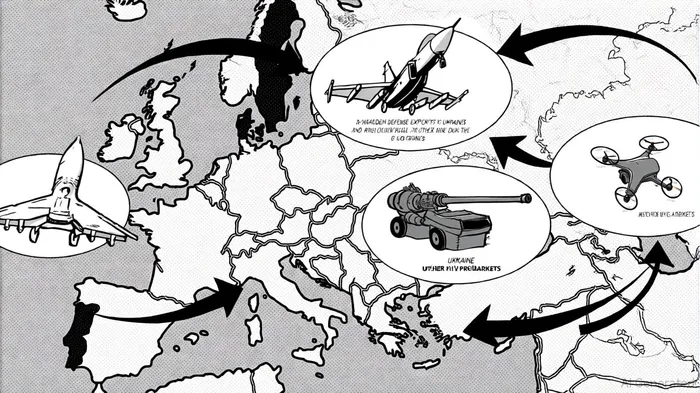







Comentarios
Aún no hay comentarios