
Swedbank's Stagnant Earnings and Capital Buffer as Strategic Crossroads
Swedbank (SWDBF) stands at a critical juncture, balancing a fortress-like capital position against stagnant earnings growth and mounting strategic uncertainties. With a CET1 ratio of 19.7%—exceeding regulatory requirements by a robust 4.5 percentage points—and a cost-to-income ratio of 0.35, the bank appears financially resilient on paper. Yet its Q1 2025 results, which included a 15.2% ROE and a 2% annual profit increase, mask deeper challenges. Declining Baltic corporate lending, regulatory overhang from U.S. investigations, and margin pressures from smaller competitors are testing Swedbank's ability to sustain its 15% ROE target. Investors must weigh whether the stock's current P/B ratio of 1.55x reflects these risks or offers a buying opportunity.
The Capital Paradox: Strength or Stagnation?
Swedbank's capital buffer is a double-edged sword. While the 20.4% CET1 ratio (as of Q4 2024) provides a cushion against shocks, it also highlights the bank's reluctance—or inability—to deploy excess capital profitably. The question is: Should Swedbank return more capital to shareholders via dividends or buybacks, or retain the buffer to navigate Baltic market headwinds and regulatory risks?
The Baltic conundrum is central here. Q1 2025 saw a slight decline in corporate lending in Latvia and Lithuania, exacerbated by sector-specific taxes and economic uncertainty. Though sustainable loans remain stable, Swedbank's strategy to dominate Baltic corporate banking faces structural hurdles. 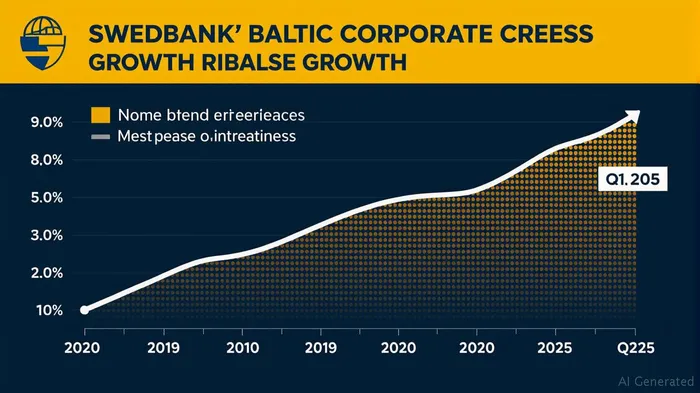 . With Baltic loans contributing roughly 18% of total lending, stagnation here limits top-line growth.
This comparison reveals Swedbank's capital strength but also its lack of capital redeployment agility. While peers have used higher CET1 buffers to acquire assets or expand digitally, Swedbank remains constrained by Baltic market headwinds and U.S. regulatory uncertainties.
Regulatory Overhang and Competitive Pressures
Swedbank's unresolved U.S. investigations—stemming from its 2018 money-laundering scandal—cast a shadow over its capital allocation strategy. Until these risks are mitigated, the bank may prioritize preserving buffers over aggressive expansion.
Meanwhile, smaller Nordic banks like Handelsbanken and Sparbanken are eroding Swedbank's pricing power. These competitors, unburdened by legacy liabilities, are offering more attractive loan terms in Baltic markets, squeezing Swedbank's net interest margins. The 6% annual decline in net interest income underscores this vulnerability.
Valuation Risks and the 15% ROE Target
Swedbank's 15% ROE target hinges on stabilizing Baltic loan growth and reducing regulatory drag. However, Q1 2025's 15.2% ROE—while within target—was achieved through cost discipline rather than revenue growth. With Baltic lending under pressure and net interest income declining, sustaining ROE may require aggressive cost cuts or a recovery in loan demand.
This overlay shows the inverse relationship between Baltic lending strength and ROE stability. A prolonged Baltic slump could force ROE below target, pressuring valuation multiples further.
The stock's P/B of 1.55x reflects lingering reputational risks and growth concerns but remains above some regional peers. Falkenbergs Sparbank's recent stake purchase suggests pockets of optimism, yet the discount to pre-2018 crisis levels (P/B >2x) signals investor skepticism about Swedbank's ability to reignite growth.
Investment Dilemma: Caution Until Clarity
Investors face a binary choice:
1. Optimism: Buy the stock if Baltic loan growth recovers, U.S. investigations conclude favorably, and net interest margins stabilize. Swedbank's capital strength and ESG focus could then justify a valuation rebound.
2. Pessimism: Avoid the stock until these risks are resolved. The current P/B may already price in a “best-case” scenario, leaving limited upside.
The safer bet is caution. Until Swedbank demonstrates:
- A recovery in Baltic corporate lending (Q2 2025 results are critical),
- A resolution to U.S. regulatory issues, and
- Margin stabilization amid competitive pressures,
the stock's risks outweigh its rewards. The 15% ROE target is achievable only if these factors improve—a tall order given the current landscape.
Conclusion: Wait for the Crossroads to Clear
Swedbank's capital buffer is a fortress, but its earnings stagnation and strategic crossroads make it a high-risk, low-reward play today. While the P/B discount offers allure, the bank must prove it can navigate Baltic headwinds and regulatory hurdles before investors reward it with a valuation uplift. For now, the prudent move is to wait on the sidelines until clarity emerges.
This comparison underscores Swedbank's underperformance, reflecting its unique risks. A turnaround hinges on execution in Baltic markets and resolution of legacy issues—outcomes that remain uncertain.







Comentarios
Aún no hay comentarios