
The Surprising Rise in Crude Inventories and Geopolitical Risks: A Case for Rebalancing Energy Exposure
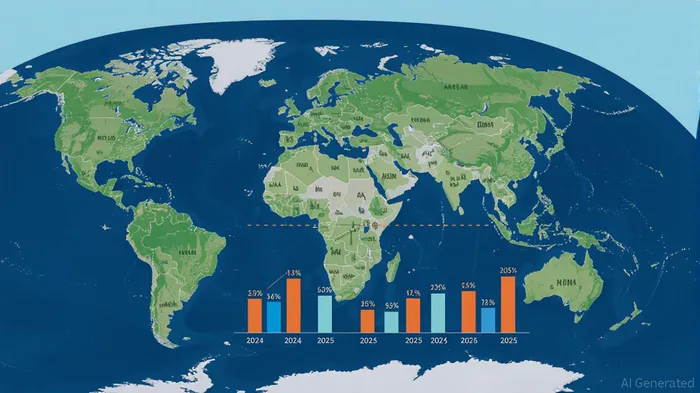
The global energy landscape in 2025 is defined by a paradox: record crude oil inventory builds coexist with persistent geopolitical risks that threaten to disrupt supply chains. This duality has forced investors to rethink traditional energy exposure, prioritizing resilience over short-term gains. As the U.S. Energy Information Administration (EIA) reports a 3.9 million barrel rise in commercial crude stockpiles for the week ending September 5, 2025—marking a reversal from the prior week's draw—broader trends suggest a structural shift in market dynamics[4]. Meanwhile, escalating conflicts in the Middle East and shipping disruptions in the Red Sea have injected volatility into a market already grappling with oversupply pressures[5].
Inventory Overhang and Price Pressures
The EIA's latest data underscores a critical divergence between physical markets and financial benchmarks. Despite the inventory build, Brent crude traded at $66.82 per barrel and WTIWTI-- at $63.09 per barrel post-release, defying expectations of a sharper price correction[4]. This resilience, however, masks deeper vulnerabilities. The EIA forecasts that global oil inventories will continue expanding through 2026, driven by OPEC+ and non-OPEC producers outpacing demand growth[1]. By Q4 2025, average prices are projected to dip to $59/b, with a further decline to $49/b anticipated in early 2026[1]. Such projections signal a bearish outlook for energy-linked assets, compounding risks for investors reliant on traditional hydrocarbon exposure.
Geopolitical Tail Risks Amplify Uncertainty
While inventory trends reflect supply-side imbalances, geopolitical tensions have introduced a layer of demand-side unpredictability. The Israel-Iran conflict has reignited fears of a Strait of Hormuz closure, a chokepoint responsible for 20% of global oil flows[4]. Similarly, Houthi attacks in the Red Sea have forced shipping lines to reroute vessels around the Cape of Good Hope, adding 10–14 days to transit times and inflating costs[5]. These disruptions, coupled with the potential for new U.S. tariffs on oil imports, create a volatile backdrop for energy markets[5].
The Russia-Ukraine war further complicates the picture. Despite waning direct impacts on oil flows, the risk of renewed sanctions on Russian exports—and the associated rerouting of crude to Asian markets—has fragmented pricing benchmarks[2]. Such fragmentation reduces transparency, making it harder for investors to hedge against regional shocks.
Strategic Rebalancing: From Fossil Fuels to Diversified Portfolios
In response to these converging risks, asset reallocation strategies have gained urgency. Asian buyers, for instance, are increasingly securing long-term oil supply agreements with Middle Eastern producers to insulate against spot market volatility[2]. This trend reflects a broader shift toward contractual stability in an era of geopolitical uncertainty.
Meanwhile, U.S. shale producers like Diamondback EnergyFANG-- have scaled back capital expenditures, signaling a strategic retreat from aggressive growth[1]. This adjustment aligns with a market reality where low-cost producers—both within and outside OPEC+—are dominating supply-side dynamics.
Investors are also turning to financial instruments to hedge exposure. Renewable energy ETFs have surged in popularity, capitalizing on the energy transition and offering diversification against fossil fuel volatility[3]. Active ETFs, with their real-time trading flexibility, have emerged as tools for dynamically adjusting portfolios amid liquidity challenges[3]. Gold and green bonds, meanwhile, are being deployed to balance energy-specific risks with broader macroeconomic uncertainties[3].
The Path Forward
The interplay of inventory overhangs and geopolitical risks demands a recalibration of energy exposure. For institutional and retail investors alike, the case for rebalancing is clear: diversify into hedging instruments, lock in stable supply contracts, and allocate to sectors less sensitive to oil price shocks. As the EIA's projections make evident, the era of sustained high oil prices is waning[1]. Those who adapt now will be better positioned to navigate the next phase of energy market evolution.





Comentarios
Aún no hay comentarios