
The Surging XRP ETF Market: A Contrarian Opportunity Amid Crypto ETF Outflows?
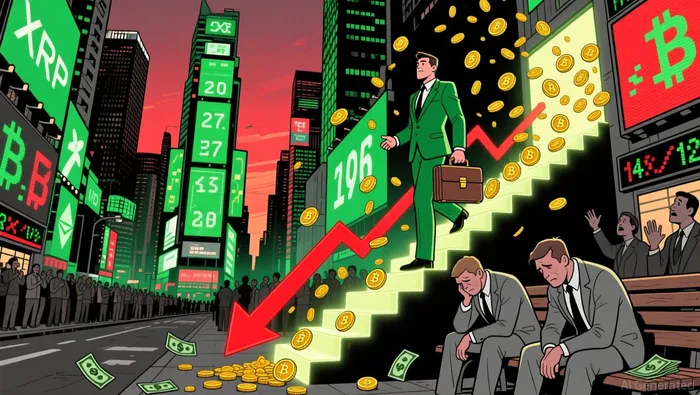
The crypto market has entered a correction phase in late 2025, with BitcoinBTC-- and EthereumETH-- ETFs hemorrhaging billions in outflows as investors engage in tax-loss harvesting and year-end portfolio rebalancing according to market data. Yet, amid this broader selloff, XRPXRP-- ETFs have defied the trend, absorbing $1.3 billion in inflows since their November 2025 launch-the fastest adoption for any altcoin ETF. This divergence raises a critical question: Is XRP's ETF surge a contrarian opportunity, or a fleeting anomaly in a market still grappling with macroeconomic headwinds?
XRP ETFs: The Unlikely Outperformers
Data from Q4 2025 paints a stark contrast between XRP and its crypto peers. While Bitcoin ETFs saw $1.09 billion in outflows and Ethereum ETFs lost $564 million according to reports, XRP ETFs attracted $483 million in December alone. This performance has continued into early 2026, with cumulative inflows surpassing $1.5 billion despite a 15% drop in XRP's spot price to $1.77 according to data. Analysts attribute this resilience to three factors: regulatory clarity, institutional-grade utility, and mandate-driven accumulation.
Ripple's legal victory over the SEC in August 2025- settling the long-running lawsuit and establishing XRP as a non-security in public transactions-removed a major overhang. This clarity, combined with the launch of 11 XRP ETF products on DTCC's list, has unlocked institutional access. Major players like Franklin Templeton, Grayscale, and Bitwise have already allocated capital to XRP ETFs, signaling a shift from speculative trading to strategic asset allocation.
The XRP Edge: Utility Over Speculation
Unlike Bitcoin and Ethereum, which remain largely speculative assets, XRP's value proposition is rooted in real-world utility. The token underpins Ripple's cross-border payment solutions, which are already adopted by institutions like SBI Remit, CIBC, and Santander. These partnerships leverage XRP's ability to settle transactions in seconds at near-zero cost-a stark contrast to traditional SWIFT systems that take days and charge hefty fees.
This utility-driven narrative sets XRP apart from altcoins like SolanaSOL-- and CardanoADA--, which, while technically robust, lack XRP's entrenched infrastructure in the $150 trillion cross-border payments market according to analysis. Solana's high throughput and Cardano's academic rigor may appeal to developers, but XRP's institutional adoption and proven use case make it a more compelling play for investors seeking tangible value.
Macro Tailwinds and Institutional Momentum
The Federal Reserve's anticipated rate cuts in 2026 could further amplify XRP's appeal. Lower interest rates typically boost risk-on assets, and XRP's ETF inflows-driven by institutional mandates-suggest a growing appetite for crypto as a strategic asset class. Standard Chartered's bullish projection of a 330% price increase to $8 by year-end 2026 hinges on sustained ETF demand and regulatory progress, particularly the pending approval of XRP ETFs under the CLARITY Act.
Moreover, XRP's recent launch of earnXRP-a yield-generating vault for token holders- adds another layer of utility, addressing a key criticism of crypto's lack of income-generating mechanisms. This innovation, coupled with Ripple's expansion into custody solutions and treasury management, positions XRP as a foundational infrastructure asset rather than a speculative token.
Risks and Realities
Critics argue that XRP's ETF-driven rally is fragile. Technical indicators, including a bearish "death cross" formation according to technical analysis, suggest a potential decline to $1.25 before a reversal in Q2 2026. Additionally, the broader crypto market remains vulnerable to macroeconomic shocks, such as a Fed pivot delay or a global economic slowdown.
However, these risks are not unique to XRP. The broader market's correction has created a buying opportunity for contrarian investors, particularly in assets with strong fundamentals. XRP's institutional adoption, regulatory progress, and utility-driven growth trajectory make it a standout candidate in a landscape dominated by speculative narratives.
Conclusion: A Contrarian Case for XRP
While the crypto market's correction has spooked many investors, XRP's ETF performance highlights a compelling contrarian opportunity. The token's regulatory clarity, institutional backing, and real-world utility position it as a bridge between traditional finance and blockchain innovation. As the market matures and crypto transitions from speculative frenzy to strategic allocation, XRP's unique value proposition could unlock significant upside-especially for those willing to bet against the short-term noise.
In a world where Bitcoin and Ethereum ETFs bleed red, XRP's green streak is more than a statistical anomaly. It's a signal.






Comentarios
Aún no hay comentarios