
The Surge in ZK Technologies and Its Implications for Crypto Markets
Privacy and Scalability: The Twin Engines of ZK's Momentum
Zero-knowledge proofs have long been hailed as a solution to blockchain's privacy and scalability dilemmas. In 2025, these promises are materializing. Ethereum's EVM (Ethereum Virtual Machine) optimization has slashed the cost of ZK-proofs by up to 50-fold, enabling Layer 2 protocols like Lighter to achieve transaction rates of 24,192 TPS. This leap in scalability is critical for DeFi applications, which require high throughput to compete with traditional finance.
ZK-rollups, a subset of Layer 2 solutions, are now the backbone of this progress. By bundling transactions into cryptographic proofs, they reduce on-chain congestion while preserving privacy. For instance, StarkNet saw its total value locked (TVL) triple in Q4 2025, partly due to $72 million in BTC bridged to the platform. Such metrics underscore ZK's growing utility in handling both public and private transactions at scale.
Institutional Adoption: From Experimentation to Mainstream Trust
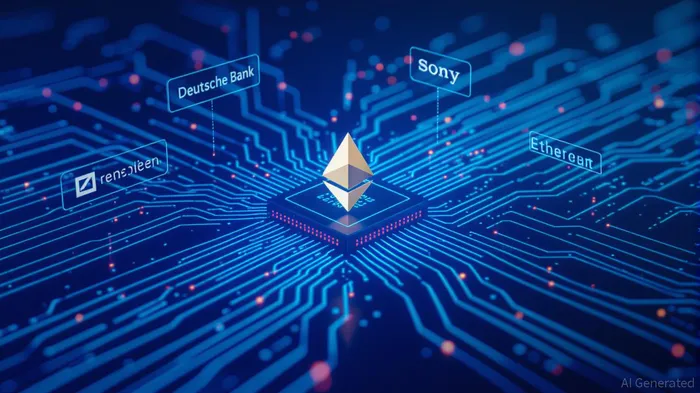
Institutional interest in ZKZK-- technologies has shifted from cautious observation to active integration. Major players like Deutsche Bank and Sony are leveraging ZK-rollups to manage large-scale transactions while meeting regulatory requirements. This adoption is not merely about cost savings-it's about aligning blockchain with compliance frameworks that institutions demand.
Circle's Arc Layer 1 blockchain further illustrates this trend. Positioned as programmable financial infrastructure, Arc attracted over 100 companies in banking and payments during its public testnet phase. The platform's native token, slated for launch, aims to incentivize developers and institutions, reflecting a broader industry push toward tokenized ecosystems. Meanwhile, USDC's average circulation surged by 97% to $67.8 billion in Q3 2025, driven by both retail and institutional use cases.
DeFi Integrations: Scaling Beyond Speculation
Decentralized finance is no longer just a niche experiment. ZK technologies are enabling DeFi to evolve into a robust alternative to traditional banking. dYdX, for example, has integrated zk-STARKs to facilitate high-leverage trading with reduced costs. Similarly, Polygon Hermez and Immutable X are leveraging ZK proofs to enhance transaction speeds and privacy, making DeFi platforms more accessible to mainstream users.
The tokenization of real-world assets (RWAs) is another frontier. In Q3 2025, DeFi protocols began integrating RWAs like real estate and corporate debt, with Layer 2 solutions providing the scalability needed to handle these complex transactions. This convergence of DeFi and TradFi is not just speculative-it's a structural shift that could redefine liquidity and yield generation.
Expert Commentary: The Future is Layer 2
Ethereum co-founder Vitalik Buterin has publicly endorsed DeFi's potential as a banking alternative, citing security advancements like the "walkaway test," which ensures users can always access their funds according to analysis. His optimism is shared by industry analysts, who highlight Layer 2's role in solving the blockchain trilemma of scalability, security, and decentralization.
Projects like Arbitrum and Optimism (using Optimistic Rollups) now process 2,000–4,000 TPS, slashing Ethereum gas fees by up to 95%. Meanwhile, zkSync and StarkNet are pushing the boundaries of ZK-rollups, with Ethereum's upcoming Proto-Danksharding expected to amplify their throughput to 100,000 TPS according to technical forecasts. These advancements are not just technical-they're economic, enabling DeFi to compete with legacy systems on cost and efficiency.
Implications for Crypto Markets
The surge in ZK technologies is creating a flywheel effect. As scalability improves and privacy strengthens, institutional capital is flowing into ZK infrastructure. This trend is evident in the $50 billion in value locked in Layer 2 ecosystems and the growing TVL on platforms like StarkNetSTRK--. For investors, the key takeaway is clear: ZK is not a speculative fad but a foundational shift in blockchain's value proposition.
However, challenges remain. Regulatory scrutiny and competitive pressures could slow adoption. Yet, the underlying economics-lower costs, higher throughput, and institutional trust-suggest that ZK's ascent is irreversible.
Conclusion
The ZK revolution is here, driven by a confluence of technical innovation and institutional demand. For crypto markets, this means a future where privacy and scalability are no longer trade-offs but enablers of mass adoption. As DeFi platforms and Layer 2 networks continue to mature, the winners will be those who recognize ZK not as a niche technology but as the bedrock of the next financial era.







Comentarios
Aún no hay comentarios