
Surge in WBTC Accumulation by a Key Smart Money Address: A Signal of Institutional Confidence in Bitcoin
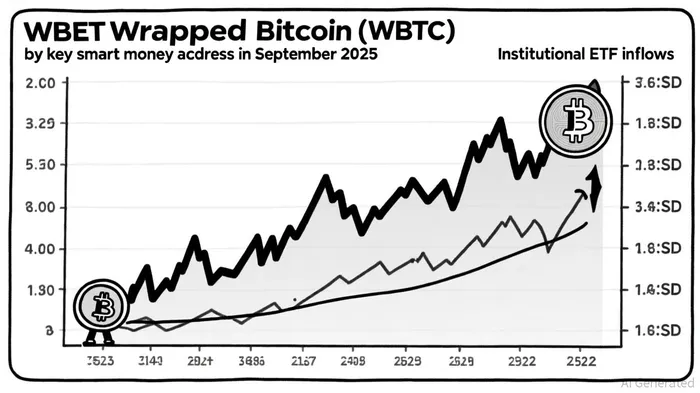
In September 2025, a notable shift in institutional sentiment toward BitcoinBTC-- emerged, as evidenced by aggressive accumulation of Wrapped BitcoinWBTC-- (WBTC) by a key "smart money" address. This address, previously known for profiting $5.16 million by shorting BTCBTC-- during the LUNA/UST collapse, spent $9.485 million to purchase 80.2623 WBTCWBTC-- at an average price of $118,174 [2]. Simultaneously, another strategic address acquired 89.44 WBTC for 9.829 million USDT at $109,897 [1]. These transactions, occurring after a bearish phase, signal a recalibration of institutional positioning in Bitcoin, leveraging WBTC's unique role as a bridge between Bitcoin and decentralized finance (DeFi).
On-Chain Behavior: A Macro Signal of Confidence
The accumulation of WBTC by these addresses aligns with broader on-chain trends indicating institutional confidence. WBTC, a tokenized version of Bitcoin on EthereumETH--, has seen its Total Value Locked (TVL) exceed $9.2 billion in April 2025, driven by its utility in lending and yield-generating protocols like AaveAAVE-- and CompoundCOMP-- [1]. This surge reflects a strategic move by institutional investors to collateralize Bitcoin in DeFi while retaining exposure to its price action. The custodial model of WBTC—backed 1:1 by Bitcoin reserves and subject to regular audits—provides transparency, reducing risks associated with fractional reserves and enhancing trust [1].
Moreover, on-chain metrics suggest the market is in a healthier bull cycle phase. The MVRV Z-Score, a measure of realized value versus market capitalization, dropped to 1.43 in September 2025 after peaking at 3.36 when Bitcoin hit $100,000. This level historically correlates with local bottoms in bull cycles, such as in 2017 and 2021 [1]. Concurrently, Value Days Destroyed (VDD) entered a "green zone," indicating reduced profit-taking and increased long-term holder accumulation [1]. These patterns reinforce the narrative that institutional and experienced investors are capitalizing on dips, positioning WBTC as a proxy for Bitcoin's scarcity in a DeFi-optimized context.
Institutional Adoption and Macroeconomic Drivers
The surge in WBTC accumulation must be contextualized within a broader institutional adoption wave. The approval of U.S. spot Bitcoin ETFs in 2025 catalyzed over $50 billion in assets under management (AUM), signaling a paradigm shift in how institutional investors allocate to digital assets [1]. Companies like MicroStrategy further solidified Bitcoin's role as a corporate treasury asset, with strategic holdings reducing volatility through longer-term holding patterns [2]. Meanwhile, macroeconomic factors—persistent inflation, rising U.S. national debt, and a search for alternative stores of value—have driven demand for Bitcoin as a hedge against fiat devaluation [3].
WBTC's appeal is further amplified by its integration into DeFi. Ethereum 2.0's scalability improvements and lower transaction costs have made WBTC a preferred asset for liquidity pools and yield farming strategies [1]. By staking WBTC, institutional investors generate returns on Bitcoin holdings while participating in decentralized financial activities. This dual utility—price exposure and yield generation—positions WBTC as a more versatile tool for institutional portfolios compared to native Bitcoin.
Macroeconomic Catalysts and Future Outlook
The Federal Reserve's rate cuts in 2025 and potential approval of altcoin ETFs in October 2025 could reignite buyer enthusiasm, according to analysts [5]. These developments align with Bitcoin's historical correlation with low-interest environments, where non-yielding, scarce assets gain traction. Additionally, the redemption process of WBTC—burning tokens to reclaim Bitcoin—introduces deflationary pressure, further supporting its value proposition [1].
However, challenges persist. The rise of Central Bank Digital Currencies (CBDCs) and regulatory shifts favoring compliance-ready alternatives could fragment institutional capital, potentially diluting Bitcoin's dominance [4]. Yet, the structural factors driving WBTC adoption—ETF inflows, DeFi utility, and custodial transparency—suggest that institutional confidence in Bitcoin remains robust, even as market dynamics evolve.
Conclusion
The accumulation of WBTC by key smart money addresses in September 2025 is notNOT-- an isolated event but a macro signal of institutional confidence in Bitcoin's long-term value. On-chain metrics, coupled with macroeconomic and regulatory tailwinds, indicate that the market is in a consolidation phase within an extended bull cycle. For investors, this underscores the importance of viewing WBTC not just as a tokenized asset but as a strategic lever for capitalizing on Bitcoin's scarcity and DeFi's innovation. As the Fed's policy trajectory and ETF flows unfold, the interplay between institutional demand and technological utility will likely shape Bitcoin's next phase of growth.






Comentarios
Aún no hay comentarios