
The Surge in Office Investment Demand in H1 2025: A Strategic Buying Opportunity
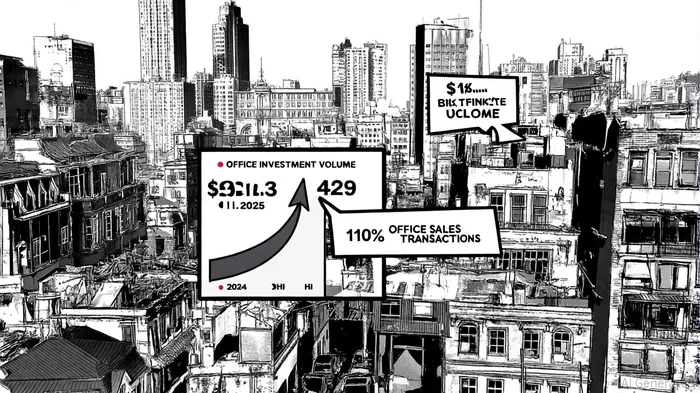
The commercial real estate market in 2025 is witnessing a seismic shift, with office investments emerging as a compelling strategic opportunity amid broader asset allocation realignments. According to JLL, total office investment volume in the first half of 2025 soared by 42% year-over-year to $25.9 billion, driven by a confluence of lower interest rates and a renewed institutional appetite for high-quality assets [1]. This surge—outpacing even the robust industrial and data center sectors—signals a transition from “office curious” to “office serious,” as investors capitalize on stabilization in prime markets and the growing return-to-office mandates adopted by corporations [1].
Asset Allocation Shifts: From Flight to Quality to Strategic Rebalancing
The office sector's resurgence is part of a broader reallocation of capital across commercial real estate. While industrial and multifamily properties have long been favored for their resilience, the bifurcation of the office market has created a unique value proposition. Prime office spaces in major metro areas like New York and San Francisco are seeing stabilized absorption and declining vacancy rates for Class A properties, even as secondary and tertiary assets struggle [2]. This “flight to quality” dynamic mirrors trends in multifamily, where high-occupancy rates (95% during downturns) and limited new supply have driven returns above 9% annually over the past decade [3].
Industrial real estate, meanwhile, remains a strong performer, with in-place rents rising 6.1% year-over-year and cap rates averaging 6% for stabilized warehouses [4]. However, the sector faces near-term headwinds, including a 7.4% vacancy rate and slowing construction. Retail, on the other hand, has demonstrated surprising resilience, with grocery-anchored centers and experiential formats driving 4.5% rent growth and vacancy rates below 5% [5]. Yet, the office sector's unique combination of stabilization in prime assets and undervalued secondary properties offers a risk-reward profile that is hard to ignore.
Risk-Adjusted Returns: Office's Undervalued Potential
When evaluating risk-adjusted returns, the office sector stands out as a high-conviction opportunity. While multifamily and industrial assets offer steady cash flows, their valuations have become increasingly stretched due to competitive bidding. Office propertiesOPI--, by contrast, trade at a discount, with cap rates declining modestly by just 7 bps in 2025 compared to 30 bps for industrial and 17 bps for multifamily [6]. This compression reflects lingering concerns about hybrid work trends but overlooks the sector's structural advantages:
- Debt Refinancing Tailwinds: With interest rates stabilizing, borrowers with prime office assets are securing favorable terms, reducing refinancing risks that plagued the sector in 2023–2024 [7].
- Tenant Demand in Prime Locations: Companies like Google and Microsoft are enforcing stricter return-to-office policies, driving demand for modern, amenity-rich spaces in urban cores [8].
- Supply Constraints: The office construction pipeline has contracted sharply, limiting new supply and creating upward pressure on rents for high-quality assets [9].
Strategic Buying: Navigating the Bifurcated Market
The key to unlocking office investment potential lies in selective targeting. Prime assets in transit-oriented, mixed-use developments—particularly in Sun Belt cities like Austin and Raleigh—offer the best risk-adjusted returns. These properties benefit from demographic tailwinds, lower construction costs, and a growing preference for urban living among younger workers [10]. Conversely, investors should avoid overexposed central business districts with high concentrations of Class B/C assets, which remain vulnerable to prolonged vacancies and refinancing challenges [11].
For institutional investors, the current environment resembles the early 2009 real estate market: a period of dislocation where disciplined buyers can acquire assets at discounts while avoiding the pitfalls of overleveraged properties. The surge in bid volume—$16 billion in Q2 2025 alone—suggests that the market is already pricing in a recovery, but the gap between prime and non-prime assets remains wide enough to justify a strategic entry [12].
Conclusion: A Window of Opportunity
The office sector's 2025 resurgence is not a fleeting rebound but a recalibration driven by macroeconomic forces and corporate behavior. While industrial and multifamily investments remain solid, the office market's undervaluation, coupled with its alignment with long-term urbanization trends, makes it a standout opportunity for investors willing to navigate its complexities. As JLL notes, “The office market is no longer a write-off—it's a write-up waiting to happen” [1].







Comentarios
Aún no hay comentarios