
Supreme Court Tariff Ruling: A Test of Presidential Fiscal Authority
This case is a landmark separation-of-powers controversy. At its core, it asks whether Congress delegated too much authority to the President to impose tariffs, effectively allowing the executive branch to levy taxes without direct legislative approval. The stakes are fundamental to the Constitution's architecture, as one expert noted, framing the dispute as potentially the most significant test of the separation of powers since the steel seizure case of 1952. The case, which the Court has expedited, is now a direct test of presidential fiscal authority.
Oral arguments in November revealed significant skepticism from a majority of justices about the White House's authority under the International Emergency Economic Powers Act (IEEPA). Both conservative- and liberal-leaning justices pressed the administration on the method by which the president imposed his most sweeping duties, questioning the breadth of the emergency declaration. The court's first opportunity to issue a verdict came this past Friday, January 10, 2026, during a scheduled non-argument session. While the justices did not release their opinion that day, the timing itself underscored the case's gravity and the imminent nature of the decision. The court has since indicated its next opinion day would be Wednesday, January 14, bringing the resolution of this constitutional test into sharp focus.
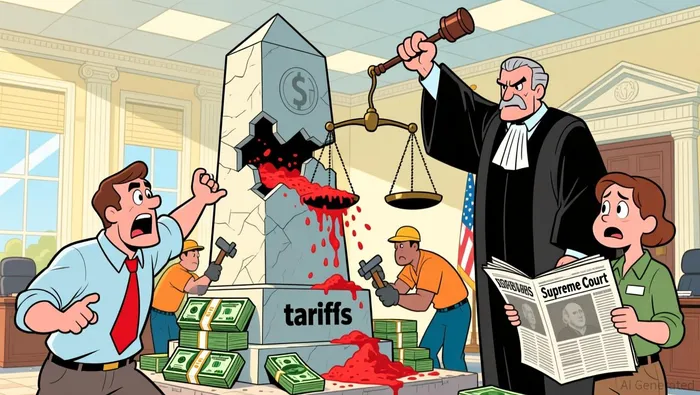
The Fiscal Engine: Tariffs as a Pillar of the Spending Agenda
The administration's ambitious fiscal plans are explicitly tethered to the tariff regime. President Trump has stated that the revenue generated by his tariffs is what enables a proposed $1.5 trillion military budget, framing a $500 billion increase over the current $1 trillion baseline as a direct outcome of the trade duties. This creates a clear, if contentious, link between the legal fate of the tariffs and the trajectory of federal spending.
Treasury Secretary Scott Bessent has acknowledged the logistical challenge of a negative ruling. He confirmed that the Treasury has more than adequate funds to cover any required refunds, citing a cash position of nearly $774 billion. However, he cautioned that the repayment process would be slow and complex, spreading out over weeks or even a year. This timeline introduces a significant friction point, as companies that have already paid the duties would face delayed relief, potentially straining their balance sheets and creating a messy administrative burden.
The bottom line is that a Supreme Court strike-down would directly jeopardize a major pillar of the administration's fiscal agenda. With tariff revenue being a key enabler for the proposed military budget increase, a ruling against the tariffs could jeopardize up to one-third of the newly proposed military budget. This outcome would force a fundamental recalibration of spending plans, shifting the focus from expansion to containment, and underscores how deeply the administration's financial strategy is interwoven with the contested trade policy.
The Strategic Pivot: Contingency Plans and Alternative Authorities
The administration's posture suggests a strategic pivot, where the goal is to maintain trade leverage regardless of the specific legal mechanism. National Economic Council Director Kevin Hassett made this clear on Friday, stating that even if the Supreme Court rules against the use of the International Emergency Economic Powers Act (IEEPA), the White House has other tools. There are a lot of other legal authorities that can reproduce the deals that we've made with other countries, and can do so basically immediately, Hassett said, indicating the administration's trade outcomes are the core objective, not the IEEPA itself.
This contingency planning underscores a broader point: the administration views its trade leverage as a strategic asset to be preserved. The focus is on achieving the same economic and diplomatic results-pressuring trading partners, reshoring supply chains, and generating revenue-through alternative legal pathways if needed. This suggests a calculated effort to insulate its trade policy from a single court ruling, framing the legal battle as a tactical hurdle rather than a strategic dead end.
Treasury Secretary Scott Bessent's comments on the potential fallout further reveal the administration's framing of the issue. When asked about the possibility of refunds, Bessent dismissed the notion of widespread tariff pass-through to consumers. He said in an interview that he still doubted that the court would rule against Trump's tariffs, but he believed that any refunds would be a corporate boondoggle for companies that passed on added costs to their customers. His characterization of refunds as a "boondoggle" reflects the administration's view that the tariff burden is a corporate cost, not a consumer tax, and that the legal outcome would primarily affect business balance sheets rather than the broader economy. This stance, however, directly contradicts economic evidence of pass-through, adding a layer of political framing to the fiscal calculus.
The Market Reckoning: Catalysts, Scenarios, and Watchpoints
The immediate catalyst is now in sight. The Supreme Court has scheduled its next opinion day for Wednesday, January 14, 2026. After the flurry of speculation last Friday, the resolution of this landmark case is finally within days. For investors, the coming days will be defined by three critical uncertainties and a clear set of watchpoints.
First, monitor the specific nature of the ruling itself. The court has several paths, and the outcome will dictate the market's next move. A complete invalidation of the IEEPA authority would be a seismic shock, directly challenging the legal foundation of the administration's trade and fiscal strategy. A narrow limitation, perhaps allowing some tariffs but not others, would create a messy, fragmented regulatory landscape. Treasury Secretary Scott Bessent has already signaled a likely middle ground, expecting a "mishmash" ruling that grants limited powers. This ambiguity is itself a risk, as it leaves companies and markets guessing about the enforceability of specific duties and the scope of any future refunds.
Second, watch the administration's immediate response. National Economic Council Director Kevin Hassett has laid out a clear contingency: the White House has other tools. There are a lot of other legal authorities that can reproduce the deals that we've made with other countries, and can do so basically immediately, Hassett stated. The market will scrutinize any announcements of alternative tariff authorities being deployed, as this will be the first test of the administration's promise to maintain trade leverage regardless of the IEEPA outcome. The speed and scope of any such pivot will be a key signal of policy continuity.
Finally, the financial mechanics of a negative ruling must be monitored. While Treasury Secretary Bessent insists the government has more than adequate funds to cover refunds, the process will be slow and complex. The administration's framing of refunds as a "corporate boondoggle" that won't be passed to consumers is at odds with economic reality. Investors should watch for early signs of how companies manage this potential cash inflow and whether any pass-through to consumers or suppliers begins to materialize, as this will test the administration's fiscal narrative and could introduce volatility into consumer-facing sectors.
The bottom line is that the market's reckoning is imminent. The ruling on January 14 will not just settle a legal dispute; it will force a rapid reassessment of trade policy risk, fiscal planning, and corporate profitability. The watchpoints are clear: the ruling's scope, the administration's pivot, and the unfolding refund mechanics.







Comentarios
Aún no hay comentarios