
Supreme Court's Potential Rejection of Trump Tariffs and Its Impact on Trade-Dependent Sectors
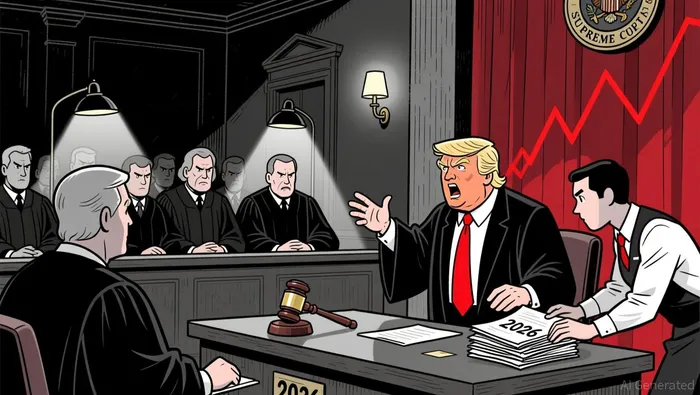
The U.S. Supreme Court's impending decision on the legality of President Donald Trump's 2025 tariffs has become a pivotal event for global markets, with prediction markets signaling a high probability of judicial constraint on executive overreach. As of early 2026, Kalshi and Polymarket data indicate only a 24–26% chance of a favorable ruling for the administration, down sharply from 46% in November 2025. This collapse in odds reflects growing skepticism among justices about the administration's invocation of the International Emergency Economic Powers Act (IEEPA) to justify sweeping tariffs on global trade partners. A rejection of these tariffs would not only curtail executive authority but also trigger seismic shifts in trade-dependent sectors, necessitating urgent strategic repositioning for investors.
Judicial Constraints and Market Signals
The legal foundation of Trump's tariffs hinges on IEEPA, which grants the president broad powers to impose economic sanctions during national emergencies. However, during oral arguments, justices questioned the administration's use of emergency powers to justify tariffs on non-security-related goods, such as consumer electronics and pharmaceuticals. Kalshi traders, now estimating only 2.8 average justices will side with Trump, imply a likely 6–3 or 7–2 decision against the policy. Such an outcome would align with historical precedents limiting executive power in trade, as seen in Carpenter v. Wymore (1917) and FDR's gold seizure (1933), where courts curtailed unilateral actions absent clear congressional authorization.
Prediction markets further underscore institutional concern over the ruling's implications. With over $1 million in combined trading volume on Kalshi and Polymarket, investors are hedging against a potential reshaping of the executive-legislative balance of power. A judicial rebuke of Trump's tariffs would likely prompt legal challenges to the validity of tariff revenue collected under the contested orders, creating retroactive uncertainty for industries reliant on current trade dynamics.
Sector-Specific Vulnerabilities and Market Positioning
Trade-dependent sectors-autos, steel, aluminum, lumber, and pharmaceuticals-face acute exposure to a potential reversal of Trump's tariffs. The administration's 50% tariffs on steel and aluminum imports, for instance, have already driven input costs up by 15% for downstream industries like construction and automotive manufacturing. Companies such as Caterpillar and Ford have passed these costs to consumers, but a court ruling could force abrupt price corrections and supply chain reconfigurations.
The agricultural sector, meanwhile, contends with retaliatory tariffs from Mexico and China, which have slashed U.S. soybean and corn exports by 12%. A judicial rejection of Trump's tariffs might spur trade negotiations to reduce retaliatory measures, but the transition period would likely exacerbate volatility in commodity prices and export-dependent equities.
Commodities tied to imported inputs-such as electronics, semiconductors, and industrial metals-are also at risk. Core goods prices have risen 1.9% above pre-2025 trends, with 61–80% of tariff costs passed through to consumers. A reversal of these tariffs could depress commodity prices in the short term, though long-term gains may emerge if global trade tensions ease.
Strategic Investment Adjustments
Given the high probability of judicial constraint, investors should prioritize hedging against regulatory uncertainty and capital outflows from trade-exposed industries. Key strategies include:
Shorting Trade-Exposed Equities: Positions in firms heavily reliant on current tariff structures-such as steel producers (e.g., U.S. Steel), auto manufacturers (e.g., General Motors), and import-dependent retailers (e.g., Walmart)-should be reduced or hedged with short-term options to mitigate downside risk. According to research, such positions carry elevated risk in a regulatory reversal scenario.
Longing Resilient Sectors: Investors should overweight industries less sensitive to tariff fluctuations, such as domestic energy (e.g., oil and gas) and technology firms with diversified supply chains (e.g., Intel, which has shifted production to Vietnam and India). Market analysis suggests these sectors offer superior resilience in a post-tariff environment.
Commodity Diversification: While industrial metals may face near-term pressure, agricultural commodities (e.g., corn, soybeans) could benefit from post-ruling trade normalization. Similarly, gold and safe-haven assets may gain traction amid heightened geopolitical uncertainty. Bessemer Trust reports that such assets often outperform during regulatory uncertainty.
Leveraging Volatility Products: Given the binary nature of the Supreme Court decision, volatility-linked instruments (e.g., VIX futures, options on trade-sensitive ETFs) offer opportunities to profit from market swings regardless of the ruling's outcome. JPMorgan analysis highlights these tools as effective hedging instruments in high-uncertainty environments.
Conclusion
The Supreme Court's decision on Trump's tariffs represents a critical inflection point for global trade and financial markets. With prediction markets signaling a high likelihood of judicial rejection, investors must act decisively to reposition portfolios against regulatory uncertainty. By shorting overexposed sectors, capitalizing on resilient industries, and leveraging volatility tools, market participants can navigate the impending shift while positioning for long-term stability in a post-tariff landscape.







Comentarios
Aún no hay comentarios