
Supply Chain Vulnerabilities in Crypto Infrastructure: A Risk Signal for Web3 Investors
The decentralized finance (DeFi) sector, once hailed as a bastion of trustless innovation, is increasingly exposed to operational and reputational risks stemming from vulnerabilities in its software supply chains. A case in point is the January 2026 Shai-Hulud supply chain attack on Trust Wallet, which resulted in the theft of $8.5 million in cryptocurrency assets and underscored systemic weaknesses in third-party infrastructure. As DeFi platforms expand their reliance on open-source tools and cloud-based workflows, investors must scrutinize the cascading risks of credential leaks, compromised API keys, and malicious code injection.
The Trust Wallet Breach: A Blueprint for Systemic Risk
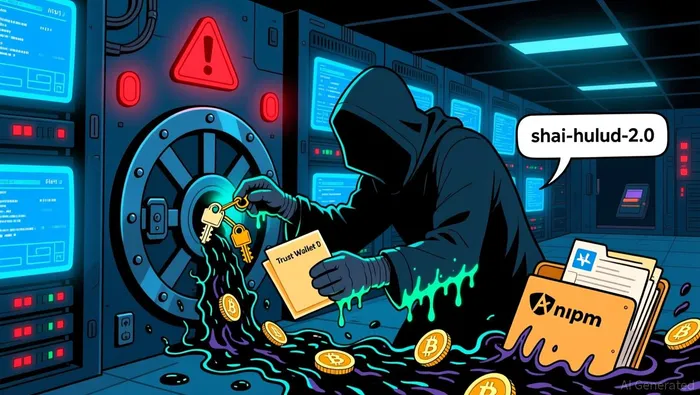
In late 2025, Trust Wallet's Chrome extension became a vector for the Shai-Hulud 2.0 malware, which exploited leaked GitHub developer secrets and a compromised Chrome Web Store (CWS) API key to deploy a malicious update (version 2.68) to users. The tampered extension exfiltrated seed phrases and private keys to attacker-controlled domains like metrics-trustwallet.com, draining assets from 2,520 wallet addresses over three days. This incident, attributed to a broader Shai-Hulud campaign that infected over 640 npm packages and 29,000 repositories, revealed how preinstall scripts and self-hosted GitHub runners could bypass standard security checks to harvest cloud credentials from AWS, Azure, and GCP.
The financial impact was severe: attackers consolidated stolen assets into 17 wallets, prompting Trust Wallet to roll back to a clean extension version (2.69) and initiate reimbursements. However, the breach also triggered a surge in fraudulent claims, as opportunistic actors exploited the chaos to demand compensation for non-affected accounts. This highlights a critical reputational risk-DeFi platforms must balance swift remediation with rigorous verification to avoid eroding user trust.
Operational Risks: Credential Leaks and CI/CD Vulnerabilities
The Trust Wallet incident exemplifies the operational fragility of DeFi infrastructure. Attackers leveraged leaked API keys to bypass Chrome Web Store release controls, a vulnerability stemming from inadequate credential rotation and access management. Similarly, the Shai-Hulud 2.0 campaign exploited misconfigured CI/CD pipelines to inject malicious code into npm packages, demonstrating how third-party dependencies can become entry points for systemic attacks.
For investors, these risks translate into potential liquidity shocks and governance failures. A 2025 report by Wiz.io noted that Shai-Hulud's use of IAM policy manipulation and self-hosted runners could enable persistent access to cloud environments, complicating incident response. Such scenarios suggest that DeFi platforms must prioritize continuous code dependency audits and zero-trust architectures to mitigate cascading breaches.
Reputational Fallout and Investor Implications
Reputational damage from supply chain attacks can be as costly as financial losses. Trust Wallet's post-breach response-while commendable for its transparency and reimbursement efforts-faced scrutiny over delayed detection and the need for white-hat DDoS attacks to disrupt attacker infrastructure. This underscores a broader challenge: DeFi platforms must not only secure their code but also communicate effectively during crises to retain user confidence.
For Web3 investors, the lesson is clear: diversification and due diligence are paramount. Platforms with opaque CI/CD pipelines or a history of credential leaks should be approached with caution. A 2025 analysis by SecurityWeek emphasized that 70% of DeFi projects lack robust supply chain security protocols, leaving them vulnerable to similar attacks. Investors should prioritize projects with audited codebases, multi-signature access controls, and proactive threat intelligence partnerships.
Conclusion: A Call for Proactive Risk Management
The Trust Wallet breach is not an isolated incident but a harbinger of growing threats in crypto infrastructure. As attackers refine techniques to exploit supply chain weaknesses, DeFi platforms must adopt a zero-trust mindset, integrating automated credential rotation, real-time monitoring, and third-party risk assessments. For investors, the priority is to allocate capital to projects that treat security as a core competency rather than an afterthought. In a sector where trust is both a promise and a liability, the cost of complacency is no longer hypothetical-it is a $8.5 million reality.







Comentarios
Aún no hay comentarios