
Supply Chain Shifts and Strategic Gambits: Vietnam's Trade Pivot Amid U.S.-China Tensions
The July 2025 U.S.-Vietnam trade agreement has recalibrated the calculus of global supply chains, positioning Vietnam as a critical node in the evolving U.S.-China trade rivalry. With tariffs on Vietnamese exports to the U.S. set at 20%—a compromise between the prior 10% and the threatened 46%—the deal offers a lifeline to Vietnam's manufacturing sector while introducing new risks tied to transshipment enforcement. For investors, this pivot presents a nuanced opportunity: sectors like textiles and electronics, where Vietnam's value-added processes are most robust, could thrive, but only for firms that navigate the vagaries of compliance and geopolitical volatility.
The Tariff Framework: A Balancing Act for Growth
The agreement's 20% tariff on most Vietnamese exports replaces a short-lived 10% rate but avoids the punitive 46% ceiling that had spooked markets. For sectors such as textiles—where Vietnam's exports to the U.S. reached $7.8 billion in Q1 2025—the lower rate preserves competitiveness. A 10% tariff would have added 8% to sweater prices, whereas the 46% threat would have nearly doubled costs. The final 20% tariff strikes a middle ground, though it still pressures companies to optimize margins through operational efficiency.
Meanwhile, the 40% levy on transshipped goods from China hinges on the U.S. “substantial transformation” standard. This requires goods to meet either a Harmonized System classification shift or a regional value content (RVC) threshold of 35-40%. Yet the absence of formal RVC guidelines leaves room for ambiguity. A reveals that 60% of U.S. rejections involved electronics and machinery, where Chinese components often dominate. For investors, this underscores risks in electronics subsectors reliant on Chinese inputs, while favoring textiles and footwear—where Vietnam's processing depth meets U.S. criteria more consistently.
Sector-Specific Opportunities: Where to Anchor Investments
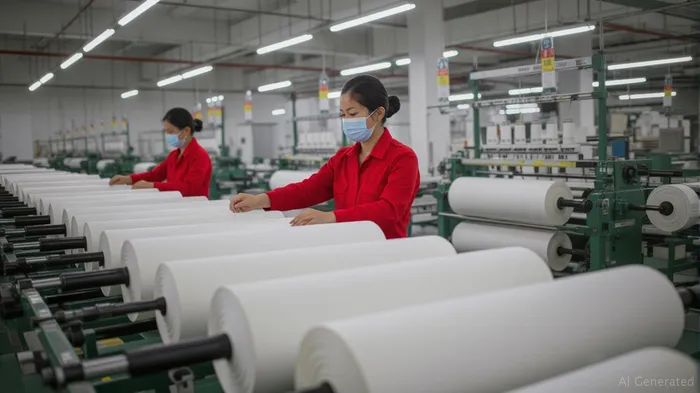
Textiles & Footwear: These sectors, accounting for 30% of Vietnam's U.S. exports, benefit from clear compliance pathways. Vietnamese firms that source yarn and fabric locally or through ASEAN partners—such as Thailand or Malaysia—can avoid transshipment scrutiny. Companies like [Vietnam Textile Group] or [Hoang Anh Gia Lai] (HAG), which integrate regional supply chains, are well-positioned to capture rising demand for “Made in Vietnam” apparel from U.S. retailers.
Electronics: While electronics exports (26% of total U.S. shipments) face higher transshipment risks, firms with U.S. partnerships may mitigate exposure. For example, [Panhapien Group], a contract manufacturer for AppleAAPL-- and HPHPQ--, benefits from just-in-time processing in Vietnam that meets RVC thresholds. A could highlight its growing share in U.S. markets as companies like Samsung (which already sources 30% of components locally) expand production.
Risks: Enforcement Uncertainty and Geopolitical Volatility
The lack of formal RVC thresholds creates a Wild West environment for compliance. U.S. customs may adopt a “near-zero tolerance” approach, penalizing goods with even 1% non-Vietnamese content. A shows a 45% increase in rejected shipments, signaling regulatory unpredictability.
Meanwhile, China's potential retaliation—such as tariffs on Vietnamese goods or restrictions on cross-border trade—could erode Vietnam's gains. Analysts estimate a 25% drop in Vietnam's U.S. exports if Beijing retaliates, though this remains speculative. Investors should prioritize firms with diversified supplier networks (e.g., using Thai steel or Indonesian rubber) and those with direct contracts to U.S. buyers, such as NikeNKE-- (NKE) or Under ArmourUAA-- (UAA) partners, which face less transshipment scrutiny.
Investment Strategy: Precision Over Panic
The U.S.-Vietnam deal is a double-edged sword: it opens doors for sectors that master compliance but punishes those ensnared in regulatory limbo. Investors should:
1. Focus on firms with ASEAN-centric supply chains: Companies reducing reliance on Chinese inputs through regional sourcing gain a compliance edge.
2. Target U.S.-linked partnerships: Firms with long-term contracts to American brands (e.g., furniture exporters to WayfairW-- or electronics suppliers to Dell) enjoy price stability.
3. Avoid pure-play transshipment plays: Subsectors like semiconductors or industrial machinery, where Chinese parts are indispensable, face prolonged uncertainty.
The agreement also positions Vietnam as a test case for U.S. engagement with “market economies”—a status Vietnam seeks, which could unlock access to advanced U.S. tech and capital. For now, the playbook is clear: bet on Vietnam's sectors that blend local value creation with U.S. demand, while hedging against geopolitical storms.
In conclusion, Vietnam's moment hinges on its ability to transform trade rules into tangible supply chain advantages. For the discerning investor, this is not a blanket endorsement of all Vietnamese equities but a call to sift through complexity for those firms that have mastered the art of compliance—and the politics of proximity.
Data queries highlighted in the text can be visualized via platforms like TradingView or Bloomberg for real-time analysis of stock performance and trade statistics.







Comentarios
Aún no hay comentarios