
Supply-Chain Security in DeFi and Web3 Infrastructure: Assessing Risk-Reward Dynamics Post-Hack
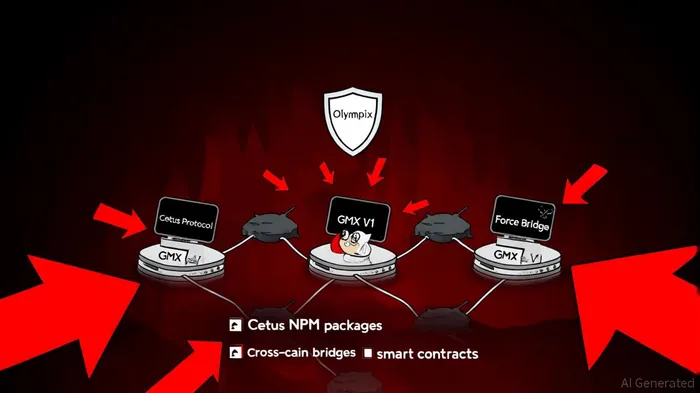
The DeFi and Web3 ecosystems have entered a critical inflection point in 2025, marked by explosive growth and equally alarming security vulnerabilities. As blockchain infrastructure scales to support decentralized finance, cross-chain interoperability, and tokenized assets, supply-chain attacks have emerged as a systemic threat. These breaches exploit dependencies in open-source code, smart contracts, and cross-chain bridges, exposing investors to asymmetric risks. This analysis evaluates the risk-reward dynamics of blockchain development ecosystems post-hack, drawing on recent incidents, recovery patterns, and regulatory shifts.
The Anatomy of Supply-Chain Vulnerabilities
Supply-chain attacks in DeFi and Web3 infrastructure often originate from compromised dependencies. A 2025 incident involving malicious npm packages injected crypto-clipper malware into foundational JavaScript libraries, enabling attackers to silently alter wallet addresses in transactions[2]. This exploit bypassed traditional perimeter defenses, affecting millions of downstream applications. Similarly, cross-chain bridges—critical for asset interoperability—have become prime targets. The Force Bridge hack in 2025, which resulted in $3.6 million in losses, stemmed from a compromised private key[5], underscoring the fragility of key management systems.
Smart contract vulnerabilities further compound risks. The Cetus Protocol hack on SuiSUI-- in May 2025 exploited a smart contract overflow bug, draining $220 million in assets[5]. These incidents highlight a recurring theme: attackers exploit weaknesses in code dependencies, governance models, and cryptographic practices to execute irreversible exploits.
Financial Impact and Recovery Rates
The financial toll of 2025's DeFi/Web3 hacks has been staggering. GMX V1, a decentralized perpetual trading protocol, lost $40–42 million due to a re-entrancy vulnerability[5], while Nobitex, Iran's largest exchange, suffered a politically motivated $90 million theft[5]. Recovery rates vary widely. For instance, GMX V1's protocol offered a 10% whitehat bounty, recovering $40.5 million of the stolen funds[1]. In contrast, Nobitex's recovery efforts were hampered by the attackers' use of burn addresses, leaving full restitution unlikely[1].
Investor returns post-hack are often asymmetric. While some protocols, like GMX V1, managed partial recovery through bounties and audits, others, such as Kinto, faced permanent losses. Kinto's $750,000 bridge loan shortfall led to a 24% haircut for Wildcat lenders[4], illustrating the cascading effects of liquidity crises in DeFi.
Regulatory Responses and Mitigation Strategies
Regulators and developers are increasingly prioritizing pre-deployment security. The concept of "security debt"—unresolved vulnerabilities that erode protocol stability—has gained traction[1]. Tools like Olympix, which employ AI-driven unit testing and mutation analysis, are now embedded in development pipelines to identify flaws early[1]. Additionally, real-time monitoring systems using blockchain events APIs and transaction monitoring APIs have become standard[2], enabling automated responses to suspicious activities.
Regulatory frameworks are also evolving. The EU's MiCA (Markets in Crypto-Assets) regulation, effective in 2025, mandates smart contract audits for DeFi protocols[3]. Meanwhile, the U.S. SEC has intensified scrutiny of cross-chain bridges, classifying them as "systemically important infrastructure" requiring enhanced transparency[5].
Risk-Reward Dynamics: Balancing Growth and Security
The Web3 market's projected growth to $177.58 billion by 2033[1] is tempered by persistent security risks. Investors face a paradox: high-reward opportunities in tokenization and decentralized finance coexist with systemic vulnerabilities. For example, moonshot tokens—small-cap projects with explosive potential—can yield 10x gains but are often susceptible to rug pulls[6].
Position sizing, diversification, and cold storage remain critical risk-management strategies[6]. However, these measures are insufficient without addressing supply-chain weaknesses. A 2025 study on token fraud revealed that phishing, hacking, and smart contract exploits have caused over $24.2 billion in losses since 2016[1], directly correlating with reduced user engagement and slower adoption.
Conclusion: The Path Forward
The 2025 DeFi/Web3 security landscape underscores the need for a holistic approach to risk management. While blockchain's potential to revolutionize finance and supply chains remains intact, investors must weigh innovation against the costs of breaches. Proactive measures—such as embedding security into development lifecycles, adopting AI-driven tools, and adhering to regulatory mandates—will be pivotal in mitigating risks.
As the sector matures, the risk-reward equation will increasingly favor protocols that prioritize transparency, interoperability, and resilience. For investors, the challenge lies in balancing high-growth opportunities with the sobering reality of supply-chain vulnerabilities.






Comentarios
Aún no hay comentarios