
Supply-Chain Risks in Crypto Wallets: The Trust Wallet Breach and Implications for Digital Asset Security
The December 2025 Trust Wallet breach, which saw over $7 million in cryptocurrency stolen from users, has exposed critical vulnerabilities in the supply chains of non-custodial wallets. This incident, rooted in a compromised browser extension update, underscores the fragility of infrastructure that underpins self-custodial tools-a sector long celebrated for its decentralization and user control. As the crypto ecosystem matures, the line between innovation and risk grows increasingly thin, demanding a reevaluation of how developers and investors approach security in digital asset management.
The Trust Wallet Breach: A Supply-Chain Exploit
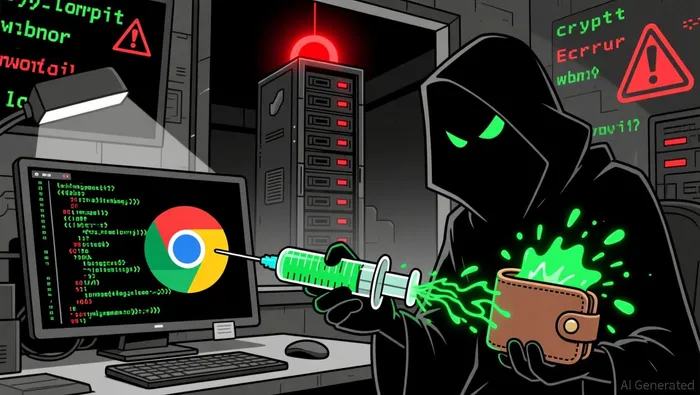
The breach originated from a malicious update to Trust Wallet's Chrome extension (version 2.68), released on December 24, 2025. Independent researchers identified a suspicious JavaScript file, 4482.js, which monitored wallet activity and transmitted data to an external domain, metrics-trustwallet.com. This domain, newly registered and later taken offline, was linked to the exfiltration of sensitive user data, including seed phrases and private keys.
Victims reported immediate fund drains after importing their recovery phrases into the compromised extension, with losses estimated at $6 million by on-chain sleuth ZachXBT according to a report. Trust Wallet swiftly responded by releasing version 2.69, urging users to disable the vulnerable extension and emphasizing that mobile-only users were unaffected. CEO Changpeng Zhao (CZ) pledged to cover losses via Binance's SAFU fund, a move aimed at restoring user trust.
Non-Custodial Wallets: A Double-Edged Sword
Non-custodial wallets, by design, eliminate third-party control over private keys, offering users unparalleled autonomy. However, this model shifts responsibility for security to the individual, creating a paradox: while decentralization reduces systemic risk, it amplifies exposure to supply-chain vulnerabilities according to industry analysis. Browser extensions, in particular, are prime targets due to their reliance on automated updates and third-party dependencies.
The Trust Wallet incident highlights a broader industry challenge: even reputable platforms are susceptible to supply-chain compromises. For instance, the 2025 npm supply chain attack injected malicious code into widely used open-source packages, redirecting crypto transactions to attacker-controlled addresses. These events reveal that the security of non-custodial tools is only as strong as their weakest link-often the infrastructure connecting users to the blockchain.
Industry Response and Best Practices
Post-breach, Trust Wallet has prioritized supply-chain hardening, including stricter update verification and user education. The company now advocates for hardware wallets and discourages seed phrase imports into browser extensions. These measures align with broader industry trends, such as the adoption of multi-party computation (MPC) and multi-signature wallets, which distribute cryptographic responsibilities to mitigate single points of failure.
Regulatory developments, including the EU's MiCA framework, have pushed for greater transparency in supply-chain security. However, compliance alone is insufficient. As the 2025 npm attack demonstrated, attackers exploit trusted dependencies through social engineering and phishing according to threat intelligence. This necessitates a multi-layered approach: developers must implement real-time transaction monitoring, while users should adopt cold storage and geographically redundant backups according to security experts.
Implications for Investors
For investors, the Trust Wallet breach serves as a cautionary tale about the risks of over-reliance on convenience-driven tools. While non-custodial wallets remain a cornerstone of the crypto ecosystem, their security is contingent on rigorous infrastructure audits and user vigilance. The projected growth of the crypto wallet market to $54.79 billion by 2029 hinges on addressing these vulnerabilities.
Investors should prioritize projects that integrate advanced cryptographic protocols (e.g., MPC) and transparent supply-chain practices. Additionally, the role of insurance mechanisms, such as SAFU funds, cannot be overstated. CZ's commitment to covering losses in the Trust Wallet incident illustrates how institutional safeguards can mitigate reputational and financial risks.
Conclusion
The Trust Wallet breach is a microcosm of the broader challenges facing the crypto industry: decentralization's promise is inseparable from its perils. As non-custodial wallets become increasingly integral to DeFi and Web3, the need for robust supply-chain security frameworks is urgent. Developers must treat infrastructure as a first-order priority, while investors must balance innovation with risk management. In a space where trust is both a commodity and a vulnerability, the path forward lies in transparency, education, and relentless iteration.







Comentarios
Aún no hay comentarios