
Super Micro Computer, Inc. (SMCI): Navigating Growth Amid Analyst Skepticism
The stock of Super Micro ComputerSMCI-- (SMCI) has become a focal point for investors seeking to balance short-term volatility with long-term AI infrastructure demand. While recent earnings reports and governance concerns have triggered analyst downgrades and a 30% stock price drop[1], the company's strategic positioning in the AI arms race offers a compelling counterpoint. This article dissects the tension between immediate valuation risks and the explosive growth of AI infrastructure, using data from industry reports, analyst ratings, and competitive dynamics.
Short-Term Valuation Risks: Margins, Governance, and Analyst Skepticism
SMCI's FY2025 earnings revealed a sharp decline in gross margins, from 17.98% in 2023 to 11.06% in 2025, driven by aggressive price concessions and inventory transitions to NVIDIANVDA-- Blackwell GPUs[1]. This margin compression has led to a stock re-rating, with analysts like Bank of AmericaBAC-- slashing price targets to $35 (an “underperform” rating) and Goldman SachsGS-- to $27[1]. The consensus price target of $45.31 implies a 5.56% upside from the current price of $42.92, but the wide range—from $27 to $100—reflects deep uncertainty[4].
Compounding these financial risks are governance issues. SMCISMCI-- disclosed material weaknesses in internal financial controls, raising concerns about restatements or delayed filings[1]. This has eroded investor confidence, particularly after Q3 FY2025 results fell short of guidance, prompting a 16% stock price drop[3]. Analysts like Morgan StanleyMS-- and MizuhoMFG-- have trimmed price targets to $34–$36, citing margin headwinds and inventory write-downs[3].
Long-Term AI Infrastructure Demand: A $7 Trillion Opportunity
Despite these challenges, SMCI's role in AI infrastructure is pivotal. The global AI infrastructure market is projected to grow at a 18.01% CAGR from 2025 to 2033, reaching $124.03 billion by 2033[2]. By 2030, 70% of data center demand will stem from AI workloads, requiring $7 trillion in global investment, with $5.2 trillion allocated to AI-related data centers[2].
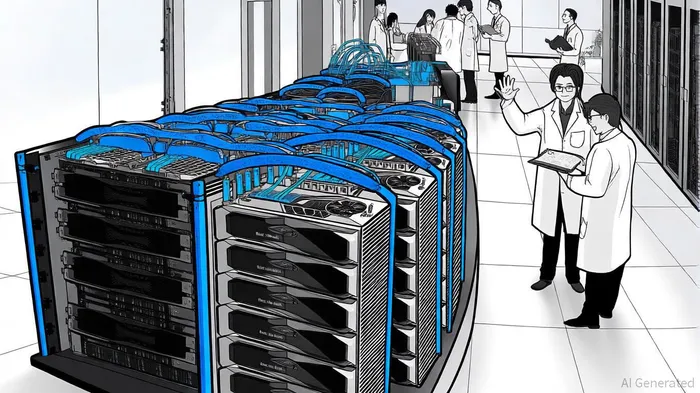
SMCI is capitalizing on this demand through partnerships like its collaboration with Lambda and Cologix to deploy NVIDIA Blackwell GPU server clusters. These systems, combined with Direct Liquid Cooling (DLC) technology, reduce power and cooling costs by up to 40%, enabling rapid deployment of next-gen AI infrastructure in key regions[1]. The company's modular “Building Block Solutions” allow for rapid customization, a critical advantage as AI model complexity and compute demands surge[2].
Competitive Positioning: Disruptor vs. Incumbents
SMCI faces stiff competition from DellDELL-- and Hewlett PackardHPE-- Enterprise (HPE). Dell leverages a $14.4 billion AI server backlog and strong NVIDIA partnerships, while HPE focuses on hybrid cloud and AI-as-a-service models[4]. However, SMCI's vertical integration and rapid time-to-market give it an edge in delivering customized, rack-scale AI systems with short lead times[4]. Analysts like Northland Capital have upgraded SMCI to “Strong-Buy” with a $57 price target, emphasizing its differentiation in the AI server market[3].
Balancing the Equation: A Cautious Bull Case
The key question for investors is whether SMCI's long-term AI growth potential justifies its current valuation risks. While the company's $5.17 billion in cash provides flexibility for buybacks or R&D[1], its governance issues and margin pressures remain red flags. However, the AI infrastructure market's $7 trillion tailwind—driven by hyperscalers, edge computing, and government initiatives—suggests that SMCI's role as a modular, energy-efficient solutions provider is here to stay[2].
Analysts like Wedbush and Needham, who have raised price targets to $40 and $60 respectively[3], argue that SMCI's execution risks are overblown. They highlight the company's expansion into Europe and its ability to integrate cutting-edge silicon (e.g., NVIDIA GB200) as catalysts for growth[2].
Conclusion: A High-Volatility Play in a High-Growth Sector
SMCI embodies the classic “show-me” story: a high-growth disruptor with significant execution risks. For investors with a long-term horizon, the company's AI infrastructure bets and technological edge could outweigh short-term margin pressures. However, those prioritizing stability may prefer Dell's scale or HPE's hybrid models. The path forward hinges on SMCI's ability to stabilize its governance, prove margin resilience, and maintain its lead in a rapidly evolving market.





Comentarios
Aún no hay comentarios