
Super Micro Computer's Relative Strength Rating Upgrade: A Momentum Play in the AI Hardware Boom
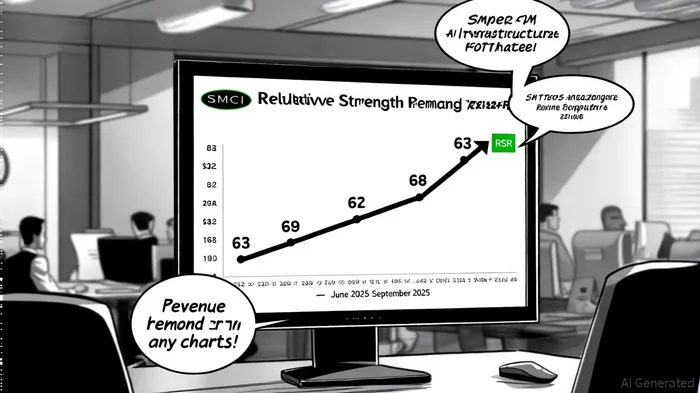
The recent surge in Super MicroSMCI-- Computer's (SMCI) Relative Strength Rating (RSR) has positioned the stock as a focal point for momentum investors eyeing the AI-driven hardware sector. With its RSR climbing from 63 to 74 in late 2025 and further to 87 by mid-September[1], SMCISMCI-- has demonstrated robust market leadership, outperforming peers in a sector defined by rapid innovation and surging demand. This upgrade, coupled with technical indicators and strategic positioning in AI infrastructure, suggests a compelling case for breakout potential—though risks remain.
AI-Driven Hardware Momentum: The Catalyst
Super Micro's performance is inextricably tied to the global rush to build AI infrastructure. The company reported a 47% year-over-year revenue increase in fiscal 2025, reaching $22 billion, driven by demand for AI-optimized servers and liquid cooling solutions[3]. Its modular systems, integrated with NVIDIANVDA-- and AMDAMD-- hardware, have become critical for large-scale AI operations, while deployments of 100,000 GPUs in “AI factories” underscore its role in enabling high-performance computing[4]. Analysts highlight Super Micro's 37.87% revenue growth rate and 6.64% net margin—well above industry averages—as evidence of its competitive edge[2].
The company's forward-looking guidance—projecting $33 billion in revenue for 2026, a 50% year-over-year jump—further cements its position in the AI boom[3]. CEO Charles Liang has emphasized the demand for energy-efficient solutions, with Super Micro's direct liquid cooling technology reducing energy costs for data centers[4]. This aligns with broader industry trends, as AI workloads intensify and operators prioritize sustainability.
Technical Analysis: A Bullish Setup
From a technical perspective, SMCI's stock has shown a mix of strength and caution. The 14-day RSI of 52.2 sits in neutral territory[5], while the 50-day ($47.1) and 200-day ($42.3) moving averages form a “golden cross,” signaling short-term bullish momentum[5]. Volume trends reinforce this, with positive price-volume correlations indicating strong investor confidence[6]. However, the MACD at -0.28 suggests a sell signal[5], highlighting potential near-term volatility.
Comparisons with peers reveal SMCI's relative strength. While NVIDIA's RSI and moving averages reflect strong momentum[7], AMD and Intel lag, with the latter struggling to regain traction after a 40% decline from 2024 highs[1]. SMCI's RSR of 87, which ranks it among the top 10% of stocks on the IBD scale[2], further underscores its outperformance.
Breakout Potential and Risks
The confluence of AI demand, technical strength, and analyst optimism points to breakout potential. Five analysts have raised price targets for SMCI in the past 30 days, averaging $44.40—a 26% increase from prior estimates[2]. However, risks persist. A 53% quarterly earnings decline[3] and mixed sentiment among analysts (2 bullish, 1 bearish ratings recently[2]) highlight volatility. Additionally, the broader AI hardware sector remains sensitive to macroeconomic shifts, with NVIDIA's Blackwell platform and AMD's MI300X posing competitive pressures[7].
For momentum investors, SMCI's current setup—a golden cross, strong volume, and leadership in AI infrastructure—offers a high-conviction trade. Yet, prudence is warranted. A breakout above the $60.71 resistance level[5] could validate the bullish case, while a drop below $29.51 support[5] might signal a correction.
Conclusion
Super Micro Computer's RSR upgrade reflects its pivotal role in the AI hardware revolution. With technical indicators aligned for a short-term rally and fundamentals pointing to sustained growth, the stock embodies the momentum-driven opportunities emerging in the sector. However, investors must balance optimism with caution, monitoring earnings reports and macroeconomic signals that could sway sentiment. For those willing to navigate the volatility, SMCI represents a compelling intersection of innovation and market dynamics.





Comentarios
Aún no hay comentarios