
Super Micro Computer's Margin Compression and Long-Term Viability: Strategic Risks in High-Margin Tech Plays
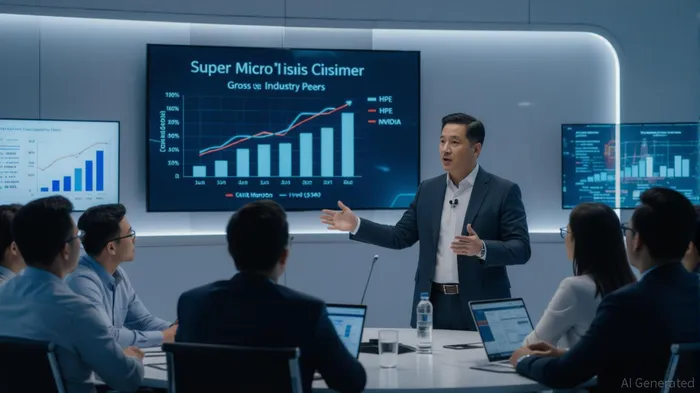
The AI server market, once a golden goose for high-margin growth, is becoming a battleground where even the most innovative players face existential threats. Super Micro ComputerSMCI-- (SMCI), a pioneer in AI infrastructure, exemplifies this tension. While the company reported a 54% year-on-year revenue surge in Q2 2025, driven by AI demand, its financials tell a darker story: gross margins contracted to 9.5% in Q4 2025, and operating margins faced "temporary pressure" from production delays, R&D costs, and product mix shifts [2][4]. This raises a critical question: Can SMCISMCI-- sustain its position in a sector where competitors like DellDELL-- and HPEHPE-- are already grappling with margin compression, and NVIDIANVDA-- dominates with 72.7% gross margins?
The Margin Squeeze: A Sector-Wide Challenge or SMCI-Specific Weakness?
The AI server market’s profitability hinges on access to cutting-edge components, particularly GPUs. Super Micro’s reliance on NVIDIA’s platforms—such as the transition from Hopper to Blackwell—has exposed it to pricing pressures and supply chain bottlenecks [1][4]. Meanwhile, Dell TechnologiesDELL--, which saw AI server revenue surge 44% in Q2 2025, reported gross margins of 18.3%, down from 21.4% in the prior year, underscoring the sector’s competitive intensity [1]. HPE’s AI server segment fared worse, with operating margins collapsing to 5.9% in Q2 2025 from 11.0% in 2024, as it struggled to balance high-volume AI orders with profitability [4].
Super Micro’s margins, already below industry peers, are further strained by its business model. Unlike Dell and HPE, which leverage enterprise relationships for scale, SMCI’s niche focus on energy-efficient, modular designs has limited its ability to absorb cost increases. Its recent investments in direct liquid cooling and AI-assisted firmware development, while innovative, have yet to translate into margin expansion [3].
Strategic Risks: Competition, Governance, and Valuation
Super Micro’s challenges extend beyond margins. The company’s market share in AI servers has eroded from 80% in 2022 to 40–50% by 2024, as Dell and HPE poached clients with competitive pricing and established enterprise ties [2]. Worse, internal governance issues—such as a delayed 10K filing and auditor concerns—have spooked investors, contributing to a 25% stock plunge post-Q2 results [3]. Insider selling over six months has compounded skepticism about management’s confidence in long-term prospects [1].
Valuation disparities also highlight risks. SMCI trades at a premium to peers despite weaker margins and growth. NVIDIA, by contrast, leverages its chip dominance to maintain 72.7% gross margins, while Dell and HPE focus on cost engineering to stabilize profitability [1][3]. For SMCI, the path to margin recovery hinges on its DCBBS (Direct-Current Building Block System) strategy and faster time-to-market for Blackwell-based servers. However, these initiatives remain unproven in boosting margins, and the pending B200 HGX server rollout in 2026 offers no guarantee of success [5].
The Long-Term Outlook: Innovation vs. Sustained Pressure
The AI server market is projected to grow at a 34.3% CAGR through 2030, reaching $837.83 billion [5]. Yet, SMCI’s ability to capitalize on this growth depends on its capacity to differentiate. Its modular designs and energy efficiency innovations could appeal to eco-conscious clients, but these advantages are narrowing as rivals adopt similar technologies. For instance, HPE’s recent Blackwell-powered server launches and Dell’s value-engineering initiatives threaten to erode SMCI’s niche [1][4].
Investors must also weigh macro risks: AI’s unproven ROI for enterprises, regulatory scrutiny of data privacy, and the likelihood of further price wars as supply outpaces demand. Super Micro’s reliance on a few key customers—such as CoreWeaveCRWV-- and X.ai—adds vulnerability, as reported shifts in orders to Dell underscore [2].
Conclusion: A High-Risk Bet in a Crowded Arena
Super Micro Computer’s story is one of innovation amid adversity. Its Q2 2025 results, however, reveal a company stretched thin by margin pressures, governance issues, and intensifying competition. While the AI server boom offers long-term potential, SMCI’s current trajectory suggests it is ill-equipped to defend its high-margin positioning. For investors, the lesson is clear: in high-margin tech plays, strategic risks—be they operational, competitive, or governance-related—can swiftly erode value, even in the most promising sectors.
Source:
[1] Dell Technologies (DELL) Q2 FY2026 Earnings - 8/28/25 [https://www.linkedin.com/pulse/dell-technologies-q2-fy2026-earnings-82825-faisal-amjad-cfm8f]
[2] Super MicroSMCI-- Computer, Inc. (SMCI) stock analysis and [https://roboforex.com/beginners/analytics/forex-forecast/stocks/stocks-forecast-super-micro-computer-smci/]
[3] NVIDIA Announces Financial Results for Q2 Fiscal 2026 [https://www.hpcwire.com/off-the-wire/nvidia-announces-financial-results-for-second-quarter-fiscal-2026/]
[4] Hewlett PackardHPE-- Enterprise (HPE) Q2 2025 Earnings [https://mlq.ai/stocks/HPE/q2-2025-earnings/]
[5] AI Server Market Size, Share and Trends 2025 to 2030 [https://www.marketsandmarkets.com/Market-Reports/ai-server-market-141336410.html]





Comentarios
Aún no hay comentarios